
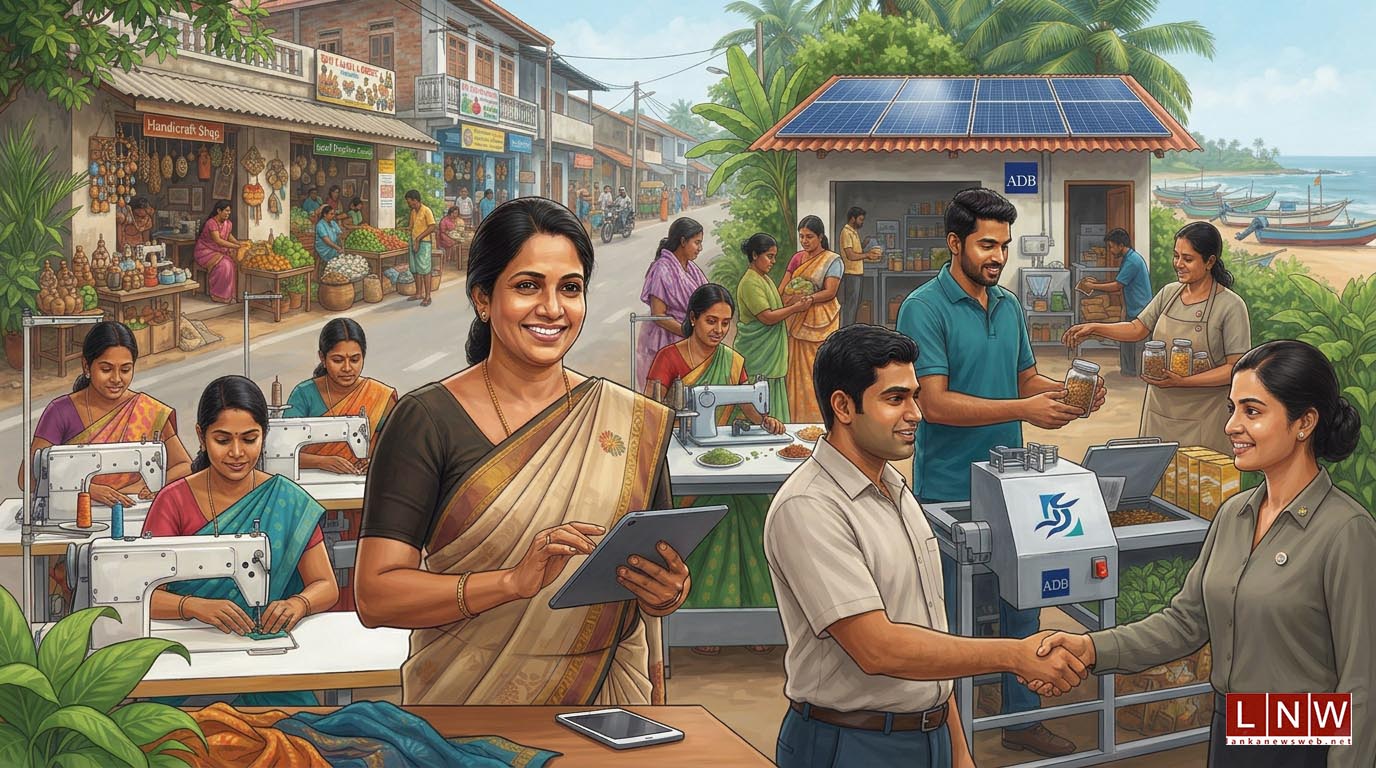
November 23, Colombo (LNW): The Asian Development Bank (ADB) has approved a US$200 million financing package to improve access to finance for Sri Lanka’s micro, small and medium-sized enterprises (MSMEs), with a particular focus on supporting women entrepreneurs, promoting environmentally sustainable investments and strengthening businesses against economic and climate-related shocks.
The funding arrangement comprises two equal components: a US$100 million policy-based loan aimed at improving the financial environment in which MSMEs operate, and a further US$100 million financial intermediation loan to increase the availability of investment financing for businesses. Of the latter allocation, US$40 million has been earmarked for green lending.
ADB Country Director for Sri Lanka Shannon Cowlin said the initiative would assist the Government in developing a more accessible and resilient financial system, enabling smaller businesses to expand operations, introduce innovations and better withstand economic disruptions and climate-related disasters.
She said the programme would place particular emphasis on improving financing opportunities for women-led enterprises while encouraging investments that support Sri Lanka’s transition towards a more sustainable economy.
MSMEs remain a vital component of Sri Lanka’s economic structure, accounting for more than 52 per cent of gross domestic product and approximately 45 per cent of total employment. Despite their contribution to economic activity and job creation, many businesses in the sector continue to face difficulties obtaining affordable credit.
Limited access to formal financing, inadequate digitalisation and exposure to economic instability and climate-related disasters have further restricted the sector’s ability to expand and improve productivity.
The ADB-backed initiative, titled the ‘Building a Strong and Inclusive Financial Ecosystem for MSMEs Sector Development Programme’, is intended to tackle these structural weaknesses through reforms designed to make financial services more accessible, transparent and responsive to the needs of smaller enterprises.
Its measures will include improving digital financial services, strengthening access to reliable business and credit information, streamlining institutional procedures and expanding financial literacy among entrepreneurs.
The programme will also support legislative changes required to establish a Microfinance and Credit Regulatory Authority. The proposed regulatory framework is expected to strengthen supervision of the microfinance industry, curb predatory lending practices and improve protections for borrowers.
Further measures will focus on upgrading credit information systems, reducing information gaps between lenders and borrowers, expanding credit guarantee arrangements and developing digital financial infrastructure alongside stronger consumer protection mechanisms.
Under the financial intermediation component, participating financial institutions will provide credit facilities to MSMEs undertaking environmentally sustainable investments and business activities. The green financing allocation is intended to encourage enterprises to invest in measures that reduce environmental risks and improve their ability to adapt to changing climate conditions.
The programme is also designed to ensure that at least 20 per cent of the MSMEs benefiting from its support are owned or led by women. These businesses will be assisted in financing investments aimed at reducing their exposure to climate-related disruptions and strengthening their capacity to recover from adverse events.
In addition to conventional lending, the initiative will explore innovative financing arrangements to help small and medium-sized enterprises at the growth stage obtain equity funding. This is expected to provide businesses with alternative sources of capital beyond traditional bank loans, particularly where expansion requires larger or longer-term investments.
The latest financing approval represents a further effort by the ADB to support Sri Lanka’s private sector recovery and strengthen the role of smaller enterprises in economic development.
Established in 1966, the ADB is a multilateral development bank focused on promoting sustainable, inclusive and resilient growth across Asia and the Pacific. The institution is owned by 69 member countries, including 50 from the region, and works with governments and development partners through financial assistance, infrastructure investment and strategic cooperation.