
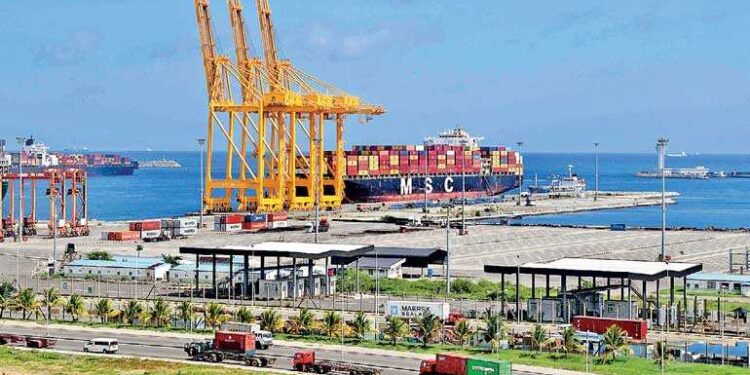
Sri Lanka’s long-awaited East Container Terminal (ECT) is approaching its first operational milestone, but the Government’s announcement of partial operations has exposed a deeper challenge: whether the country can transform a state-funded port investment into a commercially competitive enterprise before regional rivals capture a larger share of transshipment business.
The announcement by Deputy Minister of Ports and Civil Aviation Janitha Ruwan Kodithuwakku that the terminal will commence partial operations by the end of November 2026 comes after years of delays, political controversy and uncertainty surrounding the project’s management and ownership.
The most troubling aspect is that the terminal, despite reaching approximately 90% construction progress, cannot immediately operate at meaningful capacity because essential handling equipment has not yet arrived.
The first 15 straddle carriers are expected around September 2027. Another 15 are expected to follow after procurement, with the infrastructure required for full capacity scheduled for completion by the first quarter of 2028. The Government expects full operations around mid-2028.
This raises an important question about the coordination between infrastructure construction, equipment procurement and operational planning.
Why was the procurement of essential machinery not synchronised with construction so that the terminal could begin commercial operations immediately upon completion?
The original construction deadline was 2024. However, only 10% of the project had been completed by that year, according to the Deputy Minister. Government intervention subsequently accelerated construction, bringing progress to 90% in 2026.
Although the improvement is significant, the continuing equipment shortage demonstrates that accelerating construction alone does not guarantee operational preparedness.
The financial implications also deserve scrutiny. The SLPA has financed the entire ECT investment, and the Government says no additional capital investment is required. Nevertheless, public investment generates economic returns only when infrastructure is utilised effectively.
An underutilised terminal represents an opportunity cost for taxpayers and the Ports Authority, particularly when competing ports are expanding their capacity and attracting international shipping operators.
The Government’s decision to establish a wholly SLPA-owned company to operate the terminal is another significant development. The objective is to avoid traditional state-sector inefficiencies by introducing private-sector management practices without immediately transferring ownership to private investors.
However, the effectiveness of this arrangement will depend on managerial independence, transparent procurement, commercial accountability and the ability to make decisions without political interference.
The controversy surrounding the 2020 trade union protests against private-sector participation also remains relevant. The Government maintains that retaining the terminal under the SLPA fulfilled its political commitment.
But protecting public ownership should not become an excuse for protecting inefficient management. The national interest must be measured by the economic returns generated, not simply by whether ownership remains in government hands.
This is particularly important because approximately 85% of Colombo Port cargo consists of transshipment business controlled by around 10 major international shipping lines.
Winning and retaining these shipping companies will require competitive tariffs, reliable operations, modern equipment, efficient cargo handling and predictable commercial policies.
India’s expanding port infrastructure makes this challenge increasingly urgent. The development of Vizhinjam and other Indian facilities threatens to intensify competition for cargo that has traditionally moved through Colombo.
The Government’s marketing strategy must therefore move beyond promotional announcements and demonstrate measurable success in attracting shipping-line commitments.
Ultimately, the ECT’s success should be evaluated against clear performance indicators: cargo volumes, terminal utilisation, vessel turnaround times, revenue generation, operating costs and the additional foreign exchange earned.
Sri Lanka has already spent years completing this strategic investment. The next test is whether the Government can manage it efficiently enough to protect the country’s maritime position.
Public ownership must deliver public returns. Otherwise, the political victory over privatisation could become an economic defeat for Sri Lanka.