
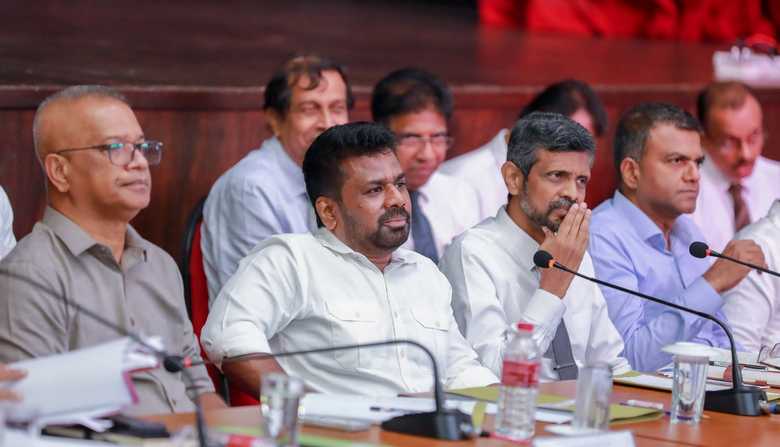
December 07, Colombo (LNW): President Anura Kumara Dissanayake has underscored the need for an emergency-style operational framework—one that surpasses the limits of routine public administration—to restore normal life in the aftermath of the recent disaster.
Speaking at the Kandy District Coordinating Committee meeting held at the District Secretariat yesterday morning (06), the President carried out a detailed review of urgent recovery efforts now under way. These include clearing blocked roads, restoring electricity and water, ensuring fuel availability, repairing irrigation systems and reconnecting disrupted communications.
He directed officials to make full use of funds already allocated for the next 25 days, insisting that road-clearing work must be completed quickly while long-term reconstruction continues in parallel. Water supply, he said, must be fully restored within three days, with bowsers deployed wherever required. The Tri-Forces have also been instructed to provide technical and logistical backing as an extraordinary measure.
The President further ordered Divisional Secretariats to coordinate the cleaning of household wells and pressed for electricity in the district to be reinstated—at least temporarily—by 31 December. Comprehensive restoration work will follow in the second phase of the recovery programme.
Turning to agriculture, he called for an urgent assessment of arable land, emphasising the need to prioritise the cultivation of both paddy and vegetables to stabilise food supplies. Irrigation authorities and agrarian officials have been told to work in closer alignment to guarantee water distribution. Compensation payments of Rs. 200,000 for affected farmers are to be expedited, with vegetable growers entitled to Rs. 150,000 per hectare. Adjustments will also be made to compensate banana growers facing similar losses.
Livestock losses were discussed at length, with the President urging that detailed records be maintained and damaged farms revived quickly so that farmers can regain income and the wider food supply—particularly milk and poultry—can recover.
Fuel shortages in Pussellawa and Meetalawa, caused by road blockages, were also addressed. The President instructed the Road Development Authority, the Tri-Forces and the Police to jointly ensure fuel reaches these areas by the end of the day.
He stressed the importance of reopening schools without delay so that scheduled examinations can proceed, and examined progress made in restoring healthcare services, railways and communications. Damage to homes and public institutions, along with resettlement needs, was also discussed. The President said nearby state lands would be identified for relocating affected families, and emphasised that compensation for house repair and reconstruction must be properly utilised. All payments arising under the 2025 Budget must, he insisted, be completed before 31 December to avoid placing pressure on next year’s finances.
A long-term solution to the garbage crisis in Gampola was also considered. Until the release of Mahaweli land is formalised, the President directed that temporarily available Ceylon Electricity Board land be used for waste disposal.
He noted that while natural disasters may be unavoidable, the scale of devastation can be reduced through proper planning. He called for a scientific study of the Central Highlands and a comprehensive plan to rehabilitate the region’s fragile ecological systems. Local authorities, he said, must enforce their powers rigorously to prevent unauthorised construction, and the Ceylon Electricity Board should refuse power connections to illegal settlements.
Despite early fears that recovery would take months, the President stated that significant progress has been made in a remarkably short period. With sustained cooperation, he said, the country can move swiftly towards full restoration.
He ended by expressing his deep appreciation for the hard work demonstrated by state officials and the Tri-Forces throughout the crisis response.