
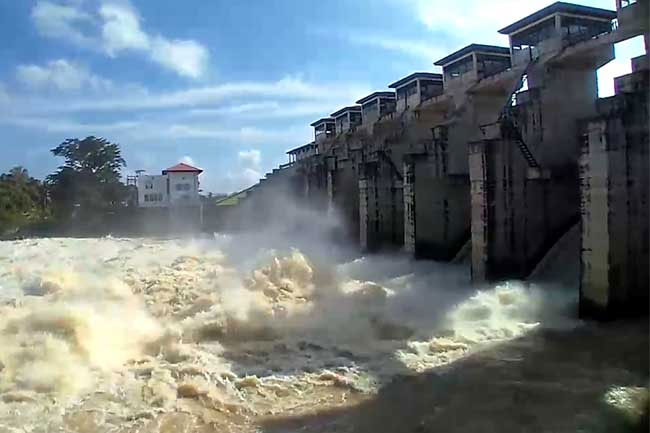
December 21, Colombo (LNW): A significant number of reservoirs managed by the Department of Irrigation have reached capacity and begun to overflow following recent rainfall, officials confirmed on Tuesday. Of the 73 major reservoirs overseen by the department, just under half are currently releasing excess water, alongside dozens of medium-scale tanks experiencing similar conditions.
Engineer L.S. Sooriyabandara, Director of Hydrology and Disaster Management at the department, said the situation remains under control and does not warrant public concern at this stage. He explained that the controlled spilling of reservoirs is a routine response to sustained rainfall and is not, by itself, an indicator of impending floods.
Nevertheless, he cautioned that river levels remain sensitive to further monsoon activity, noting that changes could occur if heavier rains arrive in the coming days. Continuous surveillance of river basins and reservoirs is therefore being maintained, with precautionary measures ready to be implemented if required.
According to departmental data, the most intense rainfall over the past 24 hours was recorded in regions linked to the Nilwala River basin. Several locations in the area experienced between 50 and 100 millimetres of rain, while much of the wet zone received around 25 millimetres. Comparable rainfall totals of roughly 50 millimetres were observed in parts of the Central Highlands and the Kelani River basin.
Elsewhere, sections of the Eastern Province saw rainfall ranging from 25 to 50 millimetres. Despite this widespread precipitation, officials report that river levels across most catchment areas have remained within safe limits.
Sooriyabandara noted a modest rise in the Nilwala River’s water level but stressed that it remains well below thresholds associated with flooding. He also said that water levels at Manampitiya along the Mahaweli River, though still elevated, are showing a gradual downward trend.
Overall, the department maintains that current conditions do not pose a flood risk, while reiterating the importance of vigilance as the monsoon season continues.