
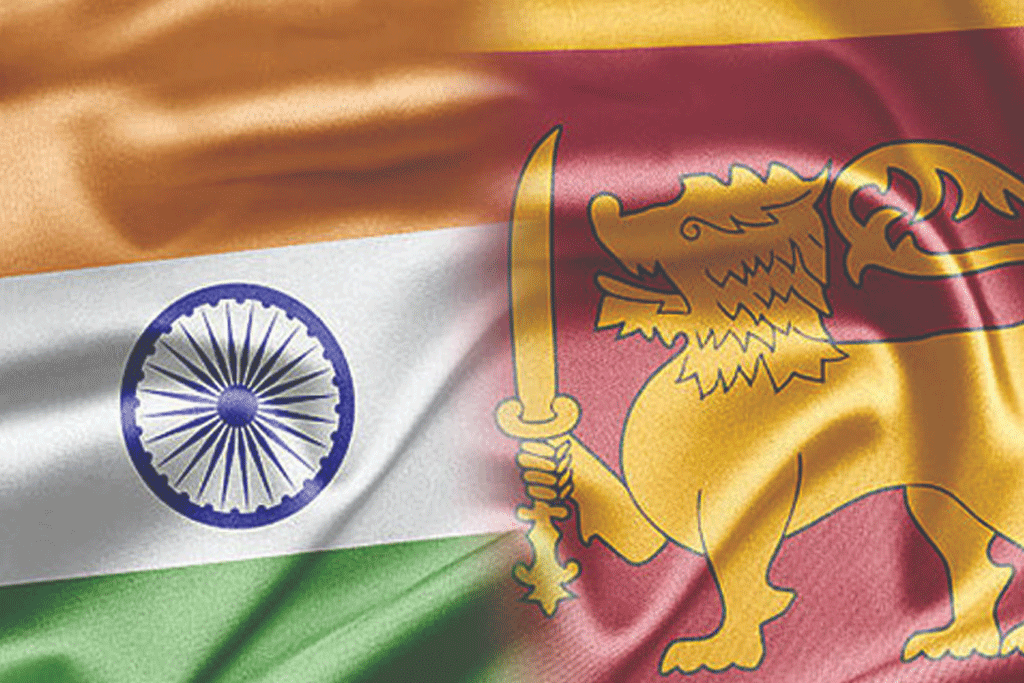
India has moved swiftly to position itself as Sri Lanka’s most reliable first responder following the island’s recent cyclone and flood catastrophe. New Delhi has committed a substantial USD 450 million recovery package, of which nearly USD 350 million will be disbursed in Indian rupees, blending humanitarian concern with strategic regional engagement.
Indian High Commissioner to Sri Lanka, Santosh Jha, announced that USD 100 million of the assistance will be provided as outright grants, easing Colombo’s burden at a time when fiscal space remains constrained.
The remaining support will be delivered through a multi-pronged reconstruction program targeting sectors hardest hit by the disaster. These include damaged roads, railways and bridges, housing reconstruction, agriculture, health and education infrastructure, and improved disaster preparedness mechanisms.
One of the most visible components of India’s intervention is infrastructure rehabilitation. Nearly USD 30 million has been earmarked to rebuild cyclone-damaged bridges, while Indian assistance will also extend to restoring rail connectivity.
Sri Lankan officials estimate rail reconstruction costs could exceed USD 330 million, with the upcountry lines suffering the worst damage. India has pledged to immediately reconstruct the Northern Railway line at an estimated cost of USD 5 million.
Notably, the Northern Railway was originally built by India’s state-owned engineering firm IRCON, using welded rails and reinforced foundations capable of supporting train speeds of up to 100 kilometers per hour. This stands in sharp contrast to Sri Lanka’s aging rail network elsewhere, where deteriorated tracks force trains to crawl at 20 kmph to avoid derailments.
India’s decision to denominate most of the aid package in Indian rupees reflects both pragmatism and precedent. Sri Lanka can readily use rupee-denominated funds as long as Indian suppliers accept payments in that currency. This mechanism mirrors Japan’s long-standing yen loan model and China’s yuan-based financing in Sri Lanka, underscoring how disaster assistance increasingly intersects with monetary diplomacy.
The aid rollout will be overseen through a joint monitoring mechanism involving multiple Sri Lankan ministries and India’s High Commission, with the first coordination meeting already held in late December. This structured oversight aims to ensure speed, transparency, and political visibility.
Beyond humanitarian relief, India’s response reinforces its role as Sri Lanka’s closest economic and strategic partner at a time when regional competition for influence remains intense. While the immediate objective is recovery from cyclone devastation, the broader implication is clear: disaster diplomacy has become a central pillar of India’s neighborhood-first strategy.