
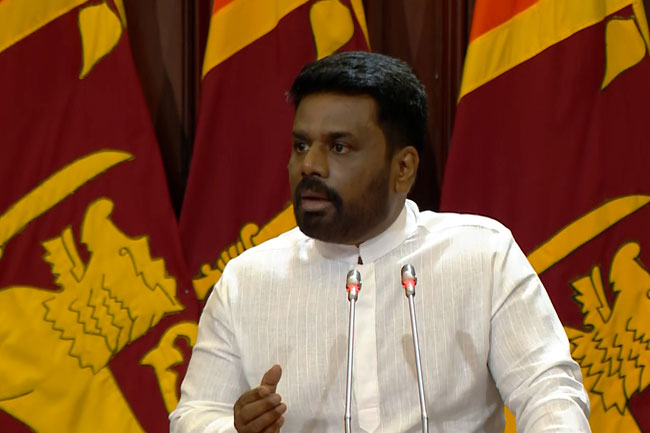
President Anura Kumara Dissanayake stressed that the extension of the emergency law is intended solely to accelerate post-Cyclone Ditwah reconstruction efforts and will not be used as a means of repression.
The President made these remarks at the Niyangoda School playground during an event held under the ‘Rebuilding Sri Lanka’ programme, which aims to provide land and financial assistance for the reconstruction of houses and the resettlement of families severely affected by the cyclone.
Addressing the gathering, President Dissanayake said Cyclone Ditwah had caused extensive damage to both livelihoods and the national economy, noting that ordinary laws were insufficient to manage rebuilding efforts following a disaster of such magnitude. He said special legal provisions were therefore required to ensure an efficient and timely reconstruction process.
He explained that the Constitution allows for the enactment of special laws, while the Public Security Ordinance provides the legal framework to introduce them when necessary. “In situations like this, laws with special administrative powers are essential. That is why the emergency law was invoked,” he said.
President Dissanayake further assured that, unlike in the past when emergency regulations were often used to suppress trade unions or restrict media freedom, the current administration would not use the law for such purposes. He emphasized that the emergency provisions would remain in force only until critical reconstruction activities are completed.
He reiterated that the emergency law would not be used as a tool of oppression, stating that its extension is aimed at expediting procurement processes, land allocation, and rebuilding work, while also providing necessary legal protection for public officials involved in the recovery process. The President added that areas most severely affected by Cyclone Ditwah would be given the legal safeguards required to ensure rapid and effective reconstruction.