LISTEN TO STORY
WATCH STORY
By: A Special Correspondent
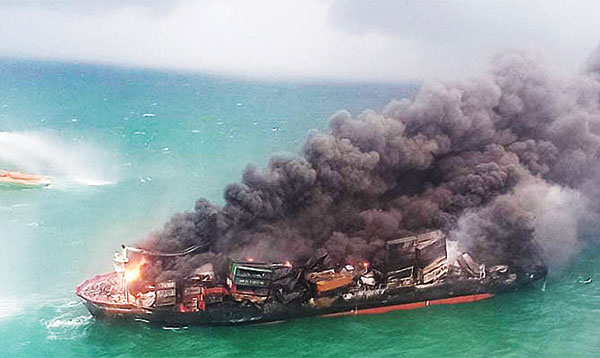
February 26, Colombo (LNW): Sri Lanka’s Supreme Court decision to step back from direct judicial oversight of the X-Press Pearl litigation and return conduct of the matter to the Attorney General’s Department has triggered predictable reactions. In some quarters it has been portrayed as a retreat from accountability — a softening of resolve after years of public insistence that those responsible for the 2021 maritime disaster would face unprecedented financial consequences.
That interpretation, however, oversimplifies what may in fact be a far more calculated institutional decision.
The court’s move appears less like withdrawal and more like an acknowledgement of the practical, scientific and legal realities that have increasingly shaped the case over time.
From Restoration to Retribution
In the immediate aftermath of the X-Press Pearl catastrophe — when plastic nurdles blanketed beaches and fishing communities were paralysed — public sentiment understandably demanded justice. The litigation that followed was framed in highly charged terms. Discussion quickly centred not only on environmental rehabilitation but on the prospect of securing compensation figures running into billions of dollars.
For a country grappling simultaneously with the economic aftershocks of the pandemic and deep fiscal instability, the notion of a substantial financial award carried political as well as emotional resonance. Expectations hardened early. Public commentary and official rhetoric alike contributed to the belief that Sri Lanka stood on the brink of a landmark financial recovery.
Yet as the case progressed, the evidential foundation supporting those extraordinary figures began to attract scrutiny.
The Science Under Pressure
At the core of the compensation claim were assessments produced by the Marine Environment Protection Authority (MEPA), particularly in relation to the scale, persistence and toxicity of environmental damage. These assessments informed not only environmental arguments but also the economic modelling that produced the headline compensation quantum.
Over time, independent scientific research — most prominently work undertaken by marine scientist Amelia Wenger — cast doubt on several of the original conclusions. Questions were raised about sampling methodology, modelling assumptions and the extrapolation of long-term ecological impacts. Claims regarding prolonged toxicity of certain chemicals and their enduring ecological consequences were challenged as overstated when measured against field data and broader international scientific opinion.
Scientific refinement is not unusual in complex environmental cases. What made this development significant was its timing. By the point at which these alternative analyses gained traction, the projected compensation figures had already shaped public expectation and political discourse.
To date, critics argue that MEPA has not meaningfully incorporated or reassessed its findings in light of the emerging research, leading to concerns about institutional rigidity and an unwillingness to reopen earlier conclusions.
Legal Strategy and Its Limits
Alongside scientific debate sat an equally consequential legal choice: the decision to pursue the matter primarily within Sri Lanka’s domestic judicial framework.
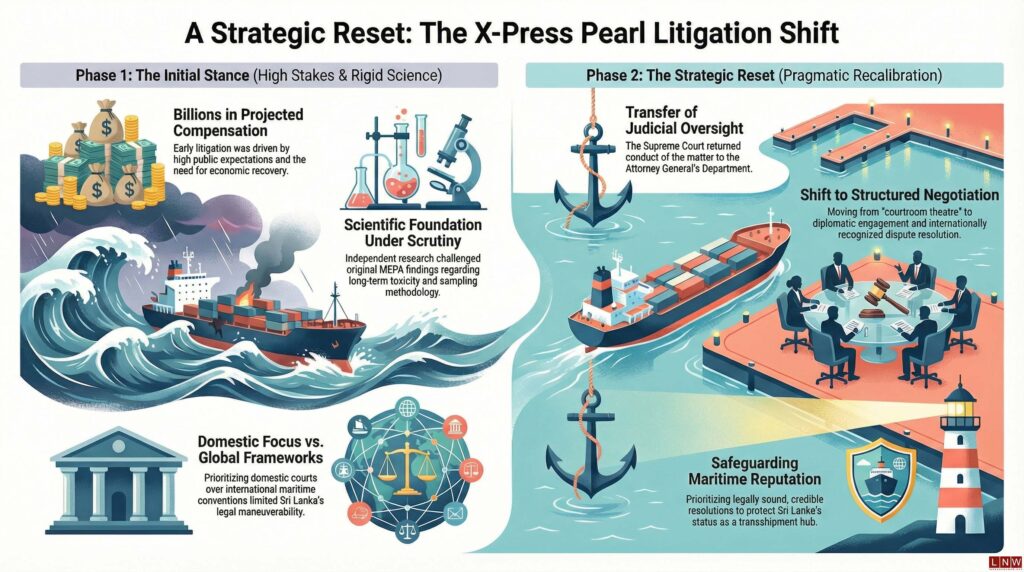
That approach carried immediate domestic appeal. It projected strength, sovereignty and resolve. However, international maritime incidents of this magnitude are typically handled through established global compensation conventions, insurance arrangements and arbitration mechanisms. These systems are not designed to produce extraordinary punitive awards; rather, they operate within defined ceilings and procedural constraints.
By prioritising domestic proceedings over aggressive engagement with international maritime dispute frameworks, Sri Lanka arguably restricted its own manoeuvrability. As legal boundaries became clearer and the enforceability of certain outcomes less certain, the risk grew that the case might reach conclusions difficult to implement in practice.
In this light, the Supreme Court’s decision to halt direct supervision and pass responsibility back to the Attorney General can be interpreted as a pragmatic recalibration rather than abandonment.
A Realignment of Expectations
As scientific uncertainty expanded and legal constraints sharpened, the judiciary found itself presiding over a case increasingly vulnerable to challenge. Continuing along the same trajectory risked producing a judgment that might prove politically dramatic but operationally fraught.
Transferring responsibility to the executive branch creates space for a different approach: one grounded in negotiation, diplomatic engagement and internationally recognised dispute resolution mechanisms. Environmental disputes of this scale often reach more sustainable outcomes through careful technical assessment and structured negotiation rather than courtroom theatre.
For coastal communities affected by the disaster, this shift inevitably produces mixed emotions. Expectations were raised dramatically over several years. Adjusting those expectations downward is never easy. Disappointment is understandable.
Yet it remains possible to achieve a fair and equitable settlement without the spectacle of inflated claims or prolonged confrontation.
Protecting More Than a Legal Claim
The government’s task now extends beyond concluding one complex environmental dispute. Sri Lanka’s standing within the global maritime community is intertwined with the outcome. Colombo has long served as a central transshipment hub in the region. Confidence among shipping lines, insurers and port operators is essential to preserving that role.
A resolution perceived as balanced, legally sound and internationally credible will do more to protect the country’s long-term economic interests than a headline-grabbing but unenforceable award.
A Necessary Course Correction
The Supreme Court’s latest decision may ultimately be seen as an institutional course correction — overdue, perhaps, but unavoidable. The initial phase of the X-Press Pearl litigation was shaped by urgency, anger and political theatre. The next phase demands realism, technical rigour and diplomatic patience.
If Sri Lanka embraces independent scientific reassessment, re-engages with international maritime legal structures and recalibrates public expectations accordingly, the country can still secure meaningful redress while safeguarding its maritime reputation.
For communities that may face environmental incidents in the future, the broader lesson is sobering but clear: sustained cooperation, however uncomfortable, often delivers more durable outcomes than confrontation alone.
The tragedy of the X-Press Pearl cannot be undone. But how Sri Lanka chooses to conclude this chapter will shape not only compensation negotiations, but its credibility as a maritime nation for years to come.