LISTEN TO STORY
WATCH STORY
By: Isuru Parakrama
March 01, Colombo (LNW): The dramatic escalation of tensions between the United States, Israel and Iran — culminating in coordinated strikes on Iranian nuclear and missile facilities — may appear geographically distant from Sri Lanka.
Yet the consequences could reach Colombo’s shores with uncomfortable speed.
The strikes, reportedly carried out under the code names “Operation Epic Fury” by Washington and “Roaring Lion” by Tel Aviv, targeted assets in Tehran, Isfahan and Qom. Amid confirmed reports that Iran’s Supreme Leader has been killed, Tehran responded with missile and drone attacks on US bases and Gulf infrastructure.
The immediate fallout was the effective paralysis of the Strait of Hormuz — the narrow maritime artery through which roughly 20 per cent of global oil supplies pass.
Brent crude surged more than seven per cent, climbing above US$ 90 per barrel. For Sri Lanka, still nursing the wounds of its 2022 economic collapse, that spike is not just a statistic — it is a warning.
Fuel: The First Shockwave
Sri Lanka imports around US$ 2.47 billion worth of refined petroleum annually, making it the country’s single largest import category. Although Colombo does not rely directly on Iranian crude, its suppliers — India, Singapore, the UAE and Malaysia — are deeply integrated into global supply chains vulnerable to disruptions in Hormuz.
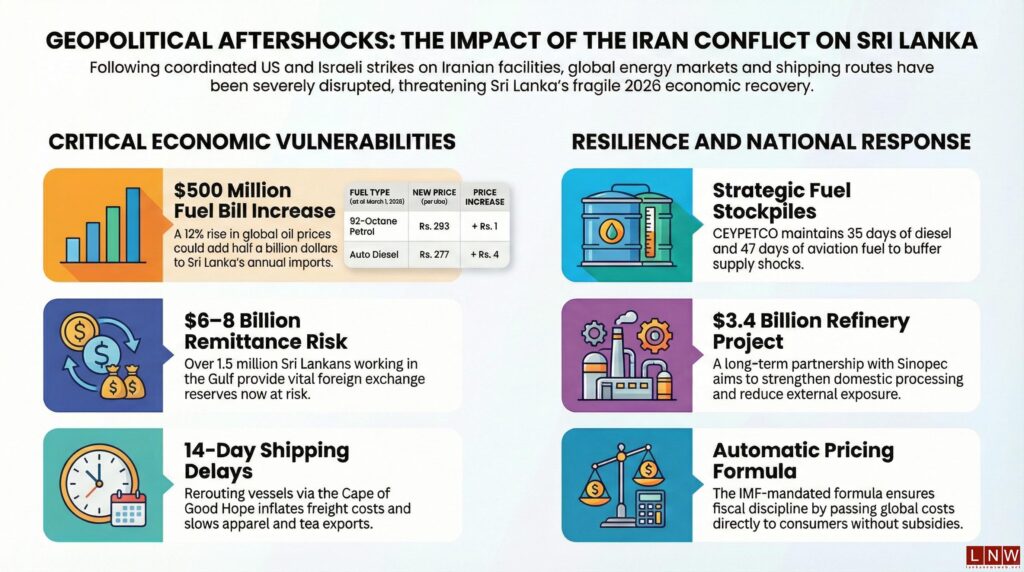
The Ceylon Petroleum Corporation (CEYPETCO) confirms that the country holds approximately 37 days of fuel reserves — 35 days for diesel and 47 days for aviation fuel. These stocks are sourced from India, Singapore, Malaysia, South Korea, Russia, Oman and Saudi Arabia, with some shipments rerouted through alternative channels such as the Fujairah pipelines.
Despite the immediate fuel price revision effective from midnight yesterday (February 28), officials insist there is no cause for panic buying, and police have been deployed to monitor filling stations amid growing public anxiety. Yet if the Strait remains closed beyond a month, Sri Lanka could face refinery shutdown risks and escalating war-risk insurance premiums on incoming shipments.
Fuel prices have already inched upward. From March 01, 2026, auto diesel rose by Rs. 4 to Rs. 277 per litre, while 92-octane petrol increased by Rs. 1 to Rs. 293. Analysts suggest that a sustained global spike could necessitate hikes of Rs. 10 to 15 per litre. Under the IMF-mandated automatic pricing formula, such increases will be passed directly to consumers, avoiding subsidies but straining households.
A 12 per cent rise in global oil prices alone could add an estimated US$ 500 million annually to the national fuel bill — currently around US$ 4.5 billion. For a country carefully rebuilding foreign exchange reserves, that is a heavy burden.
Inflation, Growth and the IMF Tightrope
Inflation, which had stabilised to 1.6 per cent headline and 3.7 per cent core by February 2026, could once again flare up. Higher transport and electricity costs — with tariffs potentially rising by 11 to 18 per cent — risk eroding consumer purchasing power and business confidence.
A weakening rupee would compound the challenge. Increased import costs and a drain on foreign reserves could complicate Sri Lanka’s commitments under its IMF programme, jeopardising future tranches and growth targets painstakingly negotiated after the debt crisis.
Exports Under Pressure
Sri Lanka’s export sector is equally exposed. Tea shipments to Iran and the UAE — important Middle Eastern markets — are reportedly facing order freezes as regional currencies come under pressure. For smallholders, a sudden collapse in demand could mean a painful drop in prices.
Shipping disruptions are another concern. With risks around both Hormuz and the Suez Canal, vessels are rerouting via the Cape of Good Hope, adding 10 to 14 days to journeys and inflating freight costs. Apparel and rubber exporters, already operating on thin margins, may find contracts squeezed.
Infrastructure projects could also stall if bitumen supplies from the UAE are disrupted, slowing road construction and related development initiatives.
Remittances: A Silent Vulnerability
Perhaps the most delicate exposure lies in the Gulf. Over 1.5 million Sri Lankans — roughly seven per cent of the population — work in the Middle East, sending home between US$ 6 and 8 billion annually. These remittances have been vital in stabilising the rupee and replenishing reserves.
A prolonged conflict could trigger hiring freezes, economic contraction or even evacuations reminiscent of the 1990 Gulf War. A sudden return of workers would not only slash foreign inflows but also swell youth unemployment and create humanitarian strains.
Tourism at Risk
Tourism, another pillar of recovery, depends heavily on Gulf aviation hubs such as Dubai and Doha. Around 60 per cent of Western visitors transit through these centres. Flight suspensions by major regional carriers could result in cancellations and reduced arrivals.
Moreover, travellers from Saudi Arabia and the UAE — a growing segment — may opt to stay home amid regional uncertainty. Even if Sri Lanka remains geographically removed from the conflict, global perceptions of instability can be swift and unforgiving.
Government Response: Discipline Over Relief
The government’s strategy hinges on fiscal discipline. It is relying on diversified import sources, adequate stockpiles and the IMF-driven pricing formula rather than price controls or subsidies. Long-term plans include finalising a US$ 3.4 billion refinery project with Sinopec to strengthen domestic processing capacity and reduce exposure to external shocks.
Yet the uncomfortable truth remains: Sri Lanka’s recovery is intertwined with global stability. A war thousands of kilometres away has the power to test the island’s resilience once more.
The question is not whether Sri Lanka is directly involved in the US–Israeli confrontation with Iran. It is whether the country, still balancing on the edge of economic rehabilitation, can withstand another external storm without being blown off course.