LISTEN TO STORY
WATCH STORY
By: Isuru Parakrama
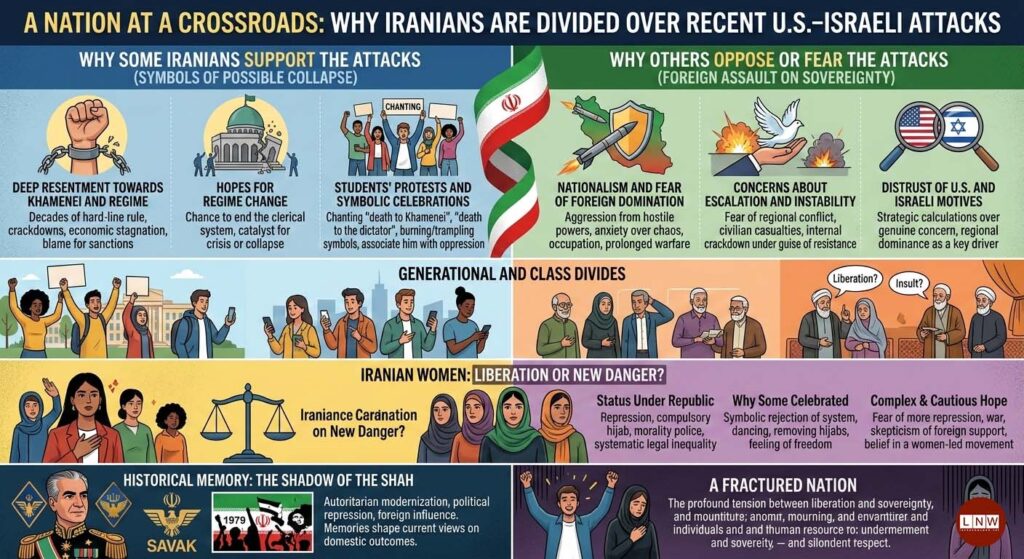
March 03, World (LNW): A storm of recent social media posts may suggest that Iranians are sharply divided over the recent U.S.–Israeli attacks because, for some, they symbolise the possible collapse of a repressive regime, while for others they represent a foreign assault on national sovereignty and identity.
The footage of university students cheering and chanting “death to Khamenei” reflect years of accumulated anger against the Islamic Republic, especially among young, urban and educated Iranians who have borne the brunt of repression and economic hardship.
Why Some Iranians Support the Attacks
Many Iranians blame Supreme Leader Ali Khamenei for decades of hard-line rule, repeated crackdowns on protests and economic stagnation under sanctions. After the violent suppression of recent demonstrations—reportedly involving thousands of deaths—some citizens privately and publicly celebrated his death as a break from what they describe as a “murderous” and dictatorial leadership.
The United States and Israel have openly framed the strikes as an attempt to weaken or unseat the Islamic Republic. Some Iranians interpret the attacks as an opportunity to end the clerical system. University-age Iranians, who have never known life before the 1979 revolution, see the attacks as a catalyst that could push the regime into crisis or collapse, even if they remain wary of the foreign powers behind them.
In the days before and after Khamenei’s death, students at major universities such as Sharif, Amir-Kabir and Tehran University gathered to chant “death to Khamenei”, “death to the dictator” and “freedom, freedom”. Some burned or trampled regime symbols. For many within this educated youth demographic, the supreme leader’s killing was not viewed as a humiliation of Iran, but as the downfall of a figure they personally associate with oppression.
Many Iranians, particularly among more conservative and religious segments, regard the United States and Israel as hostile powers that have long sought to undermine Iran. They see the strikes as foreign aggression, regardless of their personal views on Khamenei. There is anxiety that the country could descend into chaos, face occupation-style control or become embroiled in prolonged warfare.
Concerns About Escalation and Instability
Some Iranians draw a distinction between opposing the regime and allowing foreign bombs to determine their future. They fear the attacks could spark a broader regional conflict, result in significant civilian casualties or prompt a harsh internal crackdown justified by the regime under the banner of resisting a “foreign enemy”.
Even among those who welcome the weakening of the clerical elite, scepticism persists. Many doubt that the United States or Israel are motivated by genuine concern for Iranian democracy or human rights. Instead, they suspect strategic calculations and regional dominance are the real drivers. This distrust fosters ambivalence rather than wholehearted support.
Generational and Class Divides
Younger, urban and often middle-class Iranians—especially university students—are more likely to celebrate Khamenei’s death and tolerate or welcome foreign pressure on the regime. Their outlook is shaped by direct exposure to repression and economic frustration. In contrast, older, more religious or economically dependent groups, including those tied to state-affiliated patronage networks, tend to view the attacks as a national insult, even if they criticise governance privately.
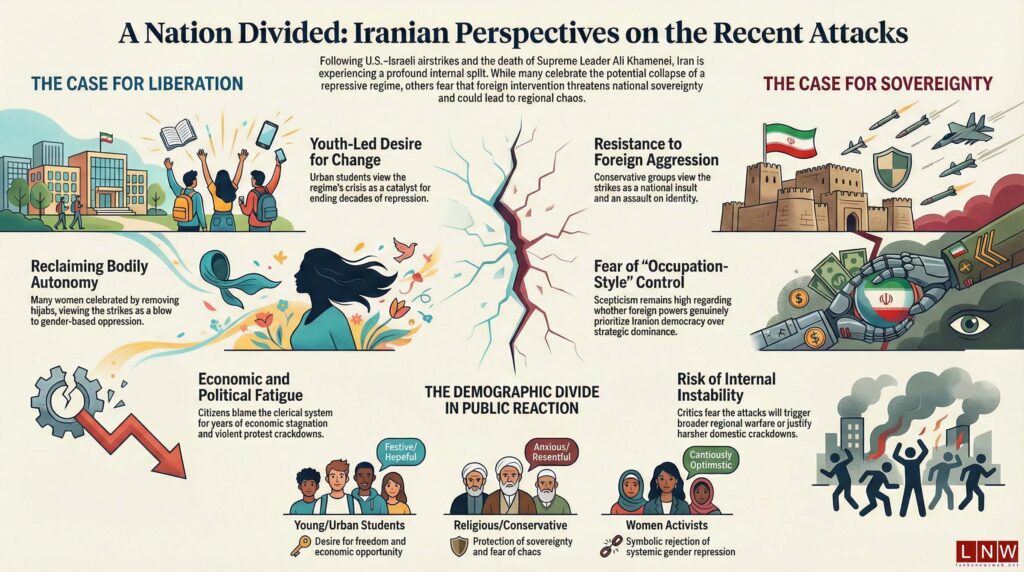
Many Iranians describe feeling both “internally festive” and fearful at the same time: relieved that a reviled leader is gone, yet anxious that foreign powers may now shape their country’s destiny. This mixture of emotions has produced a fractured public reaction—some celebrating in the streets, others mourning on television, and many remaining silent out of fear.
Iranian Women: Liberation or New Danger?
Women’s reactions to the attacks, and particularly to Khamenei’s death, must be understood in light of four decades of systematic repression.
Under the Islamic Republic, women are legally treated as second-class citizens in areas such as marriage, divorce, inheritance, child custody and court testimony, where a woman’s testimony is worth half that of a man’s. The state enforces compulsory hijab through strict morality laws, surveillance and new veiling bills imposing heavy fines, lengthy prison sentences and even death-penalty-linked provisions for resistance.
Security forces and morality police have used arbitrary arrests, beatings, car chases and public humiliation, especially since the 2022 “Woman, Life, Freedom” uprising triggered by Mahsa Jina Amini’s death. Women activists have been jailed, flogged and in some cases sentenced to death on national-security-related charges.
Following the announcement of Khamenei’s death, some women were seen dancing, removing their hijabs, honking car horns and chanting “Khamenei is dead” and “freedom”. For them, this was a symbolic rejection of a system that policed their bodies and criminalised dissent. Some described the moment as the happiest they had felt in years—a brief window to reclaim public space and bodily autonomy.
Yet many women remain cautious. They fear that foreign strikes could trigger further repression, war or even occupation-style control. There is concern that authorities may use the narrative of foreign aggression to justify renewed crackdowns, accusing protesters of collaboration.
There is also scepticism that foreign governments truly prioritise women’s rights over geopolitical interests. While some see the weakening of the regime as an opening, others insist that lasting equality must come from within Iran, through a women-led movement rather than external military intervention.
Historical Memory: The Shadow of the Shah
The debate is also shaped by Iran’s pre-1979 history. Under the Pahlavi monarchy, Iran was not a democracy but an authoritarian state marked by rapid modernisation and consumer-style liberalism for some, alongside political repression. The secret police, SAVAK, used surveillance, torture and executions to silence dissent.
Urban elites enjoyed relative cultural freedoms, yet political opposition was dangerous. Women experienced expanded access to education and work, but family law remained patriarchal. The Shah’s pro-Western stance, wealth inequality and reliance on oil revenue fuelled resentment, culminating in the 1979 revolution.
Today, memories of both dictatorship and foreign influence inform public opinion. Many Iranians who oppose the current regime are wary of repeating a history in which foreign powers shape domestic outcomes.
A Nation at a Crossroads
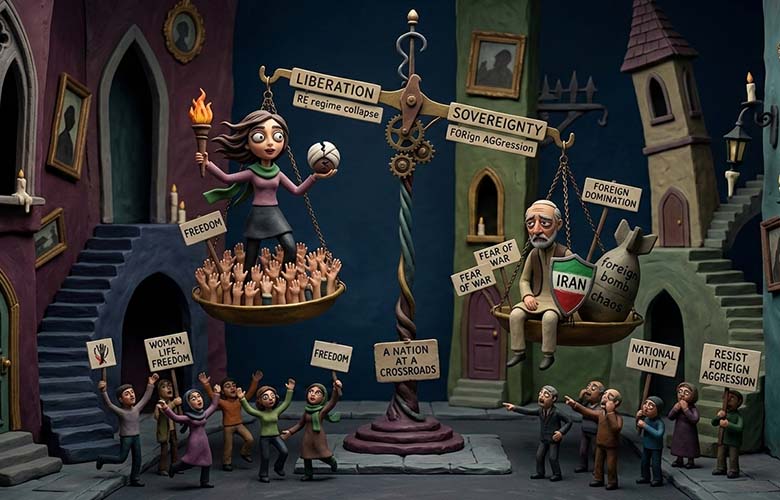
Ultimately, the division reflects a profound tension between the desire for liberation and the instinct to defend national sovereignty. For some, the strikes represent a controversial but necessary blow against a repressive system. For others, they are a dangerous intrusion that threatens chaos and renewed subjugation.
Iran’s fractured response reveals a society wrestling not only with its present crisis, but with decades of repression, revolution and unresolved questions about who should determine its future.