LISTEN TO STORY
WATCH STORY
By: Isuru Parakrama
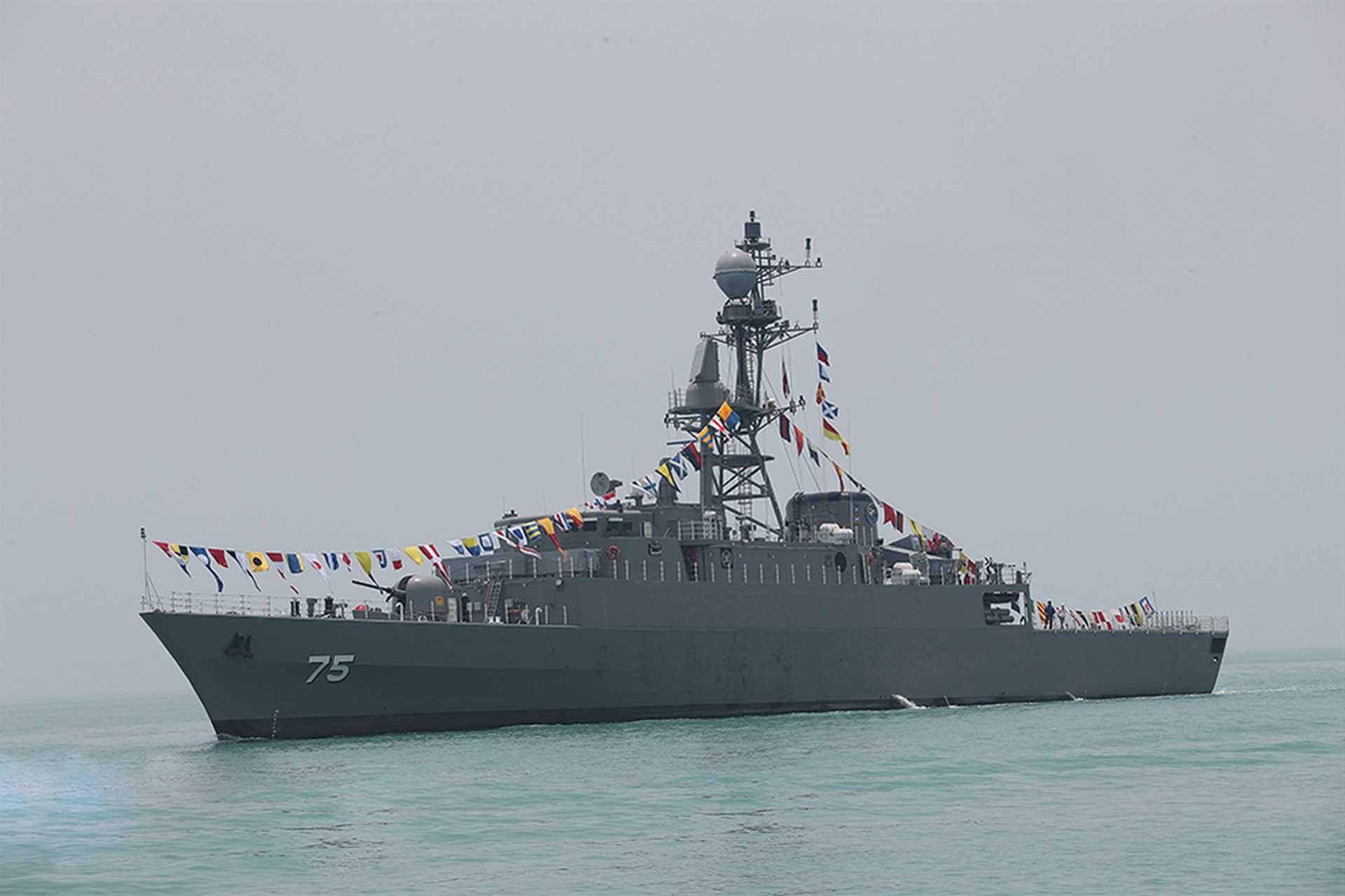
March 05, Colombo (LNW): The torpedoing of the Iranian warship IRIS Dena in the Indian Ocean near Sri Lanka represents a dramatic extension of Middle Eastern hostilities into the wider Indo-Pacific. Although the attack did not occur within Sri Lanka’s territorial waters, the incident has immediate and potentially far-reaching implications for the island’s security posture, diplomatic balancing, and economic stability.
According to available details, a United States submarine unleashed the torpedo assault against the Iranian naval frigate in international waters near Sri Lanka’s southern coastline, not far from Galle. The attack resulted in heavy casualties, leaving numerous Iranian sailors dead or missing. In the aftermath, the Sri Lanka Navy launched rescue operations, saving 32 personnel and recovering dozens of bodies from the sea.
The rescue mission was conducted under the framework of the 1979 International Convention on Maritime Search and Rescue, which obliges states to assist vessels in distress regardless of political circumstances.
While Sri Lanka’s role in the incident has been limited to humanitarian rescue efforts, the event nevertheless places the country in an uncomfortable geopolitical spotlight. The Indian Ocean sea lanes around Sri Lanka have long been among the world’s most heavily travelled maritime corridors, linking energy routes from the Middle East with the manufacturing centres of East Asia.
The sudden appearance of a direct naval confrontation between the United States and Iran in waters so close to the island underscores how rapidly distant geopolitical rivalries can spill into Sri Lanka’s immediate neighbourhood.
From a security perspective, the incident highlights the growing militarisation of the Indian Ocean. Sri Lanka now faces the reality that its surrounding waters could increasingly become an operational theatre for major-power confrontations. In response, policymakers in Colombo may be compelled to strengthen maritime surveillance systems, expand early-warning capabilities, and improve coordination with regional naval forces.
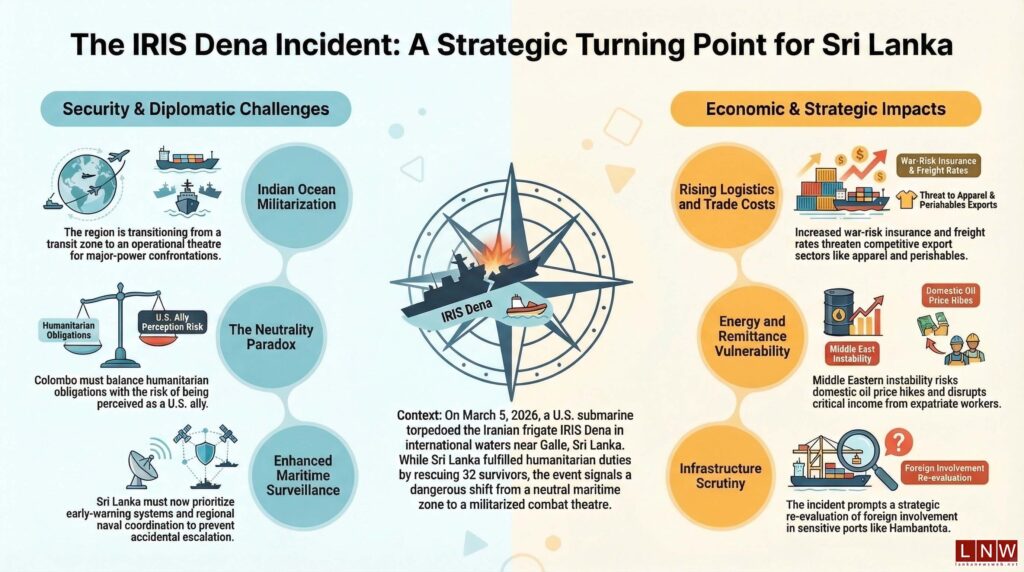
Such measures would be intended not only to monitor foreign military activity but also to prevent accidental escalation or misidentification incidents near Sri Lankan waters.
Diplomatically, the situation poses a delicate balancing act. Sri Lanka has historically pursued a policy of neutrality, seeking to maintain constructive relationships with Western powers, Middle Eastern nations, and emerging Asian partners simultaneously.
In its official response, Colombo has emphasised its humanitarian obligations and adherence to international law, deliberately avoiding direct criticism of either the United States or Iran. This cautious tone appears designed to prevent the island from becoming entangled in the political fallout of the attack.
Nevertheless, the diplomatic risks remain significant. Iran may interpret Sri Lanka’s restrained response as tacit acceptance of U.S. military activity near its maritime approaches. Such perceptions could complicate bilateral relations with Tehran and potentially influence Sri Lanka’s broader engagement with countries aligned with Iran.
At the same time, Colombo must consider the sensitivities of other major powers with strategic interests in the Indian Ocean, including China and India, both of which closely monitor developments in the region’s maritime security landscape.
Beyond geopolitics, the economic implications could be profound. Even prior to the sinking of the Dena, Sri Lankan authorities and the Central Bank had warned that escalating conflict in the Middle East might disrupt global shipping routes, increase war-risk insurance premiums, and drive up freight costs.
The attack near Sri Lanka provides tangible evidence that naval hostilities can extend far beyond the Persian Gulf, potentially making insurers and shipping companies view the entire Indian Ocean basin as a higher-risk environment.
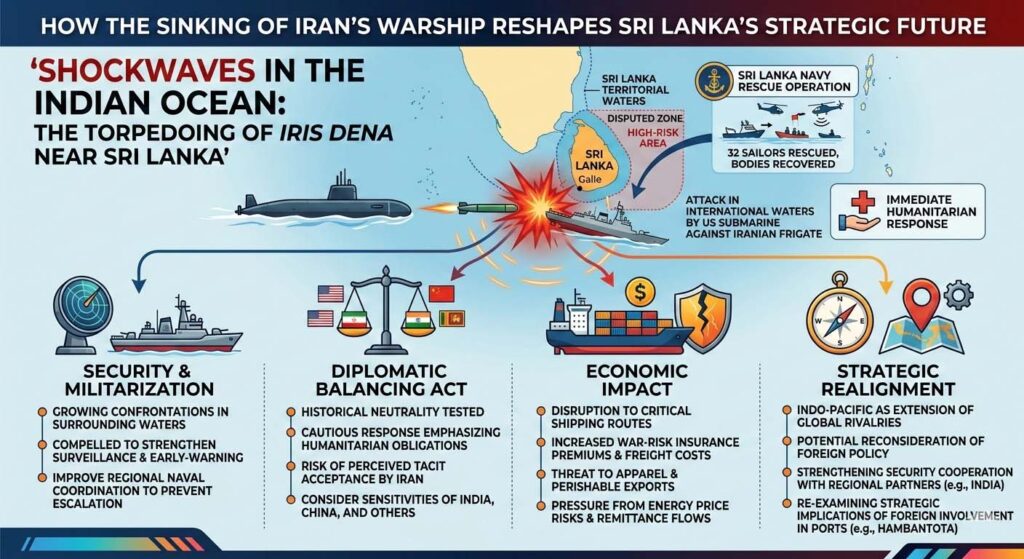
For Sri Lanka, whose economy depends heavily on maritime trade, such developments could prove damaging. The country’s export sectors—particularly apparel and time-sensitive goods such as perishables—rely on stable shipping schedules and predictable logistics costs. If freight rates climb or shipping routes become more volatile, Sri Lankan exporters could lose their competitive advantage in global markets.
Additional economic pressures may also emerge from energy markets and labour migration patterns. Sri Lanka imports the vast majority of its petroleum, meaning any prolonged rise in global oil prices triggered by Middle Eastern instability would place further strain on the country’s fragile economic recovery.
Meanwhile, millions of Sri Lankan expatriate workers in the Gulf region send remittances that form a critical pillar of the national economy. Any disruption to regional stability in the Middle East could threaten these income flows.
In strategic terms, the fact that a U.S. submarine was able to conduct a combat torpedo strike on an Iranian naval vessel so close to Sri Lanka’s coastline sends a powerful signal about the evolving nature of the Indo-Pacific security environment. The region is increasingly being treated by global powers as an extension of wider geopolitical rivalries rather than a neutral maritime transit zone.
This reality may eventually force Sri Lanka to reconsider aspects of its long-standing foreign policy. Strengthening security cooperation with regional partners—particularly India and other Indo-Pacific states—could become a priority. At the same time, Colombo may re-examine the strategic implications of foreign involvement in its ports and maritime infrastructure, including politically sensitive projects linked to Hambantota.
Ultimately, the sinking of the IRIS Dena may prove to be more than a single wartime incident. It could mark a turning point in how Sri Lanka perceives its position within an increasingly contested Indian Ocean. The island now faces the challenge of safeguarding its neutrality and economic interests while navigating a maritime environment that is becoming steadily more militarised and unpredictable.