LISTEN TO STORY
WATCH STORY
By: Isuru Parakrama
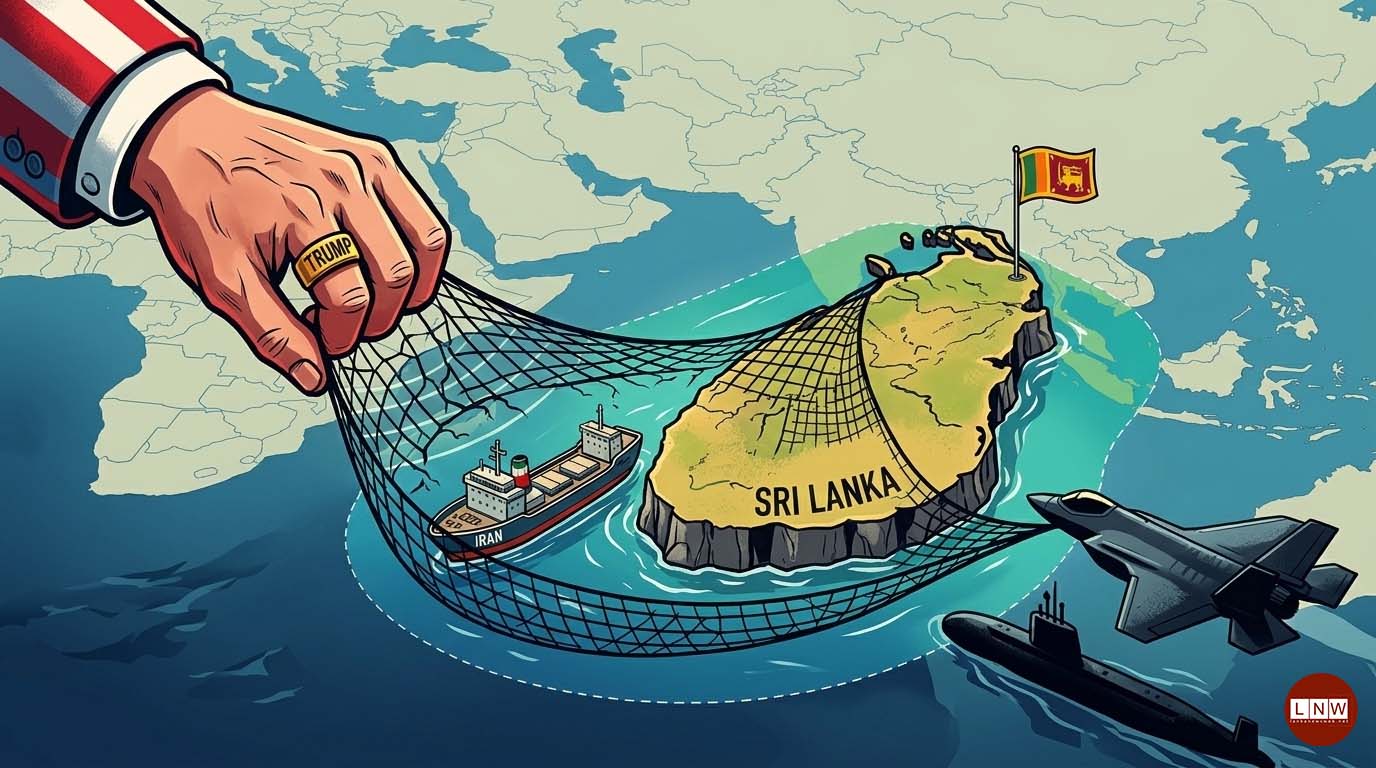
March 06, Colombo (LNW): As geopolitical tensions intensify following the United States–Israeli strikes on Iran, Sri Lanka has adopted a carefully calibrated position: neutrality grounded firmly in international law. The government has signalled that it will treat any Iranian vessels approaching or entering Sri Lankan waters strictly in accordance with legal obligations under global maritime conventions.
Yet while this stance is legally robust, it remains strategically fragile—particularly given the unpredictable behaviour associated with the leadership style of Donald Trump.
President Anura Kumara Dissanayake has made clear that Sri Lanka will not automatically align itself with either side in the escalating confrontation between the United States–Israel bloc and Iran. Instead, Colombo intends to operate as a neutral state guided primarily by the United Nations Convention on the Law of the Sea (UNCLOS) and the broader legal framework governing neutrality during armed conflict.
In practice, this means that Sri Lankan authorities would evaluate any request from an Iranian vessel—whether for port entry, repairs, resupply, or internment—based on strict legal criteria. Officials must first determine the nature of the vessel, including whether it is a warship or auxiliary support craft.
They must also evaluate whether granting access could risk escalating the conflict or inadvertently make Sri Lanka a participant in hostilities. The fundamental objective is to preserve neutrality while maintaining compliance with international maritime law.
Sri Lanka has also indicated that if Iranian vessels enter areas under its jurisdiction—including territorial waters or its Exclusive Economic Zone (EEZ)—their movements and activities will be tightly controlled. Crews, logistical arrangements, and operational restrictions would be regulated under international maritime rules, including humanitarian and search-and-rescue obligations.
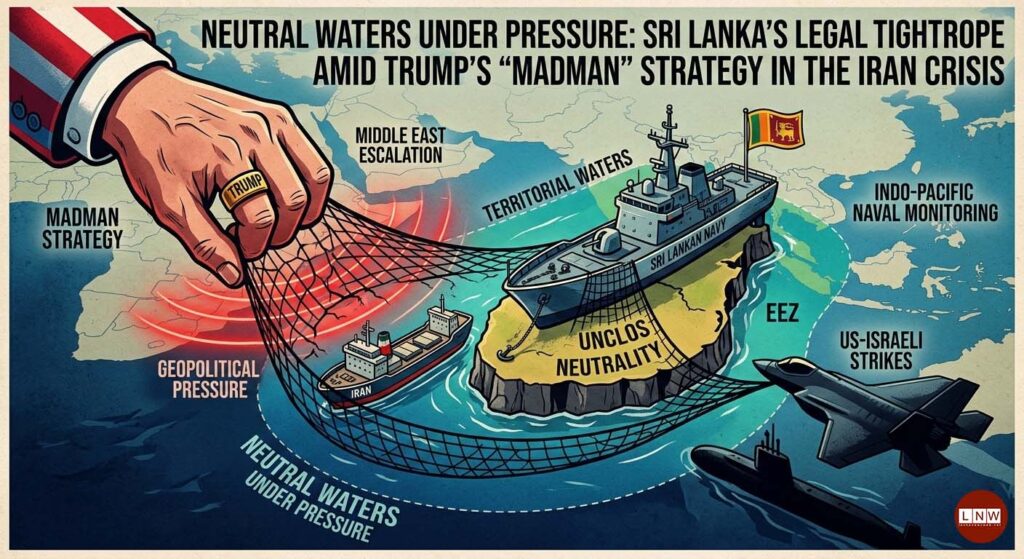
By consistently recording such decisions in accordance with UNCLOS, the Geneva Conventions, and the established law of neutrality, Sri Lanka creates a legal framework that strengthens its diplomatic defence. Any external attack on a vessel under Sri Lankan supervision would then clearly constitute a violation of international law and sovereignty.
However, the stability of this legal shield depends heavily on the behaviour of major powers involved in the conflict. The strategic uncertainty surrounding Donald Trump’s leadership style has heightened concerns. Trump has repeatedly demonstrated a willingness to treat sovereign boundaries and allied objections as negotiable constraints rather than absolute legal limits.
His public remarks suggesting that the United States could disregard Spain’s refusal to grant overflight rights or access to military bases—while threatening economic retaliation against Madrid—illustrate a readiness to apply coercive pressure even on allied states.
This behaviour feeds into what analysts often describe as the “madman” effect or “madman theory”—a strategy in which a leader cultivates an image of unpredictability and willingness to take extreme action in order to intimidate opponents and compel compliance. While such a posture may be intended to strengthen deterrence, it also introduces serious uncertainty for smaller states caught within the orbit of major-power conflict.
For Sri Lanka, the implication is clear: neutrality alone cannot guarantee protection. If Washington believes that an Iranian vessel represents a critical military asset, it might still consider targeting it—even if Colombo has refused to facilitate military operations. The precedent suggested by Trump’s rhetoric implies that sovereign objections from smaller states could be treated as obstacles to be pressured or circumvented rather than binding constraints.
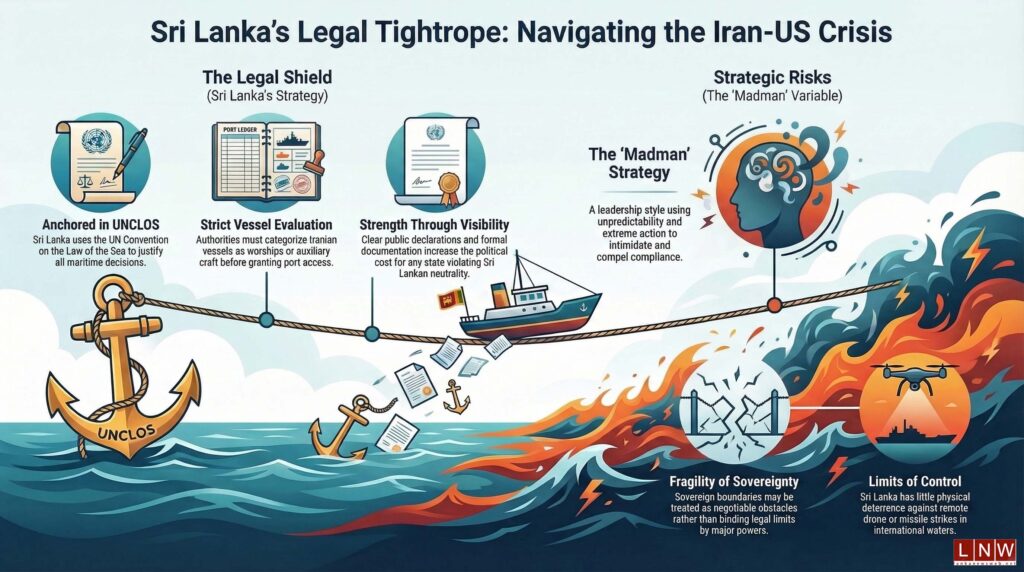
In this context, Sri Lanka’s most effective safeguard lies in the visibility and clarity of its legal position. Public declarations, formal documentation, and consistent adherence to UNCLOS provisions strengthen the country’s diplomatic shield. If an Iranian vessel under Sri Lankan jurisdiction were attacked within territorial waters or while interned at major ports such as Colombo or Trincomalee, the act would immediately appear as a blatant violation of sovereignty and neutrality on the global stage.
Nevertheless, the country must recognise the limits of its capacity to control events beyond its territorial waters. If Iranian vessels remain in international waters—or even within Sri Lanka’s EEZ—the risk of remote strikes by submarines, missiles, or drones becomes significantly harder for Colombo to prevent. In such scenarios, Sri Lanka’s influence lies less in physical deterrence and more in diplomatic consequences.
To strengthen its position, Sri Lanka could publicly designate which vessels are under its protection or internment and outline the strict conditions governing their presence, including bans on military operations or weapons use. The government could also signal clearly that any attack on vessels within Sri Lankan territorial waters would be treated as a direct assault on national sovereignty, triggering immediate diplomatic action and appeals to international bodies such as the United Nations Security Council.
Equally important is coordination with regional actors. Engagement with India and other Indo-Pacific naval partners could ensure continuous monitoring of the maritime environment around Sri Lanka, making any aggressive manoeuvre by external forces highly visible and politically costly.
Ultimately, Sri Lanka’s strategy rests on a delicate equation. The stronger its adherence to international law and the clearer its diplomatic messaging, the higher the political and legal cost for any state that violates its neutrality. Yet in a volatile geopolitical climate shaped by great-power rivalry—and the unpredictable “madman” signalling associated with Donald Trump—legal correctness alone may not be sufficient to guarantee security.