
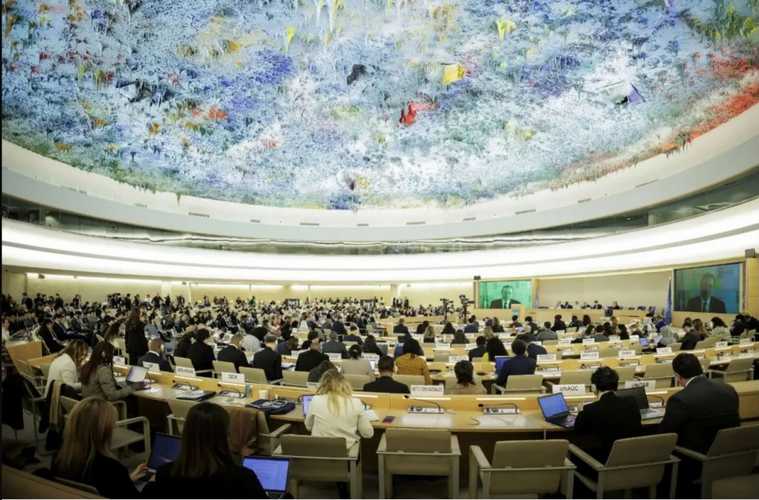
Sri Lanka faced renewed international scrutiny at the 61st session of the United Nations Human Rights Council in Geneva, as the Sri Lanka Core Group called for the repeal and non-use of the Prevention of Terrorism Act (PTA) and raised concerns over the government’s proposed replacement legislation.
Delivering the statement on 2 March 2026, the United Kingdom’s Human Rights Ambassador, Eleanor Sanders, spoke on behalf of the Core Group, comprising Canada, Malawi, Montenegro, North Macedonia and the UK.
The Core Group extended condolences to Sri Lanka for the loss caused by Cyclone Ditwah in November, before turning to issues of memorialisation, land release and accountability.
“We acknowledge the government’s steps to allow communities of different backgrounds to commemorate losses from the conflict era. Memorialisation is vital to reconciliation, and we encourage continued progress.”
The statement, however, reiterated longstanding concerns over Sri Lanka’s security legislation.
“We reiterate our call for the repeal, and non use, of the Prevention of Terrorism Act. The latest version of the proposed Protection of the State from Terrorism Bill raises even greater concerns than previously. Counter-terrorism legislation must comply with Sri Lanka’s human rights obligations.”
The Prevention of Terrorism Act has long been criticised by Eelam Tamils and international human rights organisations as a tool of arbitrary detention, torture and repression. Recent weeks have seen widespread protests across the North-East, including in Jaffna, Batticaloa and Mannar, demanding the Act’s repeal and opposing the proposed new legislation.
The Core Group also addressed land occupation and transitional justice.
“While some military held land has been released, the pace of releases remains too slow. We note recent commitments by the President on transitional justice, anti racism, and emblematic human rights cases; however, concrete results are still limited. Key institutions remain weak, and threats against witnesses, victims, and journalists associated with cases persist.”
Large areas of land in the North-East remain under military control more than sexiteen years after the end of the armed conflict, with Tamil families continuing to seek the return of ancestral lands.
The Core Group concluded by welcoming the Office of the High Commissioner for Human Rights report on conflict-related sexual violence and paid tribute to survivors.
“Finally, we thank OHCHR for its report on conflict related sexual violence and honour those who shared their experiences. We urge Sri Lanka to engage constructively, strengthen legal protections, and ensure justice for survivors.”
TAMIL GUARDIAN