
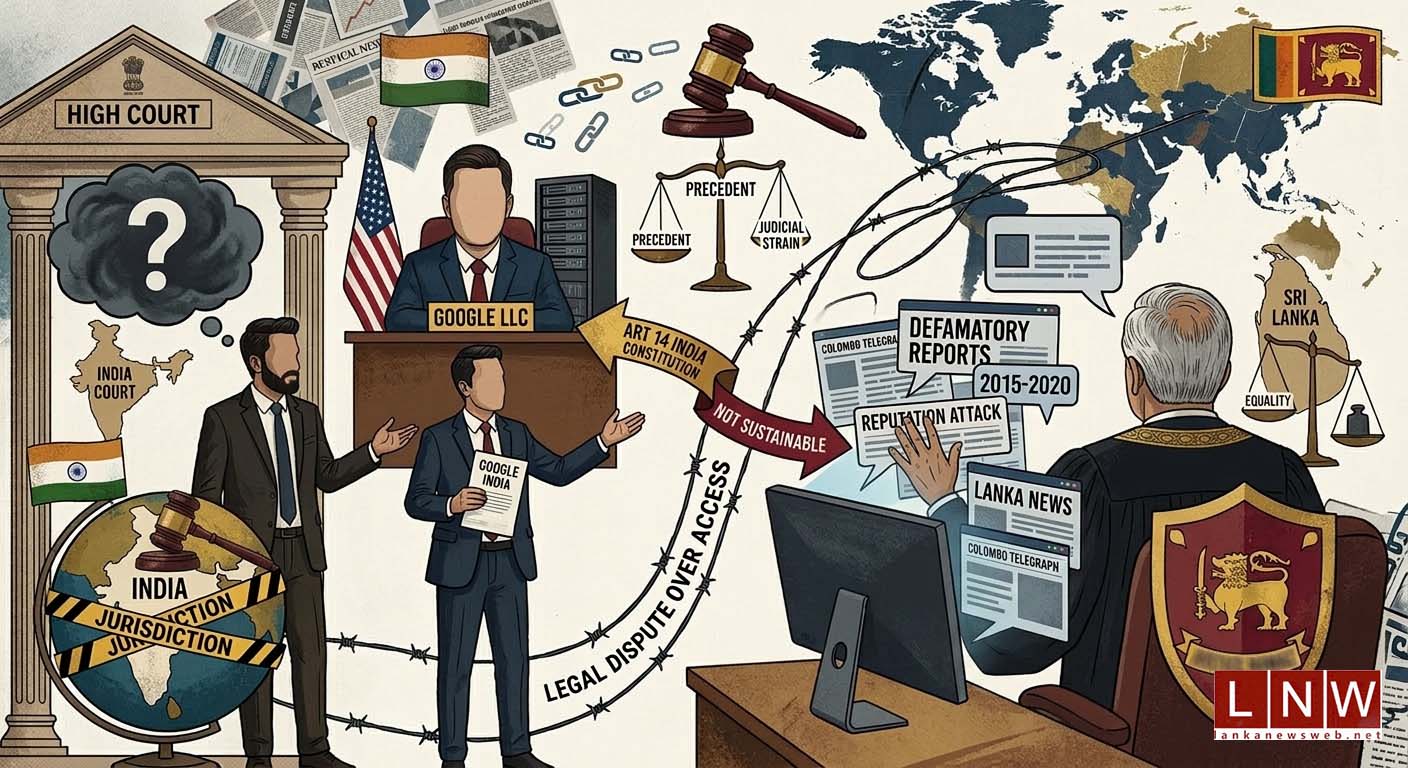
March 17, Colombo (LNW): Google has informed the Karnataka High Court that a petition lodged by a sitting Sri Lankan Supreme Court judge, seeking the removal of allegedly defamatory online reports, is not legally sustainable, a report by Indian Express disclosed.
The case centres on Justice A.H.M.D. Nawaz, who has asked the court to order Google India to take down links connected to news articles published in 2015 and 2020 by Sri Lanka-based outlets Colombo Telegraph and LankaNews. The judge contends that the material has harmed his professional standing.
Representing Google, advocate Manu P. Kulkarni argued that the Indian court lacks jurisdiction in the matter. He maintained that the petitioner, being a Sri Lankan judge, is challenging content that originated outside India, making the case inappropriate for adjudication by an Indian forum. Kulkarni further criticised the filing as overly speculative and urged the court to dismiss it outright.
He also emphasised that Google India should not be named in the proceedings, asserting that responsibility lies instead with Google LLC, the parent entity headquartered in the United States.
Google’s legal team warned that entertaining such petitions could set a precedent, encouraging individuals from across the globe to approach Indian courts over online content, thereby placing undue strain on the judicial system.
On the other side, counsel for Justice Nawaz, advocate Prabhakaran Ramachandran, pressed the court to adopt a firm stance against what he described as damaging and malicious reporting targeting members of the judiciary. He argued that judges must be safeguarded from reputational attacks that could undermine public confidence in the legal system.
During the proceedings, the petitioner’s counsel also raised concerns about social media activity allegedly linked to the journalist behind the disputed articles. It was suggested that commentary published while the matter is under consideration could potentially amount to contempt of court.
Addressing Google’s objections on jurisdiction, Ramachandran contended that the right to equality before the law, as enshrined in Article 14 of the Indian Constitution, extends to non-citizens as well. He argued that if harmful content is accessible within India, affected individuals—regardless of nationality—should be entitled to seek legal recourse in Indian courts.
Justice Nawaz has described the articles as deeply injurious, claiming they amount to a severe assault on his reputation. He further explained that initiating legal action in Sri Lanka would be problematic due to the principle that a judge cannot preside over a matter in which they have a personal interest.
Presiding over the case, Justice Sachin Shankar Magadum directed the petitioner to revise the filing and instructed both the central government and Google to submit their responses. The matter is scheduled to be heard again later this month.