
By: Staff Writer
March 17, Colombo (LNW): Sri Lanka’s ambitious plan to regulate online betting and capture millions in tax revenue faces a formidable opponent: the dominance of offshore gambling platforms already entrenched in the country’s digital economy.
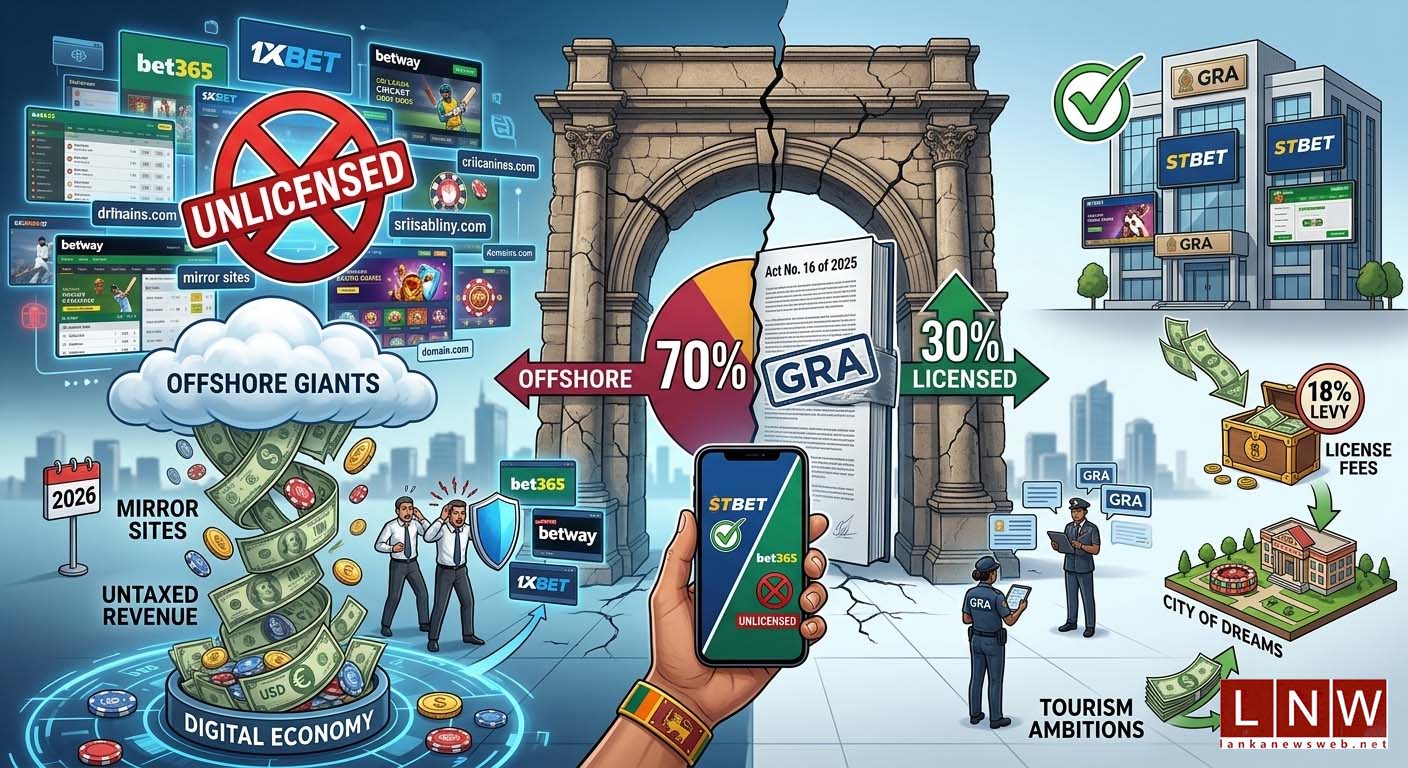
Despite the legalization of licensed online betting under the Gambling Regulatory Authority Act No.16 of 2025, government officials estimate that as much as 70 percent of Sri Lankan bettors continue to gamble on foreign platforms operating beyond the reach of local regulators.
Among the most widely used sites are global betting operators such as bet365, Betway, and 1xBet, which run Sri Lanka-focused portals and accept payments through international digital channels.
The new law was introduced in part to confront this problem. It establishes the Gambling Regulatory Authority (GRA) as a central regulator overseeing the country’s gambling industry, with powers to issue licenses, block illegal websites, and prosecute promoters of unauthorized betting services.
Operating without a digital gambling license now carries a penalty of up to Rs.10 million or two years in prison.
But enforcing the law in a borderless digital marketplace may prove difficult.
“These offshore operators are extremely sophisticated,” said a senior Inland Revenue Department official involved in the regulatory transition.
“They operate through multiple domains, mirror websites, and foreign payment gateways. Blocking one site does not necessarily stop access.”
The government’s urgency is driven by the enormous financial stakes.
According to official projections, Sri Lanka’s betting industry could exceed US$410 million by 2026, making it one of the fastest-growing segments of the country’s digital economy.
To ensure the state captures a share of that revenue, authorities have significantly increased taxes on betting businesses. The Gross Collection Levy rose from 15 percent to 18 percent in January 2026 for companies earning more than Rs.1 million in monthly collections.
In addition, internet-based bookmakers must pay Rs.5 million annually for operating licenses, while companies using live telecasts for betting activities must pay Rs.1 million per year.
The government hopes these measures will encourage legitimate operators to enter the licensed market while discouraging illegal platforms.
However, some industry observers warn that high taxes could have the opposite effect.
“If the regulatory costs are too high, operators may simply remain offshore while Sri Lankan bettors continue using those platforms,” said an analyst tracking the regional gaming industry.
One domestic betting brand already active in the local digital space is STBet, which is expected to seek full regulatory approval once the licensing process is finalized.
Meanwhile, the government is linking its gambling reforms to broader tourism ambitions. Massive developments such as the $1.2 billion City of Dreams integrated resort in Colombo are expected to combine casinos, luxury hotels, and entertainment facilities targeting high-spending foreign visitors.
Officials believe these projects could transform Sri Lanka into a regional gaming destination.
But whether regulation will successfully shift gamblers away from the offshore market—and into a system the government can tax and control remains uncertain.
For now, Sri Lanka’s online betting economy continues to operate in two parallel worlds: one regulated on paper, and another thriving quietly across the internet.