
By Nalinda Indatissa
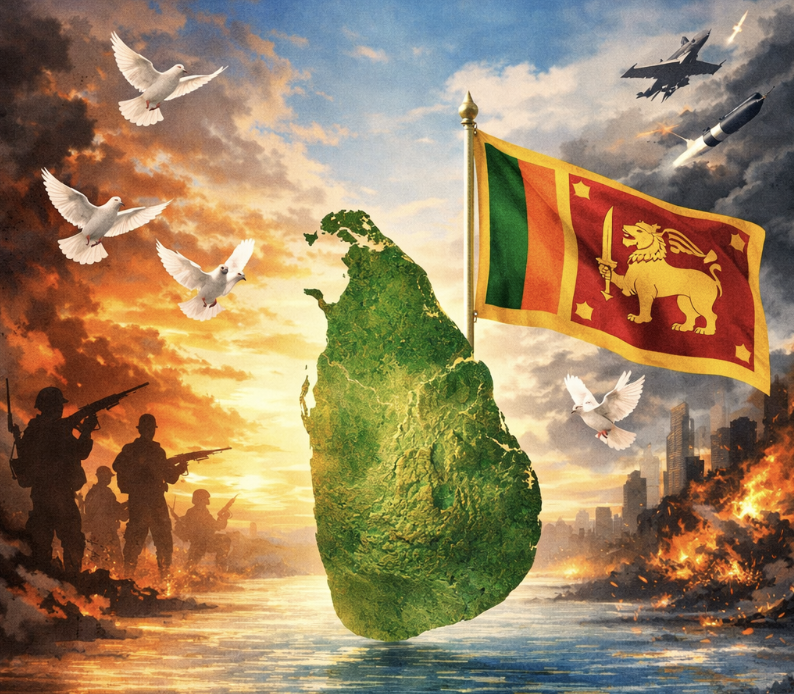
In a world increasingly consumed by conflict, the ancient truth that “hatred does not cease by hatred” has found renewed relevance. As the war between Iran and Israel intensifies—drawing in global powers such as the United States—Sri Lanka’s decision to remain steadfastly neutral stands not merely as a diplomatic strategy, but as a principled moral position.
A War Beyond Borders
The conflict, triggered by coordinated military strikes in February 2026, has rapidly escalated into a wider regional war, disrupting global energy supplies and international stability.
Wikipedia
Its consequences are no longer confined to the Middle East. Even distant nations like Sri Lanka are feeling the shockwaves—through fuel shortages, economic strain, and maritime insecurity.
Reuters
Indeed, Sri Lanka has been forced to introduce fuel rationing and even a four-day work week to cope with supply disruptions linked to the war.
The Guardian
Neutrality in Action, Not Just Words
Sri Lanka’s neutrality is not passive—it is active, deliberate, and consistent.
The government has refused military access to foreign powers, declining requests from both sides in order to avoid partiality.
Reuters
It has refused to allow its territory, airspace, or waters to be used for hostile purposes.
Daily Mirror
At the same time, it has extended humanitarian assistance—rescuing sailors, treating the wounded, and offering safe harbour where required.
Daily Mirror
This dual approach—firm neutrality coupled with humanitarian duty—reflects a mature understanding of international law and moral responsibility.
The Strategic Necessity of Neutrality
Sri Lanka’s position is not merely ethical; it is also pragmatic.
The country maintains vital economic relationships with multiple sides of the conflict. The United States remains a key export market, while Iran is an important trading partner, particularly for tea.
Reuters
To align with one would risk alienating the other—an outcome Sri Lanka, still recovering from economic crisis, cannot afford.
Moreover, situated along critical Indian Ocean shipping routes, Sri Lanka’s geographic reality demands caution. Any perceived alignment could transform it from an observer into a theatre of conflict.
Breaking the Cycle of Hatred
At its core, Sri Lanka’s stance reflects a deeper philosophical truth—one long articulated by Gautama Buddha: hatred cannot extinguish hatred.
To take sides in a conflict driven by retaliation is to perpetuate that cycle. Even indirect support—whether political, logistical, or symbolic—risks fuelling further escalation.
By refusing to endorse either side militarily, Sri Lanka rejects the logic of vengeance. Instead, it affirms a different path:
Restraint over reaction
Humanity over hostility
Balance over bias
A Model for Small States
Sri Lanka’s approach offers an important lesson for smaller nations navigating great-power rivalries. Neutrality, when grounded in principle and consistency, is not weakness—it is strength.
It requires discipline to resist pressure, clarity to maintain balance, and courage to prioritise long-term stability over short-term alignment.
Conclusion
Sri Lanka’s neutrality in the Iran–Israel war is more than a foreign policy decision. It is a statement of values.
In choosing not to participate in hatred—nor to encourage it—the nation aligns itself with a timeless principle: peace cannot be built on the foundations of conflict.
In an age where nations are often compelled to choose sides, Sri Lanka has chosen something far more difficult—and far more meaningful: to stand apart, and to stand for peace.