
By: Staff Writer
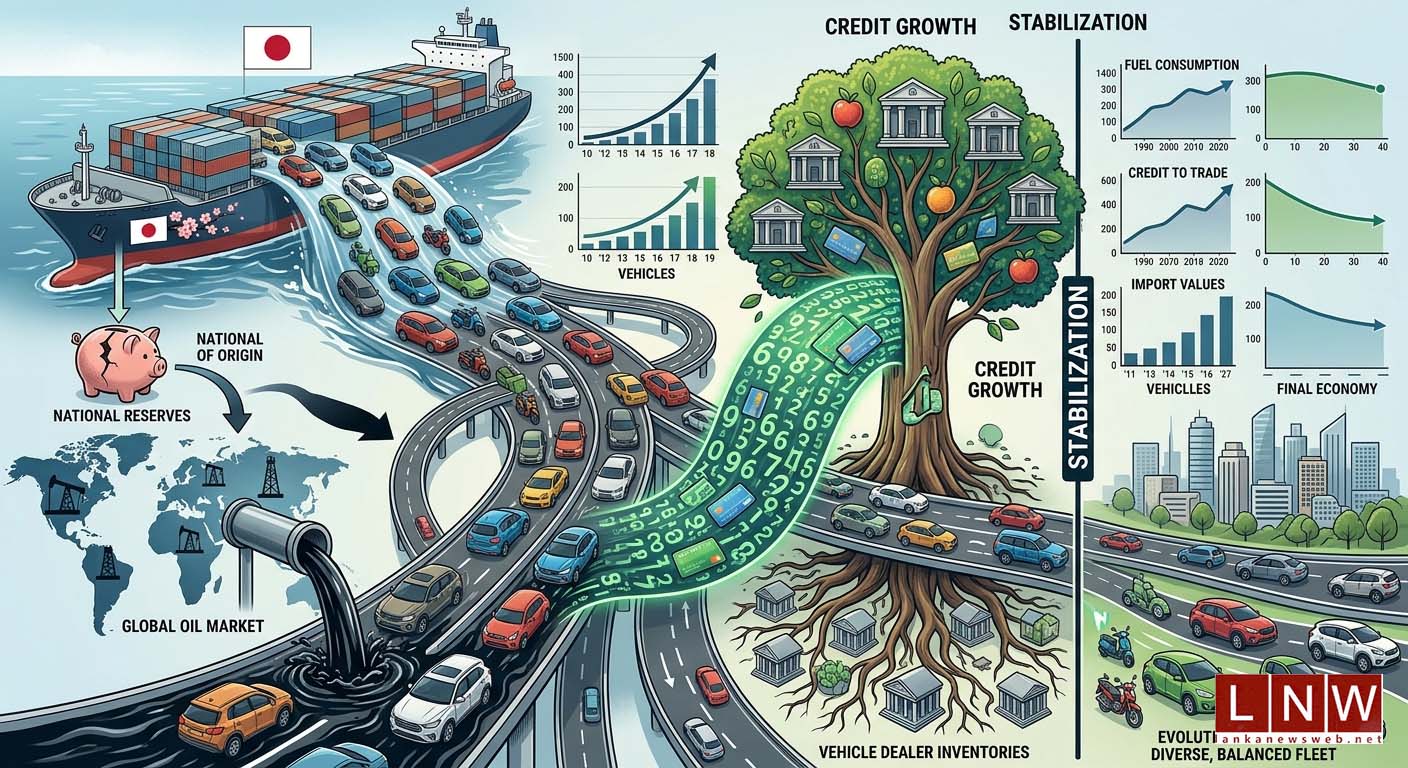
March 24, Colombo (LNW): Sri Lanka’s post-import-ban vehicle boom has not only reshaped the automobile market but also triggered wider economic consequences, from rising fuel consumption to expanding credit flows though recent data suggests the surge may finally be stabilizing.
Following the reopening of vehicle imports in 2025, Sri Lanka experienced a massive influx of vehicles across categories. Monthly registrations remained elevated into early 2026, with 55,365 vehicles registered in January and 51,682 in February. While February recorded a decline of 3,683 units, the overall numbers still reflect a historically high level of activity.
This rapid expansion has contributed to a sharp increase in the country’s total vehicle population, now estimated at over 8 million units, dominated by two-wheelers. As a result, fuel consumption has surged noticeably compared to the pre-ban period, adding strain to Sri Lanka’s already vulnerable foreign exchange position amid high global oil prices.
The economic ripple effects extend beyond fuel. Banking sector data shows a significant rise in credit to retail and wholesale trade sectors, partly driven by financing for large vehicle inventories held by dealers. Credit-backed purchases now account for a substantial share of vehicle sales, highlighting the role of lending in sustaining demand.
However, the apparent strength in registrations may be misleading. A government-imposed 3% monthly penalty on vehicles not registered within 90 days has incentivized dealers to register unsold stock, inflating official figures. This suggests that actual end-user demand may be weaker than headline numbers indicate.
Import data supports the view that momentum is cooling. Total vehicle imports fell from $311.1 million in December to $236.4 million in January, with personal vehicle imports dropping sharply by 32%. Although February data is yet to be released, indicators such as the Central Bank’s $461 million forex purchases point to reduced import pressure and a possible current account surplus.
Structurally, the market is also evolving. There is a clear shift toward compact vehicles, SUVs, and crossovers, while traditional passenger cars are losing share. Electric vehicles and hybrids remain significant but showed slower growth in February. Meanwhile, two-wheelers continue to dominate volumes, outperforming previous import cycles.
Japanese brands still lead the market, though Chinese and Indian manufacturers are making inroads, especially in the electric segment. Three-wheeler registrations, while recovering, remain below historical peaks.
Compared to previous cycles particularly the 2015 surge the current boom is notable but less extreme. More importantly, the emerging slowdown suggests a transition toward a more sustainable level of imports.
If this moderation continues, it could help stabilize fuel demand, ease pressure on foreign reserves, and reduce risks to the broader economy marking a crucial turning point after months of rapid expansion.