
By: Staff Writer
April 01, Colombo (LNW): Sri Lanka’s latest energy conservation push, led by directives from Essential Services Commissioner General. Prabath Chandrakeerthi and Minister of Public Administration Chandana Abayarathna, has reignited debate over whether Government-led awareness campaign particularly those heavily reliant on television and newspaper advertising deliver meaningful results or simply repeat past inefficiencies.
The new guidelines are extensive. Air conditioning in Government offices must be switched off by 3 p.m., illuminated billboards are to go dark by 8 p.m., and even street lighting is being curtailed. Event organisers are urged to use private generators, while citizens are encouraged to adopt small behavioural changes such as switching off unused appliances and limiting water waste.
On paper, the measures appear practical and necessary. Sri Lanka is facing mounting pressure from global energy instability and dry weather conditions, increasing the urgency for conservation. Yet, the real question lies not in the intent but in execution and impact.
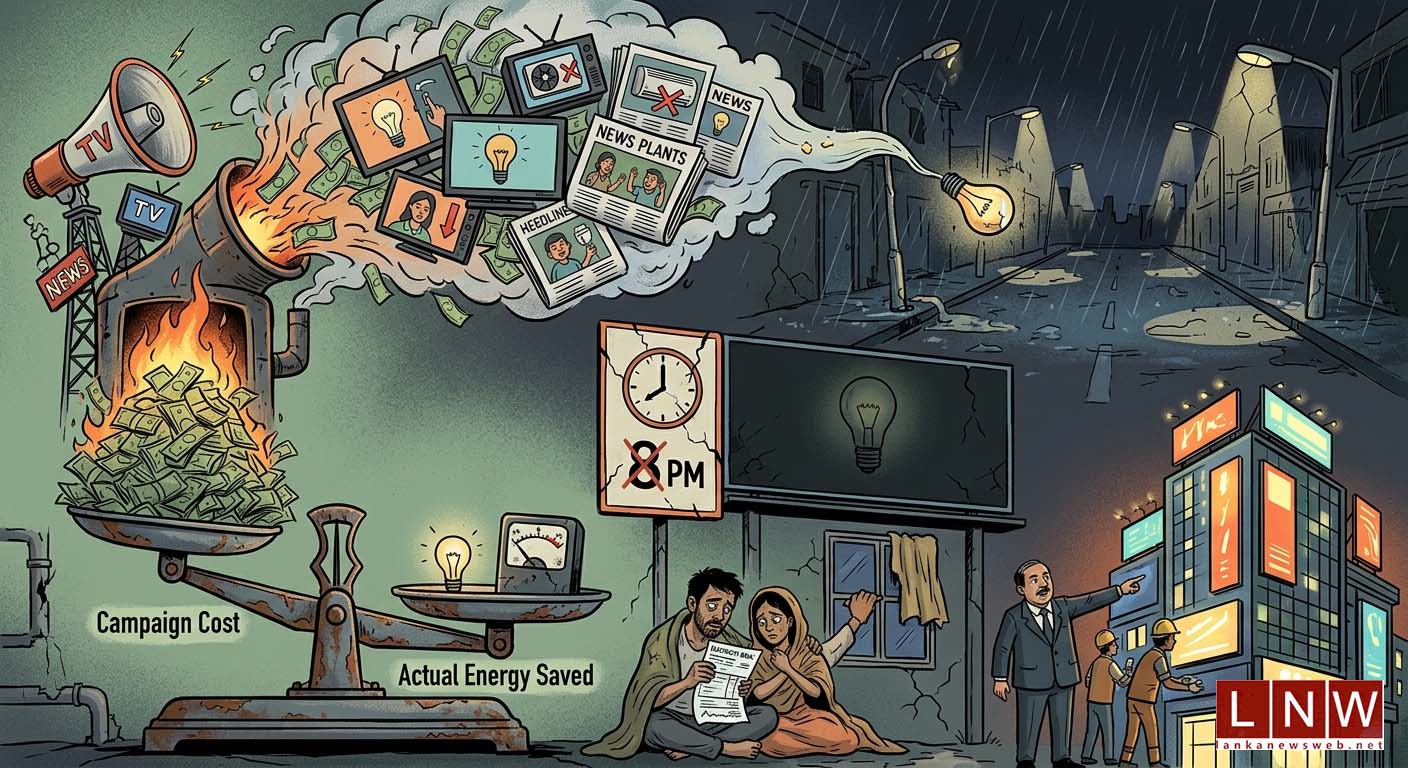
A significant portion of the campaign relies on mass media messaging, with heavy spending on TV commercials and newspaper advertisements designed to influence public behaviour.
However, this approach mirrors strategies used by previous governments, many of which failed to produce sustained reductions in energy consumption. Critics argue that awareness alone does not translate into action, especially when economic realities constrain consumer choices.
For many households, particularly amid rising living costs, energy conservation is less about awareness and more about necessity. Families are already limiting electricity use due to high tariffs and financial pressure. In such a context, expensive media campaigns risk appearing redundant if not wastefulraising concerns about the efficient use of public funds.
Moreover, structural inefficiencies within the energy system often undermine conservation efforts. Poor urban planning, outdated infrastructure, and inconsistent enforcement of regulations contribute significantly to wastage.
For instance, while the Government highlights street lighting misuse, the responsibility for such inefficiencies lies largely with administrative bodies rather than individual citizens.
The reliance on advertising also raises questions about accountability. Without transparent metrics to measure the effectiveness of these campaigns, it becomes difficult to justify their cost. Are electricity savings directly attributable to these initiatives, or are they the result of external factors such as tariff increases and economic hardship?
There is also a growing perception that the burden of conservation is being shifted disproportionately onto the public, while systemic issues remain unaddressed. Reducing consumption at the household level is important, but it cannot substitute for comprehensive reforms in energy generation, distribution, and governance.
Ultimately, while the conservation drive underscores a genuine national challenge, its success will depend on more than messaging. Without tangible improvements in infrastructure, enforcement, and policy coherence, the cycle of high-cost campaigns with limited impact is likely to continue—leaving both energy savings and public trust in short supply.