LISTEN TO STORY
WATCH STORY
By: Isuru Parakrama
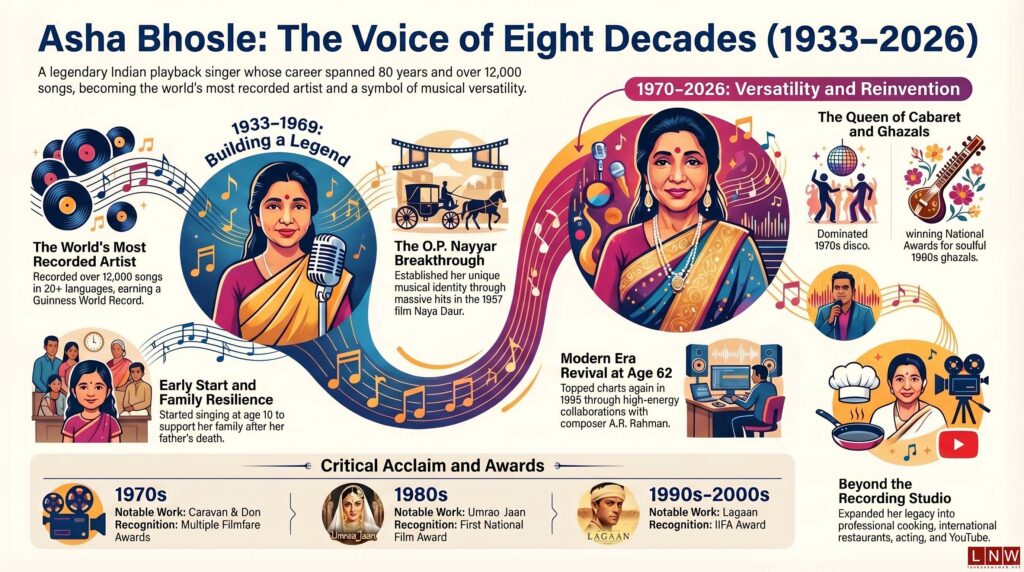
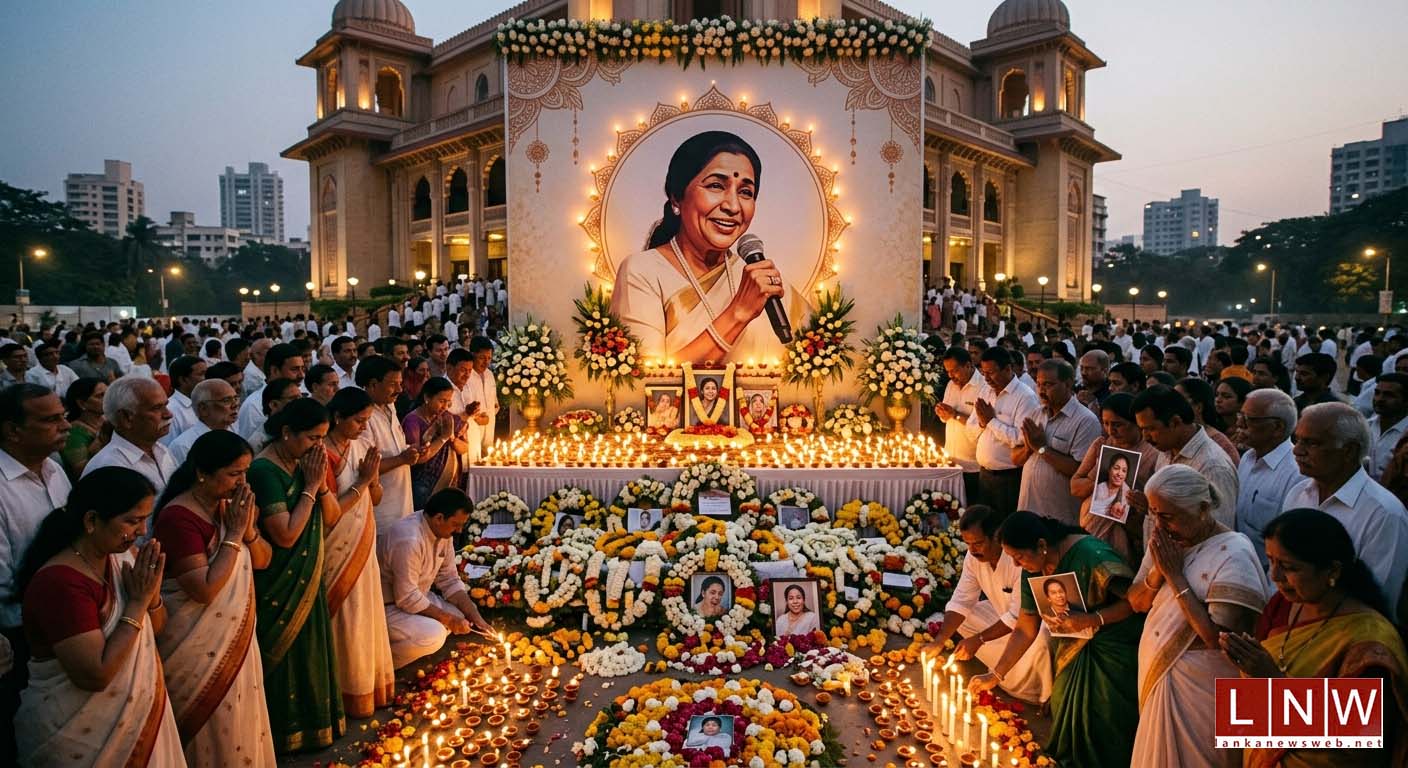
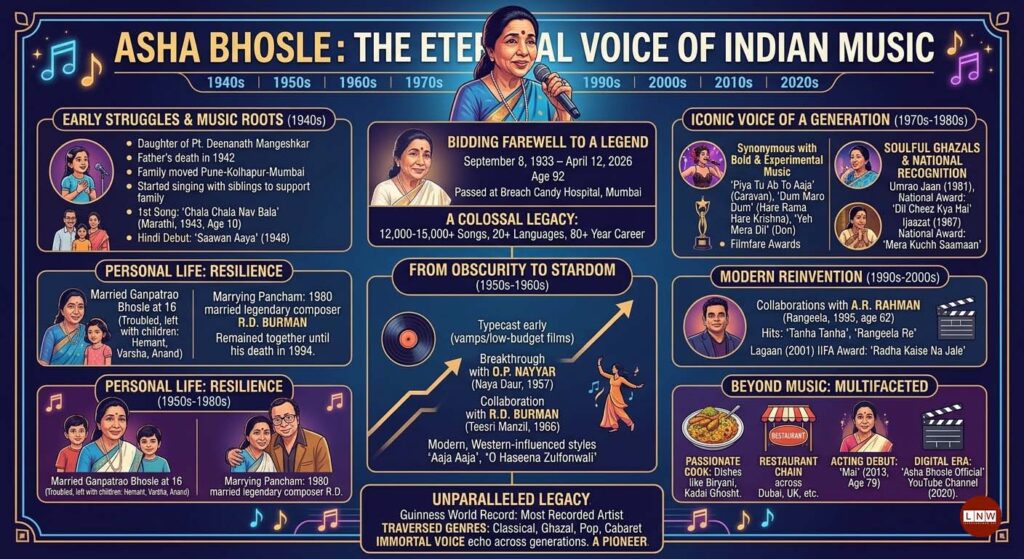
April 12, World (LNW): The world of music bid farewell to one of its most enduring and versatile voices as Asha Bhosle passed away on April 12, 2026, at the age of 92. She died at Breach Candy Hospital in Mumbai after being admitted a day earlier with extreme exhaustion and a chest infection. Her son, Anand Bhosle, confirmed that her final rites would be held at Shivaji Park on April 13. With a staggering career spanning over eight decades and more than 12,000–15,000 songs recorded in over 20 languages, she leaves behind an unparalleled musical legacy.
Humble Beginnings and Early Struggles
Born on September 8, 1933, in Goar, Sangli (now in Maharashtra), Asha Bhosle was the daughter of the renowned classical singer and actor Pandit Deenanath Mangeshkar and Shevanti. Tragedy struck early when her father passed away in 1942, forcing the family to relocate from Pune to Kolhapur and eventually Mumbai in search of stability.
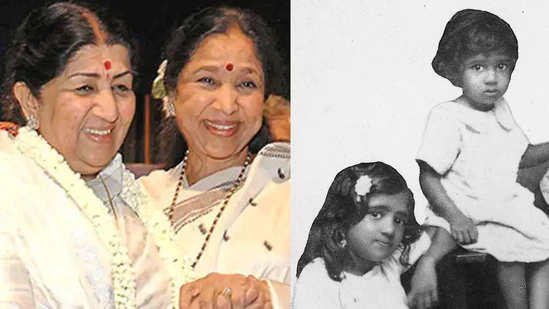
Alongside her siblings, including her illustrious elder sister Lata Mangeshkar, Asha began singing at a young age to support the family. At just 10, she recorded her first song, “Chala Chala Nav Bala,” for the Marathi film Majha Bal (1943). Her Hindi debut followed with “Saawan Aaya” in Chunariya (1948), and her first solo came in Raat Ki Rani (1949).
A Personal Life Marked by Turmoil and Resilience
Asha Bhosle’s personal journey was as dramatic as her professional rise. At 16, she married Ganpatrao Bhosle, her much older personal secretary, against her family’s wishes. The marriage proved deeply troubled, marked by abuse and isolation from her family. Eventually, she returned to her maternal home while pregnant with her third child, raising her children independently after the separation.
Her children included Hemant Bhosle, a music director who passed away in 2015; Varsha Bhosle, a columnist who died tragically in 2012; and Anand Bhosle, who later managed her career.
In 1980, she found companionship again with the legendary composer Rahul Dev Burman, affectionately known as Pancham. Despite initial opposition from his family, the two married and remained together until his death in 1994. She fondly referred to him as “Bob,” reflecting the warmth of their relationship.
From Obscurity to Stardom
The early phase of Asha’s career in the 1940s and 1950s was marked by struggle. She often sang for low-budget films and was typecast as the voice for vamps. However, her persistence paid off when she began collaborating with music director O. P. Nayyar in the 1950s. This partnership gave her a distinct identity and led to her breakthrough in Naya Daur (1957), where her duets with Mohammed Rafi became immensely popular.
Her collaboration with R.D. Burman in the 1960s marked a turning point. Songs like “Aaja Aaja” and “O Haseena Zulfonwali” from Teesri Manzil (1966) showcased her ability to adapt to modern, Western-influenced music styles. Actor Shammi Kapoor once famously remarked that if he did not have Mohammed Rafi, he would have chosen Asha to sing for him—an extraordinary testament to her versatility.
The Iconic Voice of a Generation
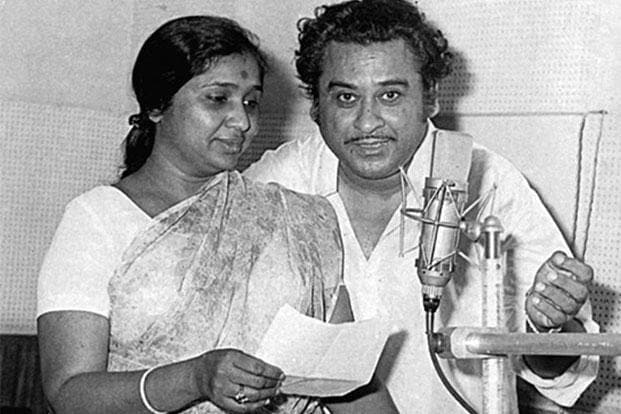
By the 1970s and 1980s, Asha Bhosle had become synonymous with bold, experimental music. Her performances in songs like “Piya Tu Ab To Aaja” (Caravan, 1971), “Dum Maro Dum” (Hare Rama Hare Krishna, 1971), and “Yeh Mera Dil” (Don, 1978) earned her widespread acclaim and multiple Filmfare Awards.
Yet, she was far more than a voice of cabaret and disco. She reinvented herself with soulful ghazals in films like Umrao Jaan (1981), earning her first National Film Award for “Dil Cheez Kya Hai” and “In Aankhon Ki Masti Ke.” Her second National Award came with Ijaazat (1987) for the evocative “Mera Kuchh Saamaan.”
Reinvention in the Modern Era
Even in her later years, Asha Bhosle remained musically relevant. In 1995, at the age of 62, she collaborated with A. R. Rahman for Rangeela, delivering hits like “Tanha Tanha” and “Rangeela Re.” She continued this successful partnership with songs such as “Radha Kaise Na Jale” from Lagaan (2001), which won her an IIFA Award.
Her adaptability across generations ensured that her voice resonated with both older audiences and younger listeners alike.
Beyond Music: A Multifaceted Personality
Asha Bhosle’s talents extended beyond singing. A passionate cook, she was particularly known for dishes such as kadai ghosht, biryani, paya curry, and Goan fish curry. Her culinary passion led her to establish a chain of restaurants across Dubai, Kuwait, Abu Dhabi, Doha, Bahrain, and the United Kingdom, where she held a 20% stake.
She also ventured into acting, making her debut at the age of 79 in the film Mai (2013), where she portrayed a mother suffering from Alzheimer’s disease—earning critical acclaim. In 2020, she embraced the digital era by launching her YouTube channel, “Asha Bhosle Official,” further connecting with fans worldwide.
A Legacy That Transcends Time
Recognised by Guinness World Records as the most recorded artist in music history, Asha Bhosle’s contribution to global music is immeasurable. Her ability to traverse genres—from classical and ghazal to pop and cabaret—set her apart as a true pioneer.
Her voice was not merely a medium of entertainment but a reflection of evolving cultural and musical landscapes over eight decades. With her passing, an era draws to a close, yet her songs continue to echo across generations, ensuring that her legacy remains immortal.