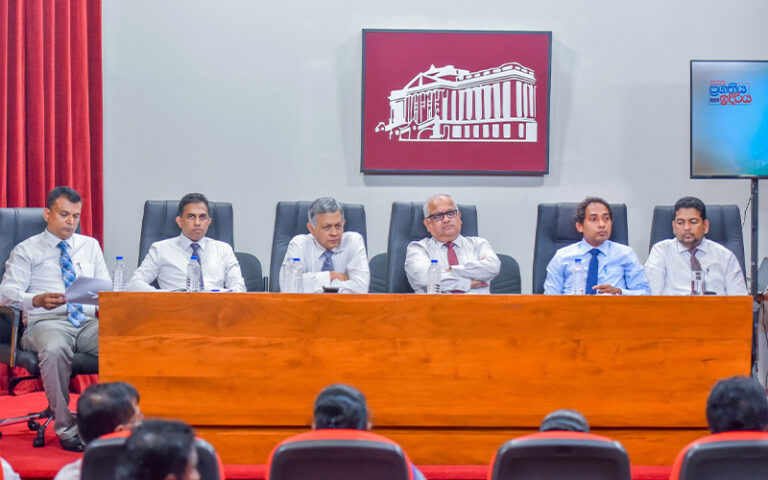
February 01, Colombo (LNW): Parliament Speaker Mahinda Yapa Abeywardena has formally endorsed the certificate pertaining to the Online Safety Bill, as confirmed by Parliament General Secretary Kushani Rohanadheera.
The Online Safety Bill, having undergone amendments, was successfully passed in parliament on January 23rd.
Subsequently, concerns were raised by opposition Members of Parliament who contended that the bill was approved without due consideration of the amendments proposed by the Supreme Court.
In response to these concerns, both opposition members and activists urged Speaker Abeywardena to withhold the endorsement of the certificate for the Online Safety Bill until it could be verified that the court’s suggested amendments were duly incorporated.
The Online Safety Bill’s primary objective is to regulate online content in Sri Lanka. However, critics caution that its implementation may result in censorship and the curtailment of free speech.
In ancient times, Sri Lanka (Ceylon) was known as the ‘Granary of the East’ as the traditional farming methods which were practiced and passed on from generation to generation helped the island nation produce enough grain not only to feed its people but to feed others in foreign lands. With the advancement of technology and the introduction of chemical fertilizers to Sri Lanka in the early 1960’s yields increased by as much as 60% and traditional farming methods were soon forgotten. Furthermore, chemical fertilizers were available in abundance and at subsidized rates, which resulted in farmers using more chemical fertilizer than what was recommended with the hope of boosting their yield. But sadly, they (the farmers) were not aware that the overuse of chemical fertilizers results in serious soil degradation, nitrogen leaching, soil compaction, reduction in soil organic matter, and loss of soil carbon or in other words stripping the soil of essential nutrients.
In April 2021, when the Sri Lankan government, in a bid to promote organic agriculture imposed a ban on the import of agrochemicals, yields dropped drastically and resulted in a severe food crisis. Plants were stunted as the soil in most farmlands had lost most of its nutrients which resulted in stunted plant growth. When the ban on the import of chemical fertilizers was lifted on 30th November 2021, the farming community was struggling to feed themselves let alone the nation. The withdrawal of subsidies on chemical fertilizers further aggravated the crisis.
In December 2022, as a push towards more effective adaptations in paddy cultivation, the European Union (EU) provided a grant of 4 million Euros to the Food and Agriculture Organization of the United Nations (FAO) to join with the Department of Agriculture to support smallholder paddy farmers in Sri Lanka to adapt to better, sustainable and climate-smart agricultural practices to improve paddy cultivation which will enhance their income and strengthen their livelihoods.
“Responding to the Economic Crisis: Protecting smallholder farmer livelihoods with safe and efficient use of fertilizer and quality seed for better productivity in paddy farming” (GCP/SRL/080/EC) also known as the ’RiceUP’ project is being initially implemented in the districts of Ampara, Anuradhapura, Badulla, Hambantota, Matale, Polonnaruwa and Puttalam.
The project promotes the transition of Sri Lankan agriculture toward more sustainable farming practices, including the integration of organic fertilizer through Integrated Plant Nutrient Management (IPNM) and supporting the production of quality certified seed paddy in Sri Lanka.
It commenced with the training of 289 Agriculture Extension Officers (AEO) in four key rice growing districts – Ampara, Badulla, on how the IPNM approach is implemented in paddy cultivation. The AEOs in turn have now trained 6,000 farmers from the four districts under the ‘Farmer Field School programme’ on how the IPNM approach could be applied in paddy cultivation to promote the efficient use of fertilizers, water and other inputs.
The ‘Farmer Field School programme’ facilitates soil testing and emphasizes soil management, compost, and bio-charcoal production, implementing good agronomic practices including using high-quality seed paddy, proper land preparation, the parachute method for seed broadcasting, efficient water management and effective weed, pest, and disease management, all integral components of IPNM practices.
1,200 selected farmers In Ampara, Anuradhapura, Hambantota, and Polonnaruwa districts were given 850 parachute trays each, along with fertilizer, seeds, and hands-on field training in seed paddy production.
Latha Hettiarachchi, a woman farmer who cultivates an acre of paddy land in Yodakandiya in Tissamaharama for over two decades admitted that she had been administering chemical fertilizer without proper knowledge of the amount of fertilizer her paddy field required. She said that it was only after the soil in her field was tested under the IPNM programme that she realized that she had been administering more chemical fertilizer than the soil required. She said that by attending the ‘Farmer Field School’ she had learnt of ways to increase her yield and profit.
Aduru Hewage Kusumawathy a resident of Goda Koggalla in Ambalanthota was excited to be selected for the project and will be producing seed paddy when she next cultivates her 2 acres of paddy land in Mayurapura.
The ‘RiceUP’ project targets paddy farmers with no prior experience in certified seed paddy production. Returns from successful seed paddy production initiated through the project are likely to encourage most farmers to continue practicing certified quality seed paddy production, thereby enhancing the availability and accessibility of certified seed paddy in the country. With the support of Agriculture Extension Officers, farmers in some areas are forming farmer societies to ensure the continuity of seed paddy farming through collaborative efforts.
According to the FAO the project’s broader objectives include meeting the country’s demand for quality seed paddy, strengthening government-owned seed farms, and enhancing seed production. Plans involve increasing seed paddy production by 16% – 20%, reaching an annual formal seed supply of 24,000 tons, up from 19,200 tons.
During a meeting in Embilipitiya, Provincial Director (Agriculture) Ms. Nalika Rubasingha, said “The ‘RiceUP’ project is the first step towards improving paddy cultivation in post crisis Sri Lanka. Management of fertilizer use, water management, pest management, use of quality certified seed paddy and weed management are the main areas of attention that when implemented, will increase productivity in paddy cultivation. The unpredictable weather patterns due to climate change, has impacted seed paddy production”. She added that it was important to create a market for the farmers who have undertaken to produce seed paddy under the ‘RiceUP’ project and suggested that the Bata-Atha seed paddy farm can become the main source of supplying quality certified seed paddy to other farmers in the Island.
She said with the implementation of the ’RiceUP’ project it was expected that the seed paddy produced in the Hambanthota District will increase to 7.5MT from the 4.5 MT produced at present.
‘RiceUP’ is a project funded by the European Union (EU) implemented by the Food and Agriculture Organization of the United Nations (FAO) in partnership with the Ministry of Agriculture, Department of Agriculture, Mahaweli Authority of Sri Lanka (MASL), the Department of Agrarian Development and the active participation of multiple stakeholders in the paddy sector including related government institutions and private sector agencies.
February 01, Colombo (LNW): Sri Lankan born Bollywood actress Jacqueline Fernandez, accused in a Rs 200 crore money laundering case, was knowingly involved in the possession and enjoyed the use of proceeds of crime of alleged conman Sukesh Chandrasekhar, Delhi High Court proceedings revealed.
The Enforcement Directorate (ED) informed the Delhi High Court that Jacqueline Fernandez knowingly participated in the possession and use of proceeds of crime related to Sukesh Chandrasekhar, who is facing charges in a ₹200-crore money laundering case, with Fernandez being named as an accused.
The ED stated to the HC, “She continues to withhold the truth even to this date. It is also a fact that Fernandez wiped out the entire data from her mobile phone after Chandrasekhar’s arrest, thereby tampering with the evidence.
She also instructed her colleagues to destroy the evidence. The evidence conclusively proves that she knowingly participated in the possession and use of the proceeds of the crime committed by Chandrasekhar.”
In August 2022, the ED had highlighted the same in its supplementary charge sheet. The ED asserted that Fernandez initially denied that Chandrasekar had purchased cars for her parents living in Bahrain, but when confronted with evidence, she “admitted” to it, indicating her collusion with accused Sukesh Chandrasekar to conceal the use of the proceeds of the crime.
Additionally, during her questioning, Fernandez attempted to “cover up” her conduct by repeatedly claiming to be a victim in the case. However, she “failed to provide any substantial material to establish victimization by Sukesh.”
Her lawyer, on the other hand, maintained that “Jacqueline is a victim of a larger conspiracy.”
The matter was listed before Justice Manoj Kumar Ohri and Jacqueline Fernandez’s counsel sought time to file a reply in response to the ED’s contention. The matter will be next heard by the High Court on April 15.
In its reply, the ED claimed that Jacqueline Fernandez “held back the truth till date” regarding the financial transactions with Sukesh Chandrasekhar and concealed facts until confronted with evidence, PTI reported.
It is also a fact that Fernandez wiped out the entire data from her mobile phone after the arrest of Sukesh Chandrasekhar, thereby tampering with the evidence.
She also asked her colleagues to destroy the evidence. Evidence proves beyond doubt that she had been enjoying, using and is in possession of the proceeds of crime,” the probe agency said.
Thus, it is proved that Fernandez was knowingly involved in the possession and use of proceeds of crime of accused Chandrasekhar,” it claimed.
The actress, the ED alleged, attempted to cover up her conduct by stating she was a victim of Sukesh Chandrasekhar, but was not able to furnish any substantial evidence to establish her claim.
February 01, Colombo (LNW): Minister Mahinda Amaraweera and former MP Thilanga Sumathipala have reportedly resigned from their positions as Secretary General of the United Peoples Freedom Alliance (UPFA).
The decision to step down follows a request from Sri Lanka Freedom Party (SLFP) Leader, former President Maithripala Sirisena, who is in the process of establishing a new alliance.
In compliance with Sirisena’s request, both Amaraweera and Sumathipala have submitted their resignation letters to the former President.
This move comes in the context of the formation of a fresh alliance, and the individuals in question have acted in accordance with the party’s leadership directive.
Amaraweera had previously been removed from the post of Secretary General of the UPFA when he accepted a ministerial position within the government.
Subsequently, Sumathipala assumed the role. However, Amaraweera contested this decision through legal channels, and the Election Commission clarified that neither of them was officially recognised as the Party Secretary General.
Given these circumstances, Sirisena deemed it necessary to have both individuals step down from the Secretary General position.
The intention is to appoint a new figure to the role, facilitating the use of the betel leaf sign (Bulath Kolaya) for the emerging alliance, which is anticipated to be named the United Peoples Freedom Alliance.
February 01, Colombo (LNW): A new directive that Sri Lankan non-life insurers remit 100% of motor insurance strike, riot, civil commotion and terrorism (SRCCT) premiums to state-owned National Insurance Trust Fund Board (NITF, BBB(lka)/Stable) should benefit NITF while the underwriting profitability of non-life insurers is likely to worsen, says Fitch Ratings.
However, the effect on non-life insurers’ profitability and risk-based capital adequacy ratios could be reduced if they are able to raise premium pricing.
The impact will also depend on the level of commissions motor insurers receive from NITF for providing SRCCT cover.
Prior to 2024, industry practice was to remit only 12% of SRCCT premiums to NITF under a reinsurance arrangement, although a 2008 government gazette required full remittance.
The SRCCT segment has generally been highly profitable in recent years due to relatively low claim incidence, though there were significant claims in May 2022 as a result of anti-government protests.
NITF has yet to renew its reinsurance cover with international reinsurers for the SRCCT segment following its expiration in July 2023, and we believe unforeseen losses faced by NITF without such cover could result in heightened volatility for its capital position and earnings.
This, along with the non-renewal of its retrocession cover for its inwards reinsurance business, was a factor in our decision to downgrade its rating, from ‘BBB+(lka)’, in October 2023.
NITF’s combined ratio for SRCCT was 27% during the last five years, against its overall combined ratio of 78%, with ratios below 100% indicating an underwriting profit, which means a rise in premiums should boost profitability.
Motor insurers previously had a maximum annual aggregate net retention of LKR10 million before passing on losses to NITF. This will no longer be the case under the new setup and NITF’s exposure will increase as a result
The non-life industry’s combined ratio increased to 113% in 3Q23, from 109% in 2022, partly reflecting various factors that have eroded the underwriting profitability and market share of non-life insurers in the motor insurance segment in recent years.
Fitch Ratings estimates that the new requirements for SRCCT premiums may add 5pp-10pp to the non-life sector’s combined ratio, before accounting for any premium price adjustments and any commissions from NITF.
This could weigh on the improvement in the combined ratio that we had expected for Fitch-rated non-life insurers in 2024.
Nonetheless, Fitch expects Sri Lanka’s economic conditions to improve in 2024, with GDP growth recovering, inflation easing and external liquidity metrics improving.
These factors should support vehicle demand and motor insurers may be able to raise premiums significantly faster than inflation, on average, over 2024.
February 01, Colombo (LNW): The Samagi Jana Balawegaya (SJB) denied reports circulating on certain media and social media platforms suggesting that General Daya Ratnayake, who joined the main Opposition party on January 30, has now joined the Mawbima Janata Party led by Dilith Jayaweera, asserting that they are completely false.
A senior spokesperson from the SJB has categorically denied the claims, stating that the news is entirely false.
February 01, Colombo (LNW): The construction industry in Sri Lanka contracted by 14.9% in real terms last year, down from the previous estimate of a 7.9% decline, owing to the ongoing economic crisis, a steep currency depreciation and rising inflation.
According to the latest report of purchasing manager index released by the Central Bank released recently, the construction PMI, as reflected by the Total Activity Index value of 48.6 in December 2023, indicated a slower contraction in construction activities compared to November 2023.
The respondents mentioned that the limited availability of project work continued to hamper the activity levels.
New Orders declined in December, broadly at a similar pace compared to the previous month. Many respondents mentioned that currently they are heavily relying on foreign-funded projects.
Meanwhile, Employment contracted mainly due to the layoffs in line with the project completions.
Further, Quantity of Purchases remained contracted during the month since the ongoing work and the upcoming projects continued to decline.
In the meantime, Suppliers’ Delivery Time remained lengthened in December With the lack of upcoming projects and the impact of tax revisions on price levels, the industry outlook for the next three months is on the downside.
Further weighing on construction activity is the suspension of major infrastructure projects due to financial issues, owing to an increase in foreign debt and decreasing tax revenues.
According to World Bank, as of December 2022, Sri Lanka has an external debt burden of around Rs16.7 trillion (US$52 billion). Of that, 40% is owed to private creditors, including financial institutions, while the rest is owed to bilateral creditors, of which China, Japan and India are the largest.
Despite near-term challenges, the medium to long term growth prospects of the Sri Lankan construction industry are expected to be positive, assuming an improvement in economic stability and a resumption of investment in transport, housing, and renewable energy projects, and government policies to promote manufacturing and exports.
The Sri Lankan construction industry is expected to register an average annual growth of 5.6% from 2024 to 2027, picking up from the low base in 2022 and 2023.
In January 2023, India’s state-owned railway company Indian Railway Construction International (IRCON) launched a Rs 28.9 billion ($90 million) program for the up gradation of the railway track in Jaffna.
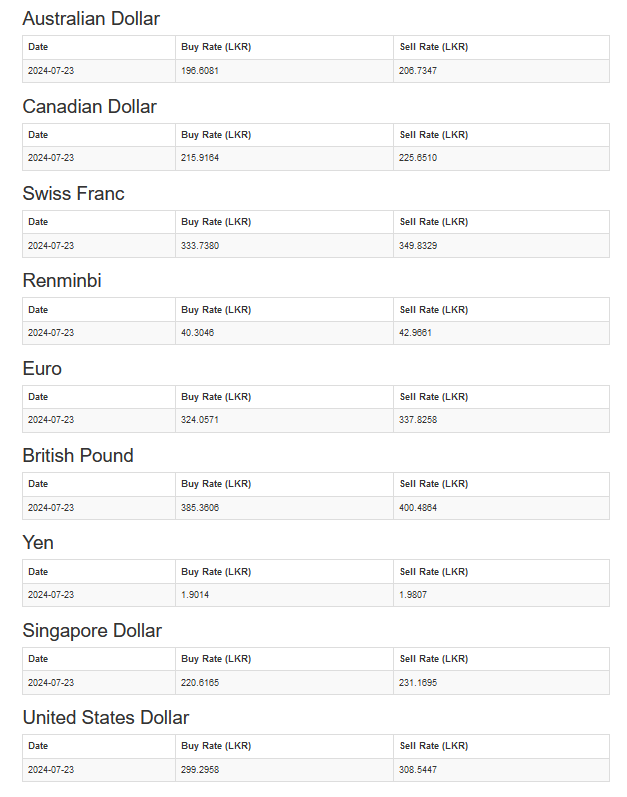
February 01, Colombo (LNW): The Sri Lankan Rupee indicates appreciation against the US Dollar today (01) in comparison to yesterday, as per the official exchange rates issued by the Central Bank of Sri Lanka.
Accordingly, the buying price of the US Dollar has dropped to Rs. 310.54 from Rs. 312.09, and the selling price to Rs. 320.40 from Rs. 321.85.
The Sri Lankan Rupee indicates similar pattern against several other foreign currencies as well.
February 01, Colombo (LNW): Litro Gas Lanka Ltd. has recently declared an impressive contribution of Rs. 3 billion in dividends to the Treasury through its primary shareholder, Sri Lanka Insurance Corporation. This consists of Rs. 1.5 billion made in October 2023 and another Rs. 1.5 billion paid on 26 January 2024.
Litro said this noteworthy gesture comes at a crucial time when Sri Lanka is actively seeking to boost state revenue to attain stability in the aftermath of a pandemic followed by an economic downturn.
Furthermore, Litro has demonstrated its commitment to national empowerment by also paying Rs. 2.6 billion in taxes and duties, solidifying its position as one of the few profitable state-owned enterprises.
Despite facing challenges, including a shortage of foreign reserves that affected its supply chain, Litro swiftly resolved the issues.
Litro Chairman Muditha Peiris said that the fiscal year 2023 has proven to be profitable for Litro, despite economic challenges and hardships.
“We are dedicated to ensuring that LPG remains affordable for our existing customer base while expanding our reach to the rural sector in the upcoming financial year,.” He added.
He highlighted the company’s focus on various aspects of safety, including educational initiatives to promote the importance of switching to LPG as a safer and healthier alternative.
Litro’s resilience and growth can be attributed to the strategic efforts of the management under the guidance of the Chairman who took over the company during a turbulent period.
The turnaround entailed ensuring a steady and uninterrupted supply of LPG to industries and households in turn ensuring convenience as well as safeguarding livelihoods across many key industrial segments.
As the largest stakeholder in the local LPG market, Litro managed to procure from the most technically qualified, competitive, and cost-effective suppliers to eliminate shortages promptly.
The selection of a supplier has been a key priority, focusing on their consistent capability to meet supply requirements and their commitment to offering a competitive price, thereby ensuring both reliability and cost-effectiveness.
Litro adopted a pricing mechanism aligning with global market rates to ensure that benefits from price fluctuations are reflected in the prices of its products. These pioneering efforts have empowered the industry as well as local enterprises and households dependent on LPG.
Especially in the past years, Litro has emerged as a success story for how State-Owned Enterprises can be steered to profitability while prioritising welfare.
The company serves as a blueprint for growth and recovery for SEOs dispelling the misconception that privatisation is the only solution. As Litro contributes significantly to the national treasury, it plays a crucial role in supporting the country’s economic recovery and stability.