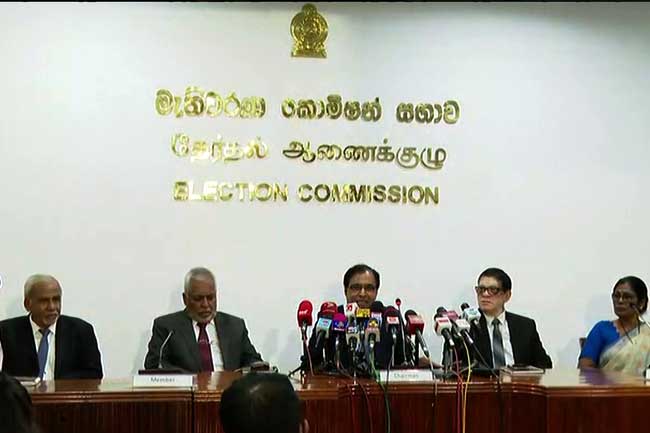
July 16, Colombo (LNW): The Election Commission has announced that the date for the presidential election will be disclosed before the conclusion of July.
Chairman of the Election Commission R.M.A.L. Ratnayake, made this announcement during a special briefing held this morning (16).
The determination of the election date is strictly in accordance with constitutional provisions and the President’s Act, dismissing any other considerations, Ratnayake emphasised.
He further outlined that the period for accepting nominations for the presidential poll will span between 16 to 21 days from the date of announcement, with the election itself scheduled to take place within 4 to 6 weeks from the closure of nominations.
The Central Bank (CB) Act states that the primary objective of the CB is the domestic price stability. However, the CB media states that it conducts the monetary policy to control inflation at a target of 5% over the unspecified medium. Inflation is the annual rate of increase in the Colombo Consumer Price Index (CPI) published monthly by the Census and Statistics Department.
The policy strategy is the policy rates-based money printing. Policy rates are the overnight standing deposit facility rate (SDFR) and overnight standing lending facility rate (SLFR).
Its aim is to keep the overnight inter-bank interest rates within the policy rates corridor.
The policy story is the confidence in overnight inter-bank interest rates to transmit the policy to country’s monetary conditions and aggregate demand suitably that would move inflation towards the target of 5%.
However, inflation dynamics and underlying market forces are too complex to be so linked to inter-bank interest rates as expected in the monetary policy.
Further, the CB does not provide credible research other than conventional policy story to prove the efficacy of its inflation control mandate and strategy.
Therefore, this short article sheds light on questionability of the monetary policy strategy in the background of policy manipulation effected through the government debt market. The reference period is the period beginning January 2022.
Data clearly show the vulnerability caused to public debt and cost through manipulation of interest rates bureaucratically for the monetary policy.
Government securities in monetary policy
Following charts show how inflation and Treasury bills market have behaved in the background of policy interest rates and grave economic uncertainties.
Observations made from Charts
Both monetary tightening and loosening so far during the reference period have been driven by Treasury bills market as determined at weekly auctions by the CB.
The visible hand is the CB’s direct purchases of Treasury bills outside weekly auctions. The historic increase by about Rs. 1,400 bn was reported in 2022 while such money printing was blamed for high inflationary pressures.
However, almost all amounts announced for auctions have been raised from auctions. Therefore, the market appears to have been liquid, given the contraction in real sector and investments.
Despite the fact that inflation has been closer to zero for the past four months, policy rates have been kept still high at 8.5%-9.5% unreasonably while allowing a faster fall of Treasury bill yields.
It is strange that Treasury bill yields fell to policy rates corridor for nine weeks until mid June. In contrast, Treasury bill yields have risen at last three auctions suddenly, despite no funding is required for CB Treasury bills holding now consequent to the domestic debt optimization completed in September 2023.
In the recent past too, the CB moved Treasury rates in such strange manners several times to be within the policy rates corridor and overshot from the corridor unreasonably (see the Chart blow). The private placement system was heavily used to drive Treasury bill yields for the monetary policy during the period 2007-2014 without any market forces.
Concerns
The CB frequently refers to market forces to explain movements of Treasury bill yields. However, the fact is the CB’s market manipulation to drive the monetary policy.
Policy rates have no basis for inflation control in the current macroeconomic context other than the old monetary faith.
Policy rates without involving in any risks on underlying credit operations have no economic basis to remain so high and irregular.
High inflation in 2022 and 2023 are direct results of political and market destabilization. Therefore, the policy tightening despite the debt and foreign currency crisis and historic economic contraction has no macroeconomic basis. Similarly, the disinflation is a direct result of seemingly stabilization of political and market conditions. Further, there is no empirical evidence that such a level of high inflationary pressures in a bankrupt economy would decline towards the zero bound so fast due to the tight monetary policy. Therefore, the drastic disinflation path is a temporary fix by bureaucratic means and not by macroeconomic/market fundamentals.
Money market trends as shown from above Charts do not reflect any market behaviors other than bureaucratic monetary policy interventions.
A significant factor behind public debt problem is the monetary policy that has resorted to public debt for money printing and interest rate control, especially, due to the CB being the debt manger for the past 73 years. High yields have been instrumental in the rising debt stock due to the issuance of new debt to pay interest as the tax revenue is limited. This impact is historically high in 2022 with yield rising to 33%. The foreign debt trap is the devise used to fund the monetary policy for external balance.
Therefore, it would be appropriate if an independent expert committee is appointed to investigate into how monetary policy has fueled debt problem. It is futile to singularly blame political leaders for the debt problem as they knew nothing on public debt and monetary management by the CB economic experts.
This article is released in the interest of participating in the professional dialogue to find out solutions to present economic crisis confronted by the general public consequent to the global Corona pandemic, subsequent economic disruptions and shocks both local and global and policy failures. All are personal views of the author based on his research in the subject of Economics which have no intension to personally or maliciously discredit characters of any individuals.)
P Samarasiri
Former Deputy Governor, Central Bank of Sri Lanka
(Former Director of Bank Supervision, Assistant Governor, Secretary to the Monetary Board and Compliance Officer of the Central Bank, Former Chairman of the Sri Lanka Accounting and Auditing Standards Board and Credit Information Bureau, Former Chairman and Vice Chairman of the Institute of Bankers of Sri Lanka, Former Member of the Securities and Exchange Commission and Insurance Regulatory Commission and the Author of 12 Economics and Banking Books and a large number of articles published.
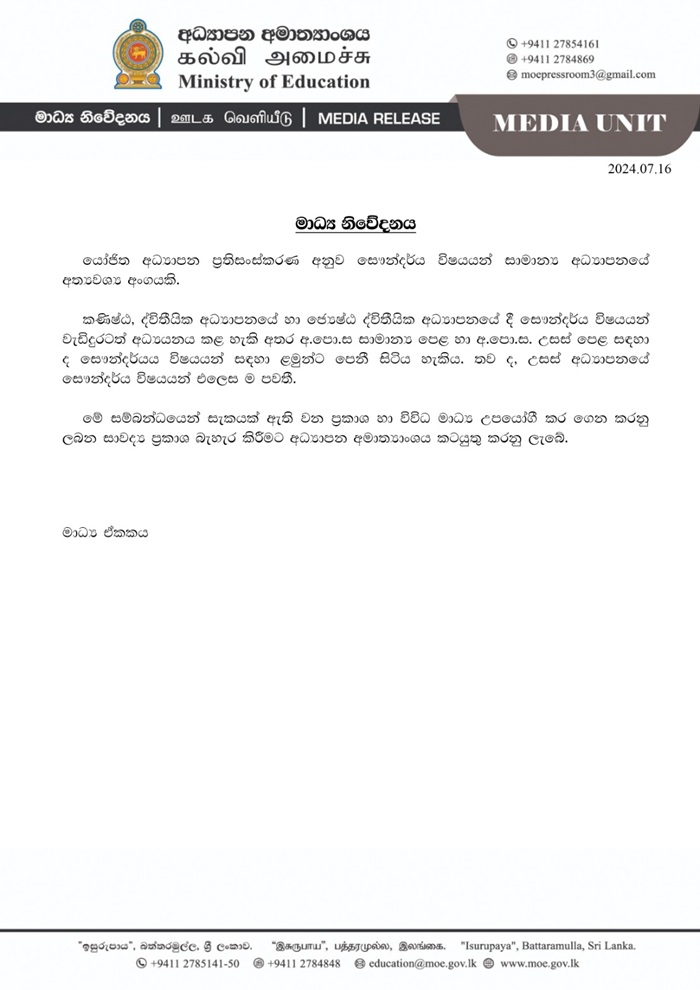
July 16, Colombo (LNW): The Ministry of Education has underscored the significance of aesthetic subjects in the proposed education reforms, stating that they are integral to general education across primary, secondary, and tertiary levels.
In a statement, the ministry clarified that students will have the opportunity to study aesthetic subjects and sit for examinations in these subjects at both the GCE Ordinary and GCE Advanced Levels in Sri Lanka.
Furthermore, the ministry emphasised that the curriculum for aesthetic subjects in higher education will remain unchanged.
Addressing misconceptions propagated through various media channels, the Ministry of Education affirmed its commitment to dispelling misinformation about aesthetic subjects.
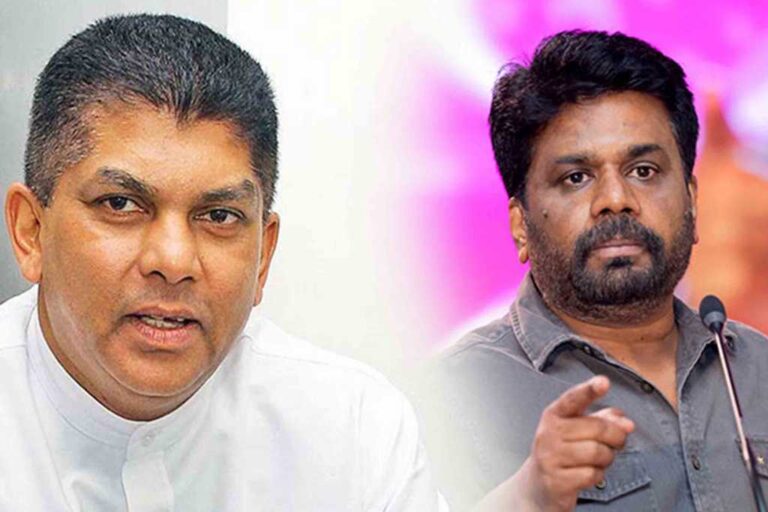
July 16, Colombo (LNW): State Minister Lohan Ratwatte’s recent comments regarding the candidacy of National Peoples Power (NPP) Leader MP Anura Kumara Dissanayake in the Presidential Election have drawn condemnation from Opposition MP Eran Wickramaratne.
During a rally in Kandy, State Minister Ratwatte stated, “Has Anura Dissanayake constructed even a small culvert for the people? We won’t allow him to become President of this country as long as I am around in politics.“
In response, Samagi Jana Balawegaya (SJB) MP Eran Wickramaratne criticised the statement, highlighting its dangerous implications given Sri Lanka’s history of election interference and violence.
While I disagree with the policies of NPP & believe that Sajith is the election frontrunner, no politician has the right to "allow" or "not allow" a candidate to be elected. Such statements have dangerous undertones considering SL's history of election interference and violence. https://t.co/5qlnPw5Wvk
“No politician has the right to ‘allow’ or ‘not allow’ a candidate to be elected,” MP Wickramaratne asserted in a statement. “While I disagree with the policies of NPP and believe that Sajith is the election frontrunner, such statements have dangerous undertones considering SL’s history of election interference and violence.”
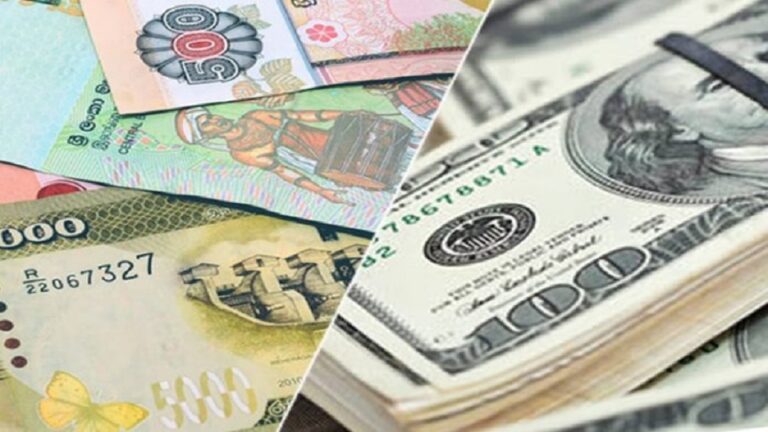
July 16, Colombo (LNW): The Sri Lankan Rupee (LKR) indicates depreciation against the US Dollar today (16) in comparison to yesterday, as per leading commercial banks in the country.
At Peoples Bank, the buying price of the US Dollar has increased to Rs. 296.80 from Rs. 295.91, and the selling price to Rs. 307.54 from Rs. 306.53.
At Commercial Bank, the buying price of the US Dollar has increased to Rs. 296.67 from Rs. 295.68, and the selling price to Rs. 306.50 from Rs. 305.50.
At Sampath Bank, the buying price of the US Dollar has increased to Rs. 298 from Rs. 297, and the selling price to Rs. 307 from Rs. 306.
President Ranil Wickremesinghe urges a political culture prioritising national interests over partisan politics for Sri Lanka’s advancement: emphasises the responsibility of political leaders to support economic initiatives free from political interference, citing recent strikes as politically motivated: calls for unity across political affiliations, drawing on historical examples of bipartisan cooperation for national progress and outlining goals for economic transformation and stability.
State Minister Lohan Ratwatte’s remarks on NPP Leader Anura Kumara Dissanayake’s presidential candidacy drew condemnation from Opposition MP Eran Wickramaratne: Ratwatte stated, “Has Anura Dissanayake constructed even a small culvert for the people? We won’t allow him to become President of this country as long as I am around in politics,” sparking criticism for undermining democratic principles: Wickramaratne emphasises no politician should dictate election outcomes, citing Sri Lanka’s history of electoral interference and violence: underscores the need for fair elections, regardless of political differences.
NPP leader Anura Kumara Dissanayake emphasises political protection of the underworld has fostered crime and drugs in Sri Lanka: pledges an NPP government would ensure equality under the law, aiming to create a peaceful environment free from fear: also highlights collaboration with senior ex-CID officials to combat crime and drug issues effectively.
Minister Vidura Wickramanayake announces plans for the repatriation of Sri Lankan artefacts, including the Tara statue, from the UK, highlighting cultural restoration efforts: underscores the importance of an education system aligned with local traditions to foster national pride: defends recent local government appointments, emphasising their procedural rigor over criticism of electoral motives.
Transport Minister Bandula Gunawardena announces the Sri Lanka Transport Board (SLTB) appointed 370 new drivers and conductors to fill vacancies in the Western Province: mandates new recruits remain at their assigned depots for three years, cautioning against union actions: stresses SLTB’s importance since nationalisation in 1957, warning of privatisation if profitability isn’t achieved by 2025.
Former CB Governor Dr. Indrajit Coomaraswamy criticises Sri Lanka’s Debt Sustainability Analysis (DSA) for using a conservative growth rate, urging for a higher trajectory supported by reopened credit lines: highlights recent debt restructuring progress and praised Sri Lanka’s negotiation skills with bondholders: Emphasises macroeconomic stability and structural reforms and suggests these are key to surpassing a 3% growth rate and achieving fiscal health targets.
A Starlink representative visits Sri Lanka to finalise a licence for the satellite internet service: Discussions with local authorities, including the Telecommunications Regulatory Commission, were positive: The visit follows recent legislative amendments enabling such operations: Despite delays, Starlink aims to commence operations soon after receiving final approval, expected within two weeks.
The Cabinet sanctions a one-time payment of Rs. 10,000 to all government employees below Executive Grade who reported for duty during the recent strike: The proposal, presented by President Ranil Wickremesinghe, also includes granting these government sector employees a certificate of appreciation.
The Railway Station Masters’ Union plans to decide today (16) on future trade union actions following unmet demands despite previous assurances from authorities: Union President Sumedha Somaratne expresses dissatisfaction with the Cabinet’s failure to address their issues as promised, prompting the union to convene this morning for a decision: Meanwhile, the Ceylon Teachers’ Union (CTU) warns of potential strikes over unresolved grievances, citing government threats to deter their actions.
Madushani Herath of Nannapurawa MV Bibile sets a new long jump record at 6.32m in the girls under 20 category during the Junior National Athletic Championships at Diyagama Mahinda Rajapaksa Stadium: surpasses her own previous record of 6.06m set last year at the same venue: Additionally, Sashini Perera of St. Bridget’s Convent Colombo achieved a new meet record of 30.42m in the under 16 Hammer Throw.
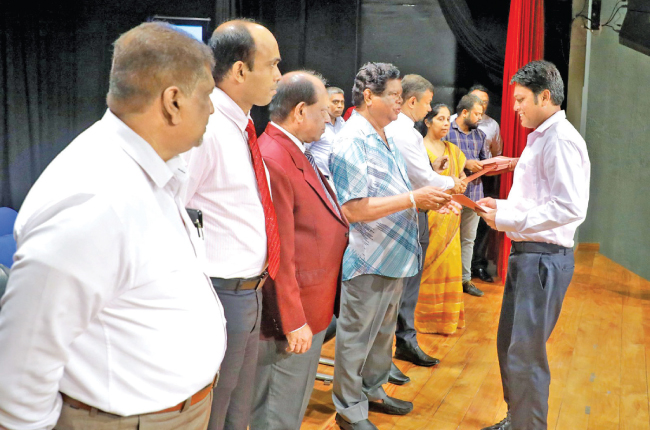
July 16, Colombo (LNW): The Sri Lanka Transport Board (SLTB) has recently appointed 370 new drivers and conductors, with the ceremony held under the patronage of Transport, Highways and Mass Media Minister, Dr Bandula Gunawardhana, at the Sri Sambuddhathwa Jayanthi Mandiraya Auditorium in Colombo.
These new recruits are set to fill vacancies left by drivers and conductors in the Western Province who have requested transfers after more than a decade of service.
Minister Gunawardhana stressed that these new employees must remain at their assigned depots for three years, with no changes allowed due to political pressure.
“Many in our country have relied on SLTB buses for commuting to school and work. Since the late Prime Minister SWRD Bandaranaike nationalised the bus services in 1957, the SLTB has provided invaluable service to the public. Drivers and conductors carry the responsibility for passenger safety and must perform their duties with integrity to minimise accidents,” said the Minister.
He also urged the new recruits to avoid trade union actions that inconvenience commuters, highlighting that issues can be resolved through dialogue with depot heads, provincial leaders, the Chairman, Ministry Secretary, or the Minister himself.
Gunawardhana pointed out that all loss-making government institutions, including the SLTB, are funded by taxpayer money. Despite being a semi-government entity, the SLTB has been included in the Rs.10,000 monthly allowance given to public servants, resulting in an additional monthly expenditure of Rs.275 million.
He noted that fraudulent activities by some employees exacerbate financial losses, threatening the institution’s viability.
“All SLTB employees must ensure all earnings are properly accounted for, avoiding any theft or corruption. Efficient work can lead to profitability, allowing profits to be shared among staff and facilitating career advancements based on merit. If we fail to make a profit by 2025, international agreements may force us to privatise or close the SLTB, which would be detrimental to both the institution and the country,” the Minister warned.
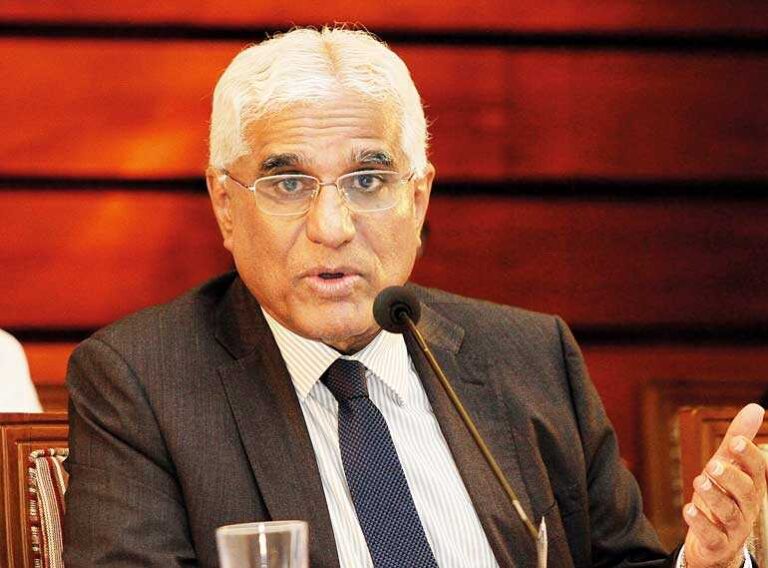
July 16, Colombo (LNW): Dr. Indrajit Coomaraswamy, former Central Bank Governor, expressed concerns over the Debt Sustainability Analysis (DSA) for using a conservative growth rate for Sri Lanka’s economy.
He argued that this conservative projection, alongside the reopening of credit lines to the government, should facilitate a higher growth trajectory.
Speaking at a virtual investor event on 9th July, hosted by CT CLSA and titled “Unlocking Potential: Sri Lanka’s Shift from Stability to Growth,” Dr. Coomaraswamy remarked, “If we maintain macroeconomic stability and implement structural reforms, coupled with the economic momentum in India, we can exceed a 3% growth rate.”
Sri Lanka has progressed significantly in its debt restructuring efforts, with recent agreements reached with International Sovereign Bond (ISB) holders and bilateral creditors.
Dr. Coomaraswamy praised the Sri Lankan authorities for their skilful negotiations, which have advanced the country towards completing its external debt restructuring.
He highlighted that bondholders had made concessions beyond their initial demands, reflecting the effective negotiation skills of Sri Lankan officials.
Emphasising the need for macroeconomic stability, structural reforms, and capitalising on opportunities from neighbouring India, Dr. Coomaraswamy stated that these elements are crucial for surpassing the 3% growth rate.
He noted that while the agreement with bondholders and other creditors aligns with the DSA targets set by the International Monetary Fund (IMF), it is imperative to exceed these targets to ensure sustainable growth.
A key aspect of Sri Lanka’s economic strategy is achieving a primary surplus target of 2.3% next year. Dr. Coomaraswamy underlined the importance of meeting this target to avoid another round of debt restructuring.
He pointed out that enhancing tax revenue through improved administration and the removal of tax concessions could significantly bolster the country’s fiscal health.
The objective is to elevate the tax revenue to GDP ratio beyond 15%, providing the financial stability needed to support growth initiatives.
Gregory Smith, World Bank Lead Economist and Program Leader for Sri Lanka, Nepal, and Maldives, noted the political infeasibility of fiscal contraction.
Smith commented, “In Sri Lanka, you have 14% of GDP as revenue, and if you take out 7% as interest costs, you are left with 7% of GDP for public services. That’s just a recipe for protests and is not politically feasible.”
Sri Lanka possesses unutilised credit lines and robust bilateral ties that can be leveraged to maintain infrastructure investments at optimal levels.
While lending has been paused due to the ongoing debt restructuring, major lenders have not indicated any reluctance to restart or implement projects.
July 16, Colombo (LNW): A representative from Starlink, the satellite internet venture founded by billionaire Elon Musk, visited Sri Lanka this week and is expected to return next week to finalise the necessary licence for operations in the country, a report by Daily Mirror disclosed.
The Starlink representative, based in New Delhi, conducted initial discussions with relevant authorities, including the Director General of the Telecommunications Regulatory Commission of Sri Lanka (TRCSL), President’s Senior Advisor Ruwan Wijewardene told Daily Mirror.
“The initial talks were successful, and it is anticipated that everything will be finalised within a two-week period,” said Mr. Wijewardene.
Parliament recently passed an amendment to the telecom regulatory law, enabling Starlink to secure a licence to operate in Sri Lanka.
Despite applying for a licence in March 2024, Starlink had encountered delays due to the absence of a legal framework accommodating independent service providers.
The TRCSL had previously granted preliminary approval for Starlink to offer satellite-based internet services in Sri Lanka.
July 16, Colombo (LNW): Minister of Buddhasasana, Religious, and Cultural Affairs, Vidura Wickramanayake, has announced that numerous artefacts taken from Sri Lanka by the United Kingdom during the colonial era, including the statue of Tara, will be repatriated.
Speaking at a press conference titled “Collective Path to a Stable Country” at the Presidential Media Centre on the 15th, the minister stressed the need for an education system that resonates with the country’s culture, fostering national pride among citizens.
Minister Wickramanayake emphasised the role of his ministry in shaping responsible and patriotic citizens, noting that the perceived economic crisis is not the sole issue facing the nation.
He highlighted the importance of addressing the cultural disconnection caused by an education system misaligned with local traditions, which has contributed to a lack of national pride and a risk of subjugation.
The minister also mentioned the recent appointments of over a thousand long-serving local government employees, addressing a longstanding need despite criticisms of it being an election strategy.
He clarified that the process involved over ten cabinet papers and has been ongoing for more than five months.
Full Statement:
“The majority of the community believes there is an economic problem in the country today. However, our ministry holds the responsibility of shaping the people of Sri Lanka into good citizens. Our ministry has the official mandate to work towards creating a better society.
Additionally, the country lacks an education system that aligns with our cultural needs, which has led to a societal crisis. This situation has resulted in the emergence of a group of people who lack love for their country and pride in their heritage, putting the nation at risk of becoming subjugated. Therefore, our ministry has implemented several programs to prevent this outcome and save the people.
Additionally, more than a thousand individuals who have served in local government institutions for many years received appointments today. This has been a longstanding need. Some critics claim this is an election tactic, but over ten cabinet papers were presented for their confirmation, indicating that efforts have been underway for more than five months.
Furthermore, many antiquities taken from our country by the United Kingdom, including the statue of Tara, are in the process of being repatriated. We are working to bring back these and other ancient treasures, and we have also received numerous similar items from the Netherlands.
Moreover, there are people in our country who constantly divide into opposing parties and accuse each other. What we need are individuals who recognise right from wrong and are dedicated to the betterment of the country and its people”.