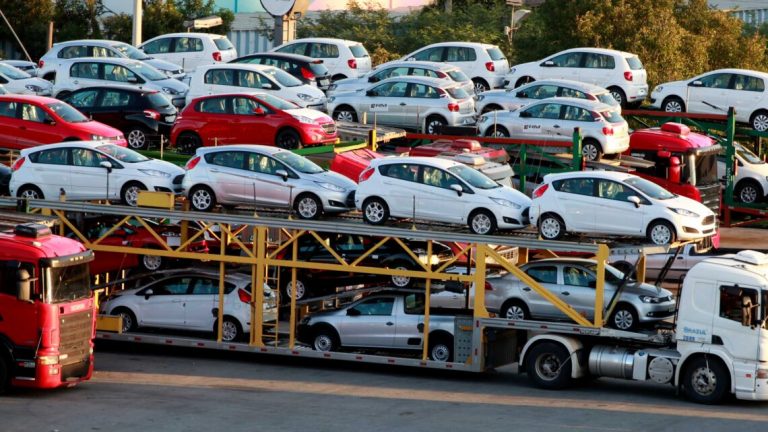
Colombo (LNW): The ongoing construction of the East Container Terminal (ECT) at the Colombo Port is set to be completed by mid-next year, marking the commencement of operations.
The Ministry overseeing the project has announced that upon completion, the terminal’s jetty will span 1,400 meters, accommodating the simultaneous berthing of three mega ships.
During a special inspection visit to the construction site, Nimal Siripala de Silva, the Minister of Ports, Shipping, and Aviation, disclosed that a total of USD 585 million has been allocated for the terminal’s development, facilitated by financial provisions from the Sri Lanka Ports Authority (SLPA). The construction is being undertaken by China Engineering and Access Engineering.
The ECT is designed to feature 12 gantry cranes and 40 transfer cranes, with an estimated container yard area of 75 hectares. It is anticipated to handle 3 million containers annually and will operate as a semi-automated terminal, incorporating digital technology.
There is potential for the Colombo Port to be recognised as one of the primary ports in Asia, Silva emphasised, advocating for the implementation of a strategic process to position Colombo as the hub port of Asia, attracting more ships and solidifying its status as a key maritime destination.
Colombo (LNW): Dr. Dedunu Dias has been appointed as the acting Director of the Medical Supplies Division of the Health Ministry, while Dr. Sudath Darmarathna has been appointed as the Deputy Director General.
Colombo (LNW): President Ranil Wickremesinghe engaged in a significant meeting with billionaire philanthropist Bill Gates on the sidelines of the COP28 summit held in Dubai.
The conversation delved into crucial aspects of agriculture modernisation and food security, where the President shared insights into Sri Lanka’s proactive green initiatives.
During their discussion, President Wickremesinghe and Bill Gates explored avenues for enhancing agricultural practices through modernisation, acknowledging the pivotal role that technology and innovation can play in bolstering food security.
The President provided an overview of Sri Lanka’s ongoing efforts to adopt sustainable and environmentally friendly practices within the agricultural sector.
The meeting highlighted the mutual commitment of both parties towards addressing global challenges related to food production, climate change, and sustainable development.
Bill Gates, known for his philanthropic endeavours, expressed interest in collaborating with Sri Lanka on initiatives that align with his foundation’s goals, promoting agricultural sustainability and addressing issues related to hunger and malnutrition.
The exchange of ideas and collaboration between President Wickremesinghe and Bill Gates underscores the importance of international cooperation in tackling pressing global issues.
The insights shared during this meeting are expected to contribute to Sri Lanka’s continued efforts in promoting sustainable agriculture and ensuring food security for its population.
Colombo (LNW): Former President of Sri Lanka Rugby Rizly Illyas has issued a public letter claiming that it would be a misuse of the power granted to lawmakers by the citizens to unfairly make accusations against those who are outside Parliament under the guise of parliamentary privileges, recalling the recent sentiments made by ex Sports Minister Roshan Ranasinghe.
Former Sports Minister Roshan Ranasinghe, who was recently removed from the position by the President, sought to clarify in his departing statement that the decision to internationally ban Rugby was not his own but had been made by his predecessor, Namal Rajapaksa.
The ex Minister also alleged that the irregularities of the former Rugby President Illyas had influenced Rajapaksa to take such decision.
Full Letter:
I vehemently denounce Roshan Ranasinghe’s claim that he did not prohibit the game of rugby in Sri Lanka. His assertion, attributing decisions to irregularities under the guise of parliamentary privileges, and exploiting the privilege bestowed upon him as a public representative to tarnish my reputation as an innocent individual devoid of such privileges, is a reprehensible act.
It is noteworthy to remember that Roshan Ranasinghe was actively pursuing a court injunction against Minister Namal Rajapaksa regarding the prohibition of Sri Lanka Rugby when he assumed the role in the Sports Ministry. I would also like to recall that the imposition of the ban was prompted by an issue related to the membership of two sports Clubs. In this context, when Minister Namal Rajapakse enforced the ban on Sri Lanka Rugby, the Secretary of the Sports Ministry presented the facts pertaining to the decisions made by the Rugby Executive Council on this matter. Sri Lanka Rugby also possesses evidence, that the Ministry has those letters.
But to the extent that it is doubtful whether it is for the purpose of fulfilling a wish of the Minister, the Ministry Secretary and the Director General of Sports continued to write letters regarding the same matter and advocated the need of Minister’s banning. However, in pursuit of justice and innocence, we sought the assistance of the honorable court and continued to work on its recommendations.
Under the tenure of Minister Roshan Ranasinghe, the court granted permission to conduct a new election for the same administration that had imposed the ban on Minister Namal Rajapaksa. Furthermore, the Minister also made a request to convene that were banned clubs during the tenure of Minister Namal Rajapakse and he instructed them accordingly and facilitated the transmission of information to the ministry with the aim of lifting the ban.
It was during the reign of Minister Roshan Ranasinghe that a restraining order was issued against the administration appointed for the second time, leading to the closure and lockdown of the administration building. Before the imposition of the ban, a new stabilization committee was appointed after providing the information as directed by the court for immediate notification and subsequent enforcement of the ban.
The decision of the Sri Lanka Rugby team, slated to participate in the Asian Games, faced delays due to a technical error in the court’s decision regarding the removal of the committee. In that instance, no official request for the tournament was reported to the court on behalf of the minister, and the stabilization committee appointed by the minister exerted pressure to postpone the decision by presenting various issues. Also, Roshan Ranasinghe, the former minister in the cricket issue, raised parliamentary privileges and blamed the same judge who identified the technology problem and delayed providing the necessary solution, but remained silent when the decision was implemented according to his wishes.
Also, another issue that needs attention is that a petition was submitted with several members of the Stabilization Committee appointed by the Minister against the way the official Rugby administration that came to power after conducting the election based on a court order was appointed. There, an investigation related to the ministry did not accept those allegations. The presence of a part of that group in the minister’s stabilization committee shows that the minister and others want to use the political power of the rugby clubs to administer rugby locally.
Some important points should be mentioned here. When Minister Roshan Ranasinghe, Minister Namal Rajapaksa, it was possible to asked from Lasitha Gunaratne, who was a member of the Minister’s National Sports Council, about the factors that led to the banning of official elections to the relevant sports clubs. Because the reasons that led to the banning of those sports clubs were formed during the time when Lasith held the position of president, Lasitha should have said where it was compatible and incompatible according to the international rugby law as well as under the Sri Lanka Rugby Constitution and the distant forms between the sports law and the common law of the country.
Lasitha plays a pivotal role in creating points of contention between the President of Asia Rugby and Sri Lanka Rugby. Lasitha, who promised to help the current Asia President during his election, Lasitha did not cast his vote in favor of the president during the election in Sri Lanka.
In response to this, the displeased Asia President communicated his objection regarding Sri Lanka to Harin Fernando, who was the sports minister at that time. Hence, I assumed the role of President with the objection from the Asia President regarding Sri Lanka.
Even so, the Asia President is trying to use Asanga Senaviratne, a former Sri Lankan President who is still with the Asia President to lead the rugby administration, based on the friendship between Minister Namal Rajapaksa and Asanga. Sri Lanka Rugby is currently facing a fine of £50,000 that remains unpaid, stemming from the employment of foreign players in the Sri Lanka Rugby team during Asanga Senaviratne’s presidency. It is proposed to Sri Lanka Rugby to appoint him, the Asia President, and the Minister of Sports together as an advisory council and accept him as its head. The Director General of Sports has also written that the committee will be formed based on the advice of the Asia President and the Minister.
There are several reasons why Sri Lankan Rugby may not be wanted this. Sri Lanka Rugby knows that they are weak in management due to the fact that Sri Lanka Rugby was fined and subjected to a debt of nearly 60 million during the tenure of both him and Lasitha Gunaratne, who was then a member of the Minister’s National Sports Council.
I assume the position as President with such a huge amount of debt. The executive council, inclusive of myself decided to sell the broadcast of the sponsored matches separately (in a way that earns Sri Lanka Cricket income). During the discussions, the sponsors were wasting their time without giving a correct answer, Minister Namal Rajapakse assigned the head of his sponsorship committee to a head of that company and used that company with Asanga Senaviratne to sponsor the Asia Rugby. None of these things should have been done by the Asia President internationally. As a member of the Asia Executive Committee, I personally blame him for the damage done to the personality and independence of Sri Lanka Rugby in these matters. To be honest, I scolded.
This did not happen in the presence of any official of Asia Rugby. In person. In that situation, I articulated certain expressions commonly used within rugby culture. However, he, being a non-player unfamiliar with the nuances of rugby culture, interpreted them as inappropriate words. This is due to his lack of practical knowledge in rugby. Similarly, Roshan Ranasinghe, who assumed the ministerial post after Namal Rajapaksa, lacks knowledge in any sport, and as a result, he places great emphasis on this matter.
When the minister met me personally, he requested me to step aside, because the Asia President’s dislike. When the world rugby was investigating the Asia President’s decision to ban me, a move that jeopardized the independent existence of a sport in the country, Minister Roshan Ranasinghe aligned himself with the Asia President, labeling me a traitor on behalf of the Asia President.
Not only did the National Olympic Committee of Sri Lanka, but also the Olympic Council of Asia, under the influence of the Asia President and apprised of the sport’s qualities, exert pressure on Sri Lanka to participate in the Asian Games under the flag of the Olympic Council of Asia and when informing the Asia Rugby of their limits when they come to exceed the limits of the tournament that the Olympic Committee has the authority to, the Stabilization Committee which was established was running around in the court reducing the time for the Sri Lanka team to receive training.
In the end, the country of the Asia Rugby President witnessed a promotion from the 12th place in the previous Asian Games to the 5th place in the tournament. Unfortunately, Sri Lanka, which aspired to secure a medal after climbing one rank from the 4th place, experienced a setback, concluding the competition in the 10th place. Amidst all these events, I requested the minister to initiate an investigation into the reasons behind the conflict between the Asia President and myself. But the minister did not do that.
Instead of the minister’s opting to conduct the investigation, he chose to seek advice from appointees within the administration who were involved in the sport but had experienced a decline in popularity. They attempted to conceal their incapacity to secure power through sports elections and instead utilized political influence to attain authority.
It is problematic that the minister who took advice from the person who created the opposition to Sri Lanka of the Asia President, the International Olympic Committee, not only the Olympic Council of Asia, but is not as flexible as the World Rugby, and behaves like a pet of the Asia President. He did not strive to uphold the lion flag, he carried a camel flag. Even though I am a person who believes in Islam, when the ministers were pulling my leg t to bring the country’s sports to the top, along with the work done by reducing the association’s debt and finding new sponsors, the short-sighted rugby supporters who were close to the sports minister, deprived me of the opportunity to go to an Asian medal.
The minister consistently prioritized giving a place in politics to the power projects of people who could not get power from the love of people in sports. Hence, the minister’s opposition to the ICC appears must be a similar personal project.
In a situation where the International Olympic Organizations and the Rugby Federation above it do not agree with the Asia President, due to the decisions taken in agreement with the Asia President, even when the World Rugby was going to ban Sri Lankan Rugby due to political pressure, the Sports Minister who did not have the strength to stand up for Sri Lanka Rugby in front of the Asia President, honestly It is difficult to imagine that the country’s cricket will clash with the ICC.
Making mistakes is a valuable aspect of learning. But in order to learn that one should not be a person who is ignorant and handles that ignorance in an arrogant way. The Sports Minister should realize this. Using his parliamentary privileges, he claimed that Minister Namal Rajapaksa banned rugby due to my irregularities.
I would like to challenge the Sports Minister Roshan Ranasinghe to point me the irregularity I have done for the independence and pride of Sri Lanka Rugby, apart from standing up to the pressure of the Asia President. (I am currently seeking legal advice to determine the feasibility of pursuing legal action against the defamation of my personal character without just cause, citing parliamentary privilege in relation to that statement)
To the former Minister Roshan Ranasinghe, I want you to comprehend that you aligned yourself with the Asia President by fell into his lap, causing harm to Sri Lanka Rugby. Your actions inadvertently or knowingly assisted in elevating his country to the top in the Asian Games and bring down Sri Lanka Rugby.
Allow me to remind you of this. You have persistently associated with individuals who lack popularity within the sports administration, exerting influence over sports clubs and federations that have legitimately come into power, thereby undermining the integrity of their respective sports. The individuals you kept close elevated you to the empty sky for their own purposes. It reflected your own intelligence and the arrogant demeanor you exhibited in relation to power.
High Commissioner of India to Sri Lanka, H.E Gopal Baglay undertook a three-day visit to Northern Province from 29 November to 1 December 2023. He was accompanied by senior diplomats of the High Commission.
2. Attesting to the significance of developing railway infrastructure under India-Sri Lanka development cooperation partnership for the benefit of the people of Sri Lanka, the delegation undertook a journey by Sri Lankan Railways from Colombo to Medawachiya in modern coaches supplied under an Indian credit line. The train journey also provided an opportunity to experience the riding comfort offered by the upgraded railway line from Anuradhapura. The upgradation work is undertaken by reputed Indian public sector company IRCON, under an ongoing Indian line of credit for upgradation of Maho-Omanthai segment.
3. The delegation visited Thalaimannar and Kankesanthurai passenger facility on 29 December in pursuance of the ongoing efforts for enhanced connectivity through ferry services between mutually agreed points in India and Sri Lanka. It may be recalled that connectivity is the central theme of the economic partnership vision expounded jointly by Prime Minister of India Shri Narendra Modi and H.E Ranil Wickremesinghe, the President of Sri Lanka during the latter’s visit to India in July 2023. Expeditious resumption of regular ferry services is at the focus of attention of the Governments of India and Sri Lanka, who are working closely together in this regard.
4. The High Commissioner visited three islands off Jaffna, namely Nainativu, Analaitivu and Delft, on 30 December to assess the preparedness for implementing the Hybrid Renewable Energy Systems project. Government of India have committed to support this project with grant in order to address the energy needs of the inhabitants of these islands.
5. Responding to diverse requirements of various sections of the society, High Commissioner inaugurated a programme to donate 1000 school bags to students across Mannar District at Murunkan Maha Vidyalayam on 29 December in presence of Hon. Minister of State for Rural Economy, K. Kader Masthan. HC also launched a special financial assistance scheme for under privileged students in University of Jaffna on 1 December. In addition, he distributed dry rations to more than 500 families, in Jaffna and Delft Island. Deep freezers were donated to 15 fishermen cooperatives for the use of fishermen in Jaffna region. Interacting with representatives of the cooperatives at Pasaiyoor, the High Commissioner stressed that India is striving to bring benefits of scientific research and expertise for commercially sustainable development of fisheries in Sri Lanka, including in the Northern Province so that the benefits can directly reach the fishermen and the common people.
6. At the Indian Peace Keeping Forces memorial in Jaffna, the High Commissioner paid homage on 1 December to the brave sons of India who made the supreme sacrifice in Sri Lanka.
7. This was the High Commissioner’s last of several visits to Jaffna during his assignment to Sri Lanka and underscored India’s abiding commitment to the development and well-being of the people of Sri Lanka, including in the Northern Province, through enhanced development cooperation and expanded economic partnership in accordance with the priorities and the requirements of the people of the region.
Colombo (LNW): Sri Lanka’s Aswesuma’ social welfare program for the vulnerable community has taken a paradigm shift from the earlier model, a high World Bank official claimed.
He underscored the need for timely recertification and implementation of grievance mechanisms for successful program integration.
World Bank Country Director Faris Hadad-Zervos this week described the ‘Aswesuma’ social welfare program as an evolutionary initiative designed to support the poor and vulnerable amid the current economic crisis.
Speaking at the Ceylon Chamber of Commerce ‘Sri Lanka Economic Summit 2023’ he highlighted the Government-led program, with World Bank technical assistance, aims to minimise political interference and ensure a people-centric approach, distinguishing it from its predecessors.
The Country Director acknowledged that while Aswesuma might require some adjustments, it represents a significant improvement over previous initiatives.
He emphasised the program’s departure from the earlier model, stating, “Key features of the Aswesuma initiative include the direct transfer of benefits to beneficiaries’ bank accounts, increasing financial inclusion and minimising opportunities for political elites to exploit the system.
“Previous initiative consisted of 12% of the highest income earners benefiting from the Government’s social welfare benefit program.
But now only the deserving will receive it and allow new entrants as the existing groups eventually graduate from the vulnerable status,” he added.
Hadad-Zervos stressed the importance of timely recertification and the implementation of grievance mechanisms by authorities to ensure the program’s successful integration.
“The program should remain dynamic, inclusive, effective, and transparent,” he stressed, underlining the need for ongoing adaptability to changing circumstances.
This commitment aligns with the World Bank’s vision for a welfare program that serves the intended recipients – the poor and vulnerable.
Providing insights into the financial support extended by the World Bank in 2023, Hadad-Zervos revealed a total disbursement of $ 850 million based on achieved milestones. It includes US $ 500 million for budgetary support, $ 200 million for social protection programs and $ 150 million allocated for a financial sector safety program.
Colombo (LNW): USAID and the PUCSL have partnered together to enhance transparency with the development of an Electricity Dispatch Database and Dashboard for Sri Lanka.
The United States Agency for International Development (USAID) in collaboration with the Public Utilities Commission of Sri Lanka (PUCSL) launched the Electricity Dispatch Database and Dashboard.
USAID said in a statement the online platform will enhance transparency in the management of Sri Lanka’s power distribution through a visualization platform.
Developed and funded by USAID’s Sri Lanka Energy Program, the Dispatch Data Dashboard is a comprehensive tool that allows stakeholders to access and visualize data relevant to electricity generation, forecasts, costs, reservoir details, and emissions, providing insights into the energy sector’s intricate operational dynamics.
Colombo (LNW): Some 938 metric tons of plastic are generated in Sri Lanka every day, the Sectoral Oversight Committee on Environment, Natural Resources and Sustainable Development revealed recently
An estimated 1.59 million tonnes of plastic waste is mismanaged in Sri Lanka, the United Nations Development Programme (UNDP) in Sri Lanka said.
Sri Lanka imports over 500,000 MT of virgin plastic annually, straining the country’s waste management systems.
An estimated 1.59 million tonnes of plastic waste are mismanaged. About half of this amount ends up in canals, rivers, and eventually the ocean, endangering marine ecosystems.
With an average 0.4-1 kg daily per capita waste generation, Sri Lanka produces 10,786 tonnes of waste per day.
According to the Waste Management Division of the Central Environmental Authority, only about half of that gets collected as municipal waste.
Overall, 85% of waste generated is estimated to be disposed inappropriately, mainly through indiscriminate open dumping and burning, giving rise to health and environmental impacts.
The Sectoral Oversight Committee on Environment, Natural Resources and Sustainable Development revealed recently that only 32 percent of the generated amount is collected and only 4 percent of the collected plastic is mechanically recycled.
The officials pointed out that even if the rest is collected, it is being disposed of informally in the environment.
It was also revealed that industrialists have been allowed to import secondary plastic without any regulations and therefore, the Sectoral Oversight Committee instructed the Central Environment Authority to issue licenses only according to the needs of the industry in the future.
The officials revealed that Sri Lanka annually imports 4 lakh metric tons of plastic raw materials and 20,000 metric tons of waste plastic is also allowed to be imported.
Although 20,000 metric tons of waste plastic was approved to be imported last year, it was revealed that only 5,179 metric tons of waste plastic was imported for the Sri Lankan industries.
Therefore, the chairman of the committee advised the authorities to consider the need of the industry and give permission accordingly and to create a system for collecting the plastic brought in within a specific period of 5 years.
Officials told the committee that many people are not interested in collecting plastic for recycling due to the high cost.
However, the chairman mentioned that this amount can be increased by increasing the incentives for plastic collection. Moreover, he also emphasized the need to establish special centers in all parts of the island for plastic collection.
Colombo (LNW): 103 year old Sri Lanka Excise Department will be modernised to enhance revenue collection by installing digital information system while improving efficiency of employees curtailing irregularities and tax evasion by large scale liquor manufacturers,
The monthly income of the Excise Department has increased by Rs. 1 billion after checking fake stickers on liquor bottles, a Parliamentary committee revealed.
This was revealed by the officials of the Excise Department to the Sectoral Oversight Committee on National Economic and Physical Plans.
The Excise Department, Inland Revenue Department and Sri Lanka Customs were summoned before the committee to discuss the matters mentioned in the report given to the President by the Sectoral Oversight Committee on National Economic and Physical Plans.
The committee inquired about the amendment of the Excise Ordinance Act. The committee also pointed out the need to maintain the revenue that the Excise Department has increased so far and the continuation of random raids will further reduce the fixing of fake stickers on liquor bottles.
The officials present before the committee mentioned that the RAMIS system will be made functional by January 2024 by avoiding the existing deficiencies.
The Inland Revenue Department said that the number of tax files is currently around 7 lakhs and it is expected to increase up to 10 lakhs in the future.
Apart from this, the committee also advised the officials to focus on preparing a system for evaluating the parties who pay income tax correctly.
The department has functioned without a computer-based Information System and details of the productions in several liquor manufacturing plants cannot be traced due to manual back office record system, parliamentary sectoral committee committee report revealed recently.
This has led to the tax evasion of. up to Rs.6.2 billion by nine leading liquor manufacturing companies making impossible for the department to collect the 2023 revenue target of Rs 207 billion , official data shows.
The Excise Department has collected Rs. 99 billion during the first eight months of this year, less than 47 per cent of the estimated revenue of Rs. 217 billion.
Finance ministry will take necessary action to devise necessary amendments to the Excise Ordinance with provisions to cancel the licenses of the manufacturers who evade paying taxes.
Measures will be taken to cancel the liquor license of the liquor shops selling alcohol without the sticker.
The department has been directed to collect data and check the quantity of liquor supplied to the liquor factories and the quantity of bottles distributed from the factories preventing any irregularities and malpractices.
It has been observed several manufacturers including a leading liquor company DCSL which has 50 percent market share of the total liquor consumption has not adhered to the directive of pasting stickers on liquor bottles.
The department has already ordered the company to paste stickers on all liquor bottles manufactured by them.