Home Blog Page 1157

SL expatriates remitted US$ 7.5 bn enabling FEB to contribute Rs. 7 bn to Treasury

0

By: Staff Writer

Colombo (LNW): Sri Lankans working overseas have remitted US$7.5 billion in 18 months enabling Foreign Employment Bureau to contribute Rs 7 billion to the treasury strengthening its cash flow.

To enhance the inflow of foreign remittances into Sri Lanka, Labour and Foreign Employment Minister highlighted challenges associated with the professional guidance activities conducted under the smart club program of Expatriate Workers’ Associations.

Minister Nanayakkara, citing a notable achievement of receiving US$ 7.5 billion in remittances over the past 18 months, updated the President on initiatives such as the introduction of a pension system for expatriate workers and the establishment of a dedicated terminal for departing workers at the airport.

President Ranil Wickremesinghe underscored the pivotal role of expatriate workers’ remittances as a primary source of foreign exchange for Sri Lanka.

He commended the Ministry, led by Minister Manusha Nanayakkara, for its proactive program and applauded the efforts in reforming labour laws through the introduction of the new Employment Security Act

The Sri Lanka Foreign Employment Bureau (SLFEB) has contributed a total of Rs.7 billion to the Treasury this year, with the formal presentation of a Rs.4 billion cheque presented to President Ranil Wickremesinghe by Minister of Labour and Foreign Employment, Manusha Nanayakkara ,yesterday afternoon (29) at the Presidential Secretariat.

In light of the prevailing economic conditions in the country, this substantial amount has been allocated from the operating surplus received by the Foreign Employment Bureau.

The funds are earmarked for crucial activities, including the procurement of essential medicines and the disbursement of government employee salaries.

A significant portion of the Rs.7 billion, specifically Rs.33 million had been handed over directly to the President earlier this year.

Concurrently, an additional allocation of Rs.100 million was designated for Apeksha Hospital Maharagama for medicine procurement.

The Foreign Employment Bureau has, on various occasions, contributed a substantial amount of Rs.3,382 million to the Treasury.

But notably, this Rs.7 billion contribution stands as a remarkable milestone, representing the Bureau’s highest annual contribution within a single year to date.

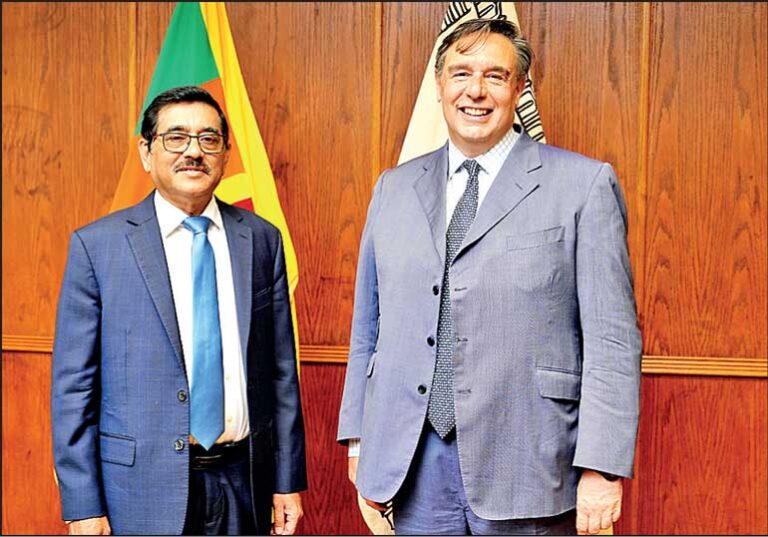
Secretary to the Ministry of Labour and Foreign Employment, R. P. Wimalaweera, Chairman of the Sri Lanka Foreign Employment Bureau, Hilmi Aziz and a delegation of senior officials graced the occasion.

Subsequently, a comprehensive review of the progress made by the Ministry of Labour and Foreign Employment in the year 2023 was undertaken.

Minister Manusha Nanayakkara apprised the President of the key ongoing initiatives spearheaded by the Ministry.

He highlighted the initiation of the “Garu Saru” program, aimed at conferring dignity upon individuals engaged in the informal sector in Sri Lanka with a focus on social security programs.

Moreover, Minister Nanayakkara emphasized the strategic integration of these individuals into the information system pertaining to the labour market.

ICTA joins hands with Brandix to bolster Sri Lanka’s start-up ecosystem

0

By: Staff Writer

Colombo (LNW): Sri Lanka’s start up ecosystem will get a new impetus with the strategic alliance between the Information and Communication Technology Agency (ICTA) and Brandix Apparel Limited.

The term startup refers to a company in the first stages of operations. Startups are founded by one or more entrepreneurs who want to develop a product or service for which they believe there is demand.

The SL front line Technology agency and apparel giant has renewed its partnership for the second consecutive year.

This strategic alliance aims to significantly bolster startups by providing essential funding and fostering their swift expansion.

The primary focus is to fuel technological entrepreneurship within Sri Lanka, propelling its future digital economy.

Under the umbrella of the Spiralation start-up incubator, early-stage tech entrepreneurs receive comprehensive support.

The initiative encompasses seed funding, specialised training, networking opportunities, and avenues for business promotion on both local and international fronts.

The memorandum was signed by ICTA Chairman Professor Malik Ranasinghe, and the Fortude Managing Director and Brandix IT/Digital Director Arjuna Sirinanda on 30 October.

ICTA has embraced a comprehensive, data-driven strategy for the development of the start-up ecosystem, providing support to entrepreneurs at every stage of the start-up lifecycle, from ideation to growth.

The Spiralation initiative has been instrumental in aiding over 150 startups to date. Many of these startups have not only expanded their reach to more than 30 countries globally but have also collectively contributed to the creation of over 1,000 job opportunities.

Brandix Apparel Ltd. has committed to funding a total of 10 million, in addition to providing expert guidance, training, and mentoring for selected Spiralation start-ups.

This partnership aims to offer vital financial support to burgeoning start-ups in their journey towards development and growth.

Professor Ranasinghe expressed, “ICTA stands as the foremost entity driving the nation’s digital transformation.

Under the digital economy pillar, our goal is to promote, encourage, and back technology-focused start-ups and innovation in Sri Lanka, aiming to establish 1,000 start-ups by 2025.

In response to the memorandum, Sirinanda highlighted, “At Brandix, our digital infrastructure is pivotal in delivering innovative solutions to our customers.

Continuously exploring how technology can enhance our operations to offer superior products at competitive prices is our ongoing commitment.

With this in mind, we are pleased to enter into a collaborative partnership with ICTA, a like-minded governmental organisation. Our joint efforts will serve to incubate the ideas of Sri Lankan technology entrepreneurs, potentially fostering the creation of world-class digital solutions,” he said.

Can CB leave T bill auctions and mind its profitable printing business?

0

Article’s Background

It is the long tradition of the CB to use public debt management as the conduit for the monetary policy. The major reason is the inherent ineffectiveness of policy interest rates to drive interest rates in the economy. The ineffectiveness mainly arises as policy rates target the levels of overnight inter-bank interest rates whose lending volume is insignificant, as compared to the total flow of credit and money created by the banking system, to affect other interest rates. In addition, the policy rates system from the beginning of this year has restricted the CB’s standing facilities and, therefore, policy rates are a dormant policy instrument.

In this context, given the large size and credit quality, the CB uses T bill yield rates as de-facto policy interest rates. This strategy is aided by the legal requirement for issuance of government securities through the CB as the fiscal agent of the government where the CB conducts weekly auctions of T bills and determines yield rates and acceptance of bids. 

The particular tender board chaired by a Deputy Governor who is also an ex-officio member of the Monetary Policy Board (MPB) caries a mandate to decide on auction in consideration of both government funding requirements and monetary policy requirements. The Governor being the Chairman of the MPB is to approve the tender board recommendation in this line along with additional and strategic information he has on the monetary policy priorities and future directions. Therefore, the governance and transparency behind the conduct of the monetary policy must be subject to public concerns.

Accordingly, even after 76 years of independence from the British rule, the government has been unable to decide independently the amounts it borrows from money market and the interest rates it pays for such borrowing in the interest of fiscal discipline and fairness to the general public who shoulders the debt service burden.

Therefore, this article is to shed light on the public questionability of the last two T bill auctions in view of the cost to public funds at the time of fiscal bankruptcy and underlying issues in monetary policy governance.

Auction held on 22 November 2023

  • On this day, there was 1% policy rate cut on the table of the MPB for next day. The Governor, tender board Chairman, Director of Economic Research (a member of the tender board) and Assistant Governor supervising the Research (a member of the tender board) knew it as MPB papers are circulated in advance. Therefore, 1% rate cut did not come from the ceiling of the MPB room without the prior knowledge of the tender board. However, tender board kept auction T bill yields almost unchanged.
  • The settlement of accepted bids took place on 24th after effecting the policy rate cut. Therefore, successful bidders settled funds for the auction at yield rates higher than market yield rates on the settlement date.
  • Further, even if the auction was fully subscribed (R. 145 bn), the placement window was open at higher yields unnecessarily to facilitate a set of dealers. An amount of Rs. 9,214 bn has been raised at yields higher than market yields prevailing on the settlement date.
  • The correct option that the CB should have pursued was to cut-off bids at yields lowers than the previous auction and raised the balance from the placement window.
  • The acceptance of significantly higher volume of bids than the auctioned amount in the case of 91-day bills has resulted its yield rate to prevail at considerably higher levels than yield rates of other two longer maturities.
  • Accordingly, additional interest cost to the public funds from the auction alone is about Rs. 1 bn.

Auction held on 29 November 2023

  • This is the first T bill auction held after the policy rates cut on 23rd. However, the cut in yields rates is only marginal and not consistent with the policy rates cut of 1%.
  • Bids for two bills were accepted more than the announced amount. Therefore, yields continued to remain higher. However, placements window also was open for raising funds beyond the announced funding requirement. Therefore, another set of dealers will benefit from higher yields on the settlement day (1st December) despite lower market rates. This means that dealers can borrow at lower rates on 01 December to settle bids and pocket a profit twice, i.e., higher yields at the auction and lower borrowing rates two days later. Two days are there for them to look for investors for disposal of bills at lower yields.
  • The correct option that the CB should have pursued was to cut-off bids at yields at least 1% lowers than the previous auction and raised the balance from the placement window at such lower yield rates.
  • If the tender board had cut yield rates by 1% at the previous auction, the yields at this auction could have fallen further and helped reduce market interest rates to support the economic recovery while easing the fiscal financing cost.
  • Accordingly, additional interest cost to the public funds from this auction alone is about Rs. 1.5 bn.

Public Concerns

  • The MPB has announced a pause in policy rates cut at the last meeting held on 23 November. This may be due to high inflationary pressure witnessed in terms of the level of Consumer Price Index (CPI). The MPB policy statement also mentioned about inflationary pressure due to proposed VAT increase. However, the direct inflationary pressure coming from the significant wage hike and increased budget deficit of Rs. 2,851 bn (by Rs. 500 bn) to be funded by the increased monetary financing (gross borrowing limit raised to Rs. 7,350 bn by 48% from 2023 level) is easy to understand without any macroeconomic research and inflation projection models.
  • Therefore, the CB that follows hard core monetary theory of inflation on monetary financing of budget deficit would not like benchmark interest rates to fall. The policy rates cuts are only superficial acts because they do not have a noticeable impact on interest rates and credit creation, given the fact that the demand for credit lags behind in the bankrupted economy where banks also are not willing to take credit risks while sitting on a large bed of non-preforming loans without any effective resolution or restructuring. 
  • Therefore, the CB has not taken action to reduce T bill yield rates to be consistent with policy rates cuts. This shows that, although the MPB insists on banks to reduce lending interest rates to pass benefits of the series of the monetary easing measures to businesses and households, the CB is not interested in providing same benefits to the government struggling with fiscal bankruptcy. In addition, the CB offered to print nearly Rs. 30 bn to 80 bn on a daily basis to lend to banks through reverse repos mostly at rates lower than inter-bank rates to support their creation of credit for the private sector. However, the CB does not carry out lawful open market operations to push down the yield rates in line with monetary easing and around zero inflation. This is the only central bank which runs interest rates at a cost to the government while leaving out monetary policy instruments. This is real hypocrisy.
  • In this background, the reduction in yield rates at last two auctions has been suppressed to few basis points (i.e., 53, 23 and 7). In contrast, the overnight inter-bank rate has fallen exactly by 1% together with market repo rate fallen by 0.92% between 22nd and 29th. Therefore, the CB’s insider act to keep T bill yield rates inflated is clear from published data.
  • This insider act is easily evident from the rise in yield rates faster in the monetary policy tightening cycle and from slower reduction in the monetary policy easing cycle (see Chart below).

T bill yield rates rise excessively 

during monetary tightening and 

fall lightly during monetary easing 

  • Therefore, the cost of CB’s insider act is the additional interest cost to public funds, especially as the fiscal front is mainly financed by Treasury bills consequent to unconstitutional default of foreign debt by the CB. Interest payment is the single highest expenditure item in 2024 budget accounting for 28% of total expenditure and 64% of income. Therefore, it is the CB’s interest rate policy that keeps the government bankrupt uninterruptedly. We need to question the rationale for printing of money at an interest rate of 10% for the private sector and inflating government securities yields at 14%-15% at the time of inflation close to zero. Therefore, taxing the public to pay high interest on debt without controlling the interest rates on borrowing that the government has a full control is an undemocratic act of the government.
  • Overall, unless the government lays Chinese walls between the monetary policy and fiscal debt management and requires the MPB to carry out the monetary policy strictly within goals and instruments provided for in the legislation and the government takes control of its debt management, the government will continue to be a hostage in the monetary Gaza Strip in Sri Lanka.

(This article is released in the interest of participating in the professional dialogue to find out solutions to present economic crisis confronted by the general public consequent to the global Corona pandemic, subsequent economic disruptions and shocks both local and global and policy failures.)

P Samarasiri

Former Deputy Governor, Central Bank of Sri Lanka

(Former Director of Bank Supervision, Assistant Governor, Secretary to the Monetary Board and Compliance Officer of the Central Bank, Former Chairman of the Sri Lanka Accounting and Auditing Standards Board and Credit Information Bureau, Former Chairman and Vice Chairman of the Institute of Bankers of Sri Lanka, Former Member of the Securities and Exchange Commission and Insurance Regulatory Commission and the Author of 12 Economics and Banking Books and a large number of articles published. 

The author holds BA Hons in Economics from University of Colombo, MA in Economics from University of Kansas, USA, and international training exposures in economic management and financial system regulation)

Source: Economy Forward

State Ministry of Sports moves to new location in cost-saving measure

0

Colombo (LNW): Newly appointed Sports Minister Harin Fernando has initiated a strategic cost-cutting measure by relocating the State Ministry of Sports from the World Trade Centre to the Sports Ministry building at Race Course.

The move aims to optimise existing infrastructure and reduce expenses, as it was reported that maintaining the State Minister’s office in the World Trade Centre cost the government Rs. 4.2 million.

Fernando, who is also the Tourism Minister, has directed his office to be at the Tourism Ministry, allowing the State Minister of Sports to occupy the Sports Ministry premises.

Additionally, the Minister instructed the Ministry Secretary to allocate the approximately Rs. 50 million saved annually from this relocation to the Sports Development Fund.

SL Judge Janak De Silva inducted into Seychelles’ Court of Appeal

0

Colombo (LNW): Two non-resident judges, one from Sri Lanka and the other from Mauritius, were sworn in at Seychelles’ Court of Appeal on Wednesday (29).

Sri Lankan Judge Janak De Silva, a justice of the Supreme Court of Sri Lanka, expressed enthusiasm for the opportunity to collaborate with judicial officers from different countries.

Meanwhile, Mauritian Judge Karuna Gunesh-Balaghee accepted the nomination with humility and expressed gratitude to the Constitutional Appointments Authority.

Both judges bring significant legal expertise, and their appointments aim to enhance the Court of Appeal’s capabilities.

The Court, consisting of five Justices of Appeal, holds sessions in April, August, and December, aligning with the Supreme Court’s vacation periods.

Sri Lanka Original Narrative Summary: 30/11

0

  1. Official Creditor Committee announces agreement with the SL Govt on main parameters of a debt treatment consistent with the IMF programme: says it will lead to the approval of the 2nd disbursement by IMF: expects SL authorities to continue engagement with private creditors to reach agreement on terms as favourable as their terms: also expects the agreement to be formalized with a MOU in the coming weeks: further expects “other” bilateral creditors to consent to sharing information for the OCC to evaluate “comparability of treatment”: agreement to cover approx USD 5.9 bn of debt & said to be of a mix of “long-term maturity extension” & “reduction in interest rates”: analysts note that the much awaited “hair-cut” as expected by the Govt & IMF doesn’t seem to have been achieved.
  2. SLPP rebel MP Dr Nalaka Godahewa says the President’s plan to break a part of the Opposition with this Budget, has failed: akins SL to a debtor who hides until the Police catch him for not paying back the debt to the creditors: warns SL is on top of a volcano and that this crisis is going to explode in a terrifying way.
  3. Senior DIG Deshabandu Tennakoon appointed as the Acting IGP: Tennakoon says that plans will be implemented to crackdown on drugs & organised crime, whilst giving priority to national security.
  4. Netherlands Embassy formally hands over 6 SL artefacts, including the Lewke cannon plundered from SL over 200 years ago: artefacts accepted by Minister Vidura Wickremanayake: items to be on public display at the Colombo National Museum from 5th December’23 onwards.
  5. Immigration Department says self-styled Prophet cum Pastor Jerome Fernando arrived in SL: the Pastor is scheduled to give a statement to the CID within 48 hours of arrival, as per a Court order.
  6. Former Head of the Human Rights Commission Professor Deepika Udagama says no country could be described as democratic if there is no “separation of powers” that ensures one branch of Govt does not exceed its powers: asserts that the three branches of Govt, i.e., the Executive, Legislature & Judiciary must keep an eye on each other so that there is a “balance”.
  7. SJB MP Harshana Rajakaruna says the SJB is proposing that the Govt holds the upcoming Presidential & Parliamentary Elections on the same day in order to reduce the related expenditure: asserts the SJB is ready to support any new legislation for that purpose.
  8. Several civil society organisations, including the Electricity Consumers’ Association to organise a protest in front of the Ministry of Power and Energy, urging the Govt to lower electricity tariffs & fuel prices.
  9. Standard Chartered Bank CEO Bingumal Thewarathanthri says there must be a “bankruptcy court” in the country to address debt repayment challenges faced by individuals and businesses.
  10. SL Cricket says they will host the Indian team for a bi-lateral series in July’24, consisting of 3 ODI’s & 3 T20Is.

Minister urges immediate educational reforms to stem high school student attrition

0

Colombo (LNW): Education Minister Susil Premajayantha emphasised the critical need for continuous updates in the education system to prevent students from seeking alternative paths after high school.

Stressing the collective responsibility of all stakeholders in the education sector, Minister Premajayantha highlighted the importance of careful and responsible efforts in this regard.

During his role as the chief guest at the National Higher Education Conference organised by the Sri Lanka Association of Non-State Higher Education Institutes (SLANSHEI), Minister Premajayantha outlined that one of the primary goals of the new education reforms is to decrease the age at which students leave the educational system and enhance their opportunities for further academic advancement.

Discussing practical steps, the Minister mentioned the Education Ministry’s readiness to conduct examinations for the appointment of teachers to development officers in schools.

However, he noted that legal impediments, including fundamental rights petitions filed against the examination, have led to its suspension for the past nine months.

Minister Premajayantha assured that once the court rulings on these petitions are received, prompt action will be taken to admit qualified individuals into the teaching service in adherence to the Teachers’ Service Constitution.

Significance of ethical practices in the medical field

0

Colombo (LNW): In his role as the chief guest at the inauguration of the Annual Academic Sessions (AAS) of the Sri Lanka College of Oncologists (SLCO) on October 13 in Colombo, Emeritus Prof. Janaka De Silva, former director of the Postgraduate Institute of Medicine (PGIM), delivered a comprehensive speech on ‘Postgraduate training and the professional practice of medicine.’

Prof. De Silva, drawing from his experience at the PGIM and the Sri Lanka Medical Council (SLMC), addressed key issues related to postgraduate training, the societal expectations of specialists’ professionalism, and the challenges faced in meeting these expectations.

Highlighting the excellence of Sri Lanka’s postgraduate training system, Prof. De Silva noted that post-MD trainees benefit from overseas training, with several qualifications being recognised internationally. Despite the high level of knowledge and skills acquired through this training, he emphasised the importance of professional conduct in determining fitness to practice.

Prof. De Silva pointed out the need for maintaining high standards of professional and moral ethics, respecting patient rights, and addressing the challenges in current training programs. He underlined the importance of doctors prioritising patient care, competence, and staying updated in their professional knowledge and skills.

While acknowledging the efforts in training programs, Prof. De Silva noted areas for improvement, particularly in addressing incidents of unnecessary investigations, irrational prescriptions, false medical certificates, and exorbitant fees charged to patients.

Expressing concerns about the brain drain and protectionism within the medical profession, Prof. De Silva urged specialists to give back to the system that nurtured them. He criticised the disgraceful practice of specialists abandoning their posts and patients without notice, leaving the country secretly to avoid fulfilling their service bonds and other obligations.

Addressing the need for more specialist doctors to serve remote areas, Prof. De Silva called for improvements in both the coverage and quality of healthcare. He emphasised the obligation to provide career opportunities for the increasing number of doctors graduating each year and suggested ways to address the issue, including developing more specialties and increasing mid-level qualifications.

In conclusion, Prof. De Silva urged the medical profession to overcome protectionist ideologies, particularly within professional colleges, to foster the development of sub-specialties and mid-level qualifications.

He spoke candidly about these challenges, noting that his remarks were prompted by the induction of an esteemed oncologist, whom he considered a role model. Prof. De Silva expressed pride in contributing to the professional career of this oncologist.

Rs. 1.5 bn allocated for ‘Greater Kandy Urban Development Programme’: Minister

0

Colombo (LNW): State Minister for Provincial Council and Local Government, Janaka Wakkumbura, revealed that President Ranil Wickremesinghe has earmarked Rs. 1,500 million for the “Greater Kandy Urban Development Programme” in the current year’s budget.

During a Press Briefing at the Presidential Media Centre (PMC) themed ‘Collective Path to a Stable Country’ held today (29), the State Minister disclosed that Rs. 1,000 million has been allocated for a special project aimed at tourism development, with the involvement of local authorities to facilitate tourists.

Expanding on future plans, the State Minister outlined a comprehensive development programme slated for 2024, backed by a substantial budget exceeding Rs. 34,000 million covering all nine provinces. The ambitious goal is to complete these development projects by December of the following year.

Noteworthy is the allocation of Rs. 7,000 million for infrastructure development in the North, North-East, Uva, and North Central provinces. Additionally, Rs. 600 million is designated to address deficiencies in local government institutions.

Under the guidance of President Ranil Wickremesinghe, a special project has been initiated with a Rs. 1,000 million allocation to enhance facilities through local government bodies, focusing on tourism development.

There is optimistic anticipation for a Rs. 1,500 million development project, complemented by a Rs. 500 million contribution from local government agencies.

President Ranil Wickremesinghe has specifically allocated Rs. 1,500 million in this year’s budget for the “Greater Kandy Urban Development Programme,” primarily for enhancing the road leading to Kandy city.

Addressing a related issue, approximately 3,000 public servants who submitted nominations for local government elections have had their concerns addressed. A cabinet paper has been submitted to review their appeals and reinstate them, with an expected reemployment within a month, under the condition of refraining from engaging in political activities.

Additionally, around 2,700 vacant positions for ‘Grama Seva’ officials are scheduled for examination by December 2nd, with efforts to appoint them before February 4th, 2024. A significant step has also been taken to convert 8,400 casual employees in local government institutions into permanent staff through mandatory employment arrangements.

Japan, India, and France Creditor Committee affirms SL’s debt restructuring

0

Colombo (LNW): The Official Creditor Committee, co-chaired by Japan, India, and France, has officially endorsed the Agreement in Principle on specific financing terms for the restructuring of Sri Lanka’s debt, aligning with the debt restructuring parameters established in the International Monetary Fund (IMF) programme, announced the Finance State Minister Shehan Semasinghe.

Minister Semasinghe highlights that achieving consensus among all of Sri Lanka’s creditors to restructure the debt marks a crucial milestone and represents a significant stride towards resolving the economic crisis in Sri Lanka.

“We are very grateful to all bilateral creditors for their cooperation,” he stated, adding that China Exim Bank had previously agreed to restructure its debt.

“This is a very significant milestone, as, along with a similar agreement in principle provided earlier by China Exim Bank, it confirms that all of Sri Lanka’s official creditors have agreed to restructure Sri Lanka’s debt, which is a major step in the resolution of Sri Lanka’s economic crisis.”

As per the Finance Ministry, the Official Creditor Committee’s agreement encompasses approximately $5.9 billion of outstanding public debt and includes a combination of a long-term maturity extension and a reduction in interest rates.

Minister Semasinghe indicated that the Official Creditor Committee’s agreement now sets the stage for the IMF board to release the second tranche of $334 million after the completion of the first review of the International Monetary Fund’s Extended Fund Facility programme expected in December.

“This would unlock the next tranche of IMF funding, which, in turn, would enable other partners such as the World Bank and Asian Development Bank to provide further financing,” he added.

Crucially, this development serves as a noteworthy indication of the ongoing cooperation and support from the global community in Sri Lanka’s economic recovery.

The Minister affirmed Sri Lanka’s commitment to implementing a comprehensive reform program aimed at restoring macroeconomic stability and placing the country on a path of sustainable and inclusive economic growth.

He mentioned that subsequently, Sri Lanka, through its financial advisors, will continue to engage in good faith with its external private sector creditors to reach a similar agreement in principle.