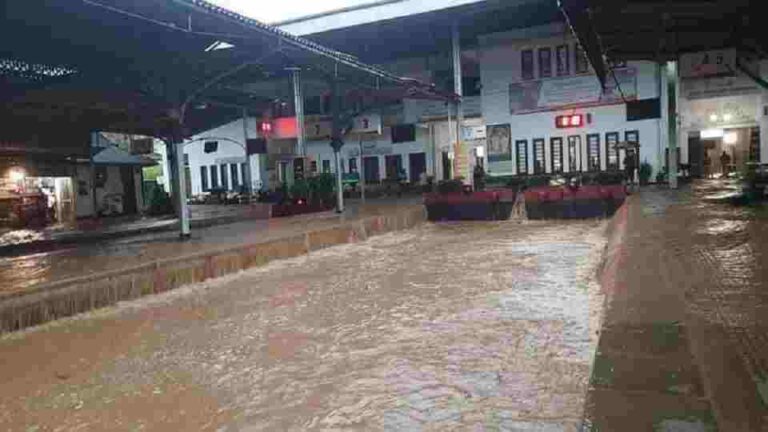
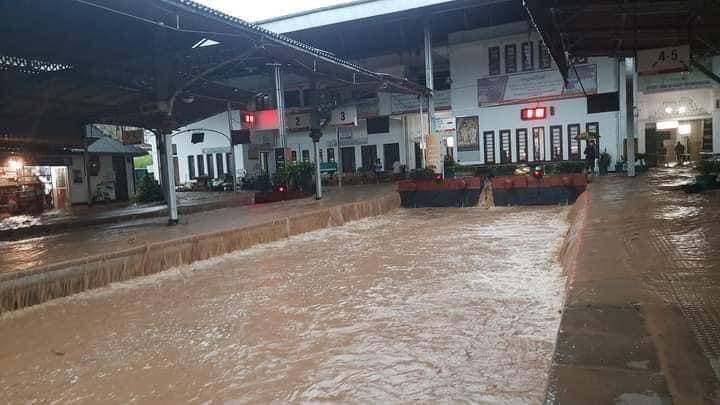
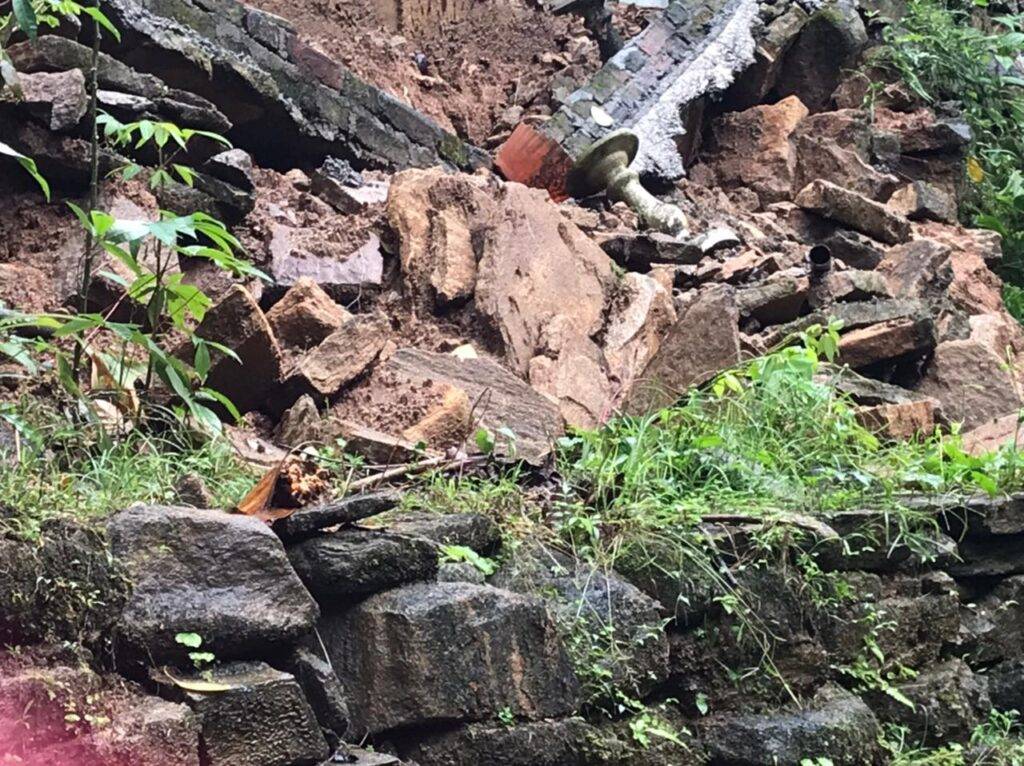
The depression has weakened into a low-pressure area and likely to move to the western coast of Sri Lanka by today (26) morning. As this system moves away from the island, it is expected that its impact on the island’s weather will lessen from this evening.
Accordingly, showers or thunder showers will occur at times over Western, Sabaragamuwa, Central, North-Western and Northern provinces and in Galle and Matara districts. Fairly heavy showers above 75mm can be expected at some places in the above areas.
Strong gusty winds of about (40-50) kmph can be expected at times over country.
General public is kindly requested to take adequate precautions to minimize damages caused by temporary localized strong winds and lightning during thundershowers.
The nation has been rattled by economic crisis, political upheaval and corruption, but many believe the dessert-making custom could spark joy in these bleak times
Yusra Farzan
As a child in Colombo, Sri Lanka, Oryan Cumaraiah-Misso remembers excitedly readying himself in front of a handheld meat grinder to crush cashews. It was his part in his family’s annual tradition of preparing a 60-year-old recipe for Christmas cake that had been passed down for generations. Christmas cake – a moist, decadent treat filled with nuts and fruit – usually kicks off the holiday season on the island nation, and for immigrants in the US, has become a way to preserve traditions from back home.
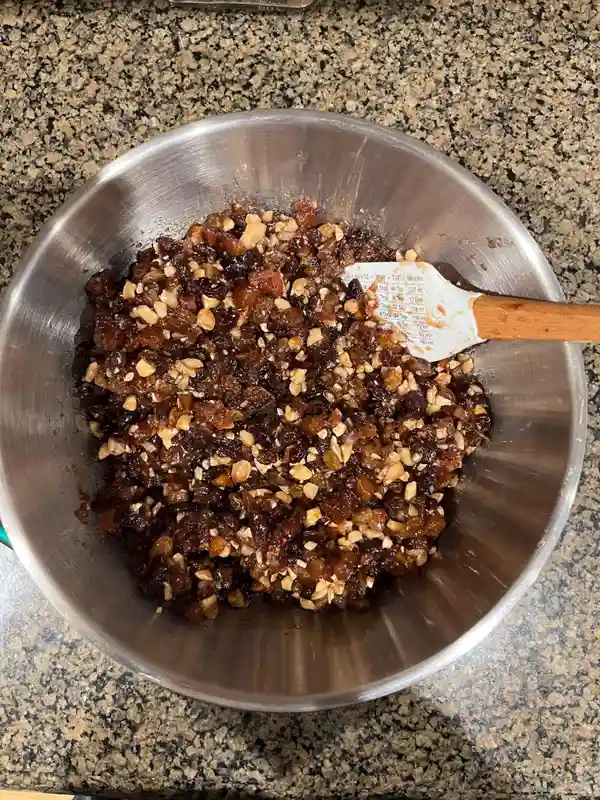
Sri Lanka’s Christmas cake is similar to the fruit cake, a quintessentially British dish, but has since evolved from its colonial roots. Like the British version, Christmas cake includes raisins and cherries, but also preserved ginger, the green vegetable chayote (or chow chow, as Sri Lankans call it) in sugar syrup, preserved melon (known as puhul dosi), candied peel, sultanas and aromatics like nutmeg.
“It definitely has been adapted to the Sri Lankan palate,” says Cumaraiah-Misso, 34, now a medical student living in Fort Worth, Texas. He still remembers being a child and the earthy aromas of cinnamon and cardamom intermingling with the sweet smell of rose essence while being elbow-deep in a 25-gallon bucket, mixing finely chopped fruit semolina with butter.
Marie Shirlene Fernando, 58, a caterer and mother of three living in Cerritos, California, remembers watching her aunt make the cake as a little girl. As a teenager, she took over the responsibility of making the stodgy treat, first for her ailing grandmother and later for her extended family to give as wedding favors. Now, she makes it with her 10-year-old granddaughter for customers across the United States. She carefully wraps the final product in parchment paper and brightly colored cellophane.
This year, one of the packages will be shipped to her family in Sri Lanka.
Indrika Arnold’s family prepares a Christmas cake at home. Photograph: Indrika Arnold
Given the country’s recent economic and political woes, she hopes the beloved dessert will help evoke unity and remind her mother, sister and extended family, of simpler times of gathering around the table to prepare the cake ingredients.
In Sri Lanka, as the country’s hotels gear up for the holiday season, some host cake-mixing parties, where people get a view of culinary staff combining the fruit and nut mixture with the wet ingredients in a custom-built, 9ft-deep barrel. The mix weighs more than 4,000lb. This year, one even took place aboard a naval ship. Fernando said she was watching the Galle Face Hotel’s recent Christmas cake mixing ceremony and thought to herself, “Oh, I’m so glad in spite of all that’s going on, they are still doing it.”
These traditions were in jeopardy this year as the nation battled its worst economic crisis since independence in 1948. Government corruption, financial mismanagement, sluggish economic growth since the pandemic, the depletion of foreign reserves and the war in Ukraine led to widespread blackouts, shortages of essential goods and school closures earlier this year. Islandwide protests ultimately led to the ouster of President Gotabaya Rajapaksa and the resignation of his brother Mahinda Rajapaksa as prime minister.
Inflation hit an all-time high of 69.8% in October before dropping slightly to 61% in November.
While Fernando is hopeful that the nostalgia of Christmas cake-making will provide some joy to celebrations, Cumaraiah-Misso worries about how the increased prices of ingredients will affect this longstanding tradition. On local Facebook groups, bakers lament the rising cost of ingredients, with some commenting that they haveve chosen not to make the treat this year and are readying themselves for an “austere Christmas”.
In a country ravaged by a 30-year civil war fought on ethnic lines and where, in 2019, at least 290 people died as bombs ripped through three churches on Easter Sunday, Christmas cake can unite across religions. It’s not just the 8% of the country’s Christian population that enjoy it.
“There are so many Buddhists, Muslims, friends who I have who are non-Christians. They love the Christmas cake, and they wait for a piece of Christmas cake,” Fernando said. She recalls them asking, “Where is my share? Did you keep me a piece?”
Indrika Arnold, a wealth adviser in Lebanon, New Hampshire, has found another set of fans for her Christmas cake: her American co-workers.
“I have some colleagues at work with whom I shared a piece, and they loved it. Now, they always ask, ‘When are you making your spice cake?’” she said. “I even mail it to some of my friends who no longer work with me.”
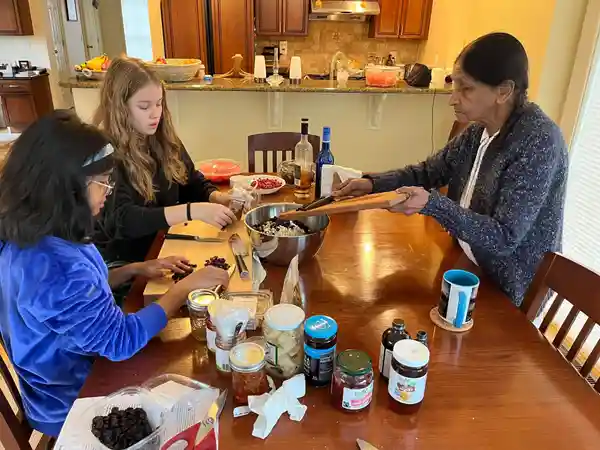
Indrika Arnold’s daughter, mother and a friend prepare a Christmas cake. Photograph: Indrika Arnold
She only made a half recipe when she started making Christmas cake five years ago. Now she’s doubled it.
Arnold moved to the US 22 years ago but only started making the rich cake – as it’s known at other times of year – to share the tradition with her 12-year-old daughter. She has core memories of sitting around the kitchen table with her siblings and parents, cutting the preserved fruit into small pieces, and sneaking bits of raisins and cashews into her mouth when no one was looking.
“A week or two before Thanksgiving, I get all the ingredients, and we actually get together as a family and cut it and we all take turns mixing the booze and the honey,” she said about how she continues this tradition with her daughter and husband in the US. She then leaves the fruits to stew in the alcohol mixture for at least two weeks, kick starting the holidays in their home.
Like Arnold, Fernando also plans to gather around the table with her granddaughter to finely chop the fruit, which will then be soaked in a brandy mixture for one day.
“By making it every Christmas, it has become a part of celebrating Christmas as Sri Lankans overseas,” Fernando said.
During the past decade, China funded the construction of massive infrastructure projects in Sri Lanka meant to boost the island nation’s economy.
However, after the economic collapse of the tiny Indian Ocean country earlier this year, there were questions whether these projects had contributed to the worst crisis it has ever faced.
A port city that dominates Colombo’s seafront was built on a 269-hectare patch of land reclaimed from the sea. It was to become a thriving business and financial hub, but it is virtually deserted.
An international airport commissioned nearly a decade ago at Mattala city is called the “emptiest airport in the world.” Both the Chinese-funded projects are seen as “white elephants” that have added to Sri Lanka’s debt.
“The airport is not functioning. The Colombo port city was supposed to attract international investors, but there is not a single investor right now,” said Asanga Abeyagoonasekera, a Sri Lankan security and geopolitics analyst.
“There is a question over the revenue model of all these projects because they are not financially viable. They were built with unsustainable large amounts of borrowings with high interest rates.”
The focus zeroed in on the Chinese projects when Sri Lanka ran out of foreign exchange to import food, fuel and medicines earlier this year.
The catastrophic economic downturn has pushed many in the nation of 22 million people into poverty.
In what was once a middle-income country, living standards have plummeted as inflation rages. The World Food Program estimates that nearly 6 million people need food assistance.
The country’s crisis is blamed on economic mismanagement by the previous government led by former president Mahinda Rajapaksa and the COVID-19 pandemic that led to a loss of vital tourism earnings in the scenic Indian Ocean country.
Analysts say the billions of dollars spent on Chinese-funded projects deepened Sri Lanka’s woes. Estimates are that the share of Chinese loans in Sri Lanka’s $40 billion debt range from 10 to 20 percent.
“China is known for working out arrangements that often turn out much costlier than just looking at the paper would tell you,” said Harsh Pant, vice president for studies and foreign policy at the Observer Research Foundation in New Delhi.
“The inability of the Sri Lankan political class to understand the long-term consequences of the kind of short-term gains that they were making from China has allowed this to happen.”
Sri Lanka was one of the countries to sign onto China’s Belt and Road initiative under which Beijing extends loans to developing countries to build roads, airports, seaports and other infrastructure.
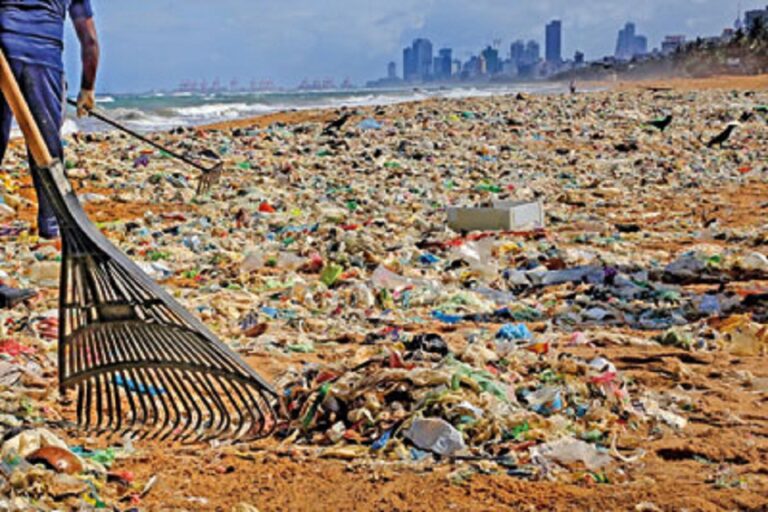
Several Sri Lanka’s consumer goods firms have been alleged of dumping packaging waste contributing to marine pollution, a conservation organization survey revealed.
Packaging of a dozen Sri Lanka firms producing 18 consumer goods brands made up over 53 percent of marine waste washing on the island’s shores, the survey findings highlighted.
Around 15 percent of the waste in the survey could not be identified by name and some of it could be from abroad. About 3 percent of the waste was identified as being transboundary material coming from South Asia and East Asia.
Pearl protectors, a marine conservation organisation, had conducted the survey on three days of September at 16 locations in the Western, Southern and Eastern shores of Sri Lanka.
“The analysis highlights the top 18 product names (brands) responsible for the largest percentage of marine waste in Sri Lanka,” a Marine Pollution Brand Audit by the group said.
“53 percent of all marine waste has been credited to one of the top 18 product names.”The branded waste was where labels were visible.
“13 percent of all surveyed marine waste was categorized as ‘unbranded’ due to lack of visible label to identify the Product name or the company name,” the report disclosed.
“Based on visual characteristics, many polyethylene terephthalate (PET) bottles had a distinct linkage to few of the top PET bottle manufacturing companies mentioned in the analysis.”
The surveyors had collected 8,057 items from the 16 beaches of which 6,865 could be traced to known brands. Another 1,038 did not have clear labels and 154 were from abroad (transboundary).
Among the branded waste, around 80 percent had come from 20 firms.Unilever (14%), The Coca-Cola company (10%), Ceylon Biscuits Limited (9%), Nestle (7%), Cargills Ceylon PLC (7%), Maliban Biscuit Manufacturers Pvt Ltd (6%), Perfetti Van Melle (6%), Ceylon Cold Stores PLC (5%) and Hemas Holdings PLC (4%) accounted for the to 10.
The balance came from Prima Ceylon Pvt Ltd (4%), Fonterra Cooperative Group Ltd (3%), PepsiCo, Inc. (3%), Lanka Milk Foods (CWE) PLC (2%), Milco Pvt Ltd (2%).
At least one company had collected its branded bottles from a beach included in the survey the day before.
“This may have had an impact on the analyzed data depending on the amount of waste owning to the company which was removed,” the report said.
“While we believe it is important to be responsible for the waste generated by each of the companies, we hope the companies will sustain the collection back or removal of waste rather than being a one-time removal.”
Due to a shortage of eggs and the high price of ,margarine and wheat flour in the local market, the price of a kilo of cake has been increased up to Rs. 1,500 during this Christmas season, All Ceylon Bakery Owners’ Association (ACBOA) President N.K. Jayawardena disclosed
The price of an egg has increased to around Rs.70 in the market he said adding that despite the prices of eggs have gone up substantially, they cannot find eggs in the market. “A mafia has formed in the market to create an artificial shortage,”
Therefore, with the price increase, people do not visit shops to buy cakes .”Even the bakeries cannot use butter for cakes. If we use butter, the price of a kilo of cake would be more than Rs.3,000,” he said.
The government should take action to control the price of egg in the market immediately to relieve the consumers, he added.
The All Ceylon Bakery Owners Association on Tuesday (4) said that the two main wheat flour companies in Sri Lanka have reportedly increased the price of a kilogram of wheat flour by Rs. 13/-.
Chairman of the All Ceylon Bakery Owners Association N. K. Jayawardena pointed out that no decision has been reached with regard to increasing the prices of bread and related bakery products.
“A kilogram of wheat flour sold by these companies will now increase to around Rs. 285/-,” he said adding that given the shortage the black market price for a kilogram of wheat flour sold to bakery owners is Rs. 400/-.
He said that over 2,000 small-time bakeries, mainly in rural Sri Lanka, have been closed down due to the shortage of wheat flour directly impacting the loss of 4,000 jobs.
Prices of bakery products have increased due to the rising production costs, The failure of the budget to address the issues faced by the industry has paved the way for a price hike, he revealed.
“Our proposal to remove the tax on wheat flour has fallen to deaf ears,” Mr. Jayawardena said while explaining that the prices of bakery products will be increased to unbearable proportions if the cost of wheat flour keeps increasing.
He added that the proposal to revise taxes on margarine, yeast, palm oil, and butter – which are key ingredients used to produce bakery items have also not been addressed in the budget.
The ACBOA President pointed out that the Value Added Tax (VAT) and Nation Building Tax (NBT) continue to be imposed on all bakery products except for bread which is exempt from NBT. This has resulted in a higher production cost.
Accordingly, he said that steps would be taken to increase the prices of products although the exact figure of the price hike cannot be predicted at present.
Sri Lanka Government plans to double tourist arrivals to 1.5 million next year and bring in in US$ 5 billion in vital foreign exchange, the Tourism Minister Harin Fernando said, as the island nation seeks ways to tackle its worst financial crisis in seven decades.
Sri Lanka tourism always had the potential but never got it right – there’s always someone pushing it down when it tries to swim and come up for air.
But a positive message comes through each time from each crisis,” he said adding that “Sri Lanka has that armory.”
The task of resurrecting the iourim industry from its down turn in the Easter Sunday bomb attack, covid-19 pandemic, youth struggle against the Rajapaksa regime and the ongoing economic crisis has become a challenge at present.
The tourism infrastructure issues and irregularities of previous administrations of the tourism authority are still haunting at its corridors. Non-commencement of operations on leased lands was among them, official sources said.
Although the Sri Lanka Tourism Development Authority had leased 35 acres to 5 companies in 2014 and 16.8 acres to 2 more companies in 2019 and 2020, in the Yala Palatupana Tourism Development Zone, only 2 companies had started operations by the end of the year 2021/2022 under review, recent auditor general’s department report revealed.
Out of the 510.086 acres of land acquired for tourism development projects in Kuchchaveli in 2011 and 2014,only 49 acres of land were leased to 3 companies, but only one of those 3 companies was engaged in operational activities.
Although, the authority had received 2055.87 acres of land in 12 islands of Kalpitiya as free grants in the years 2010 and 2012, only 206.58 acres of land belonging to 05 islands out of those 12 islands had been leased to 03 companies in the years 2010, 2011 and 2020.
However, none of these companies had commenced operations by the end of the year under review. Out of the leased companies, 2 companies have Rs. 43million and Rs. 9 million in rent arrears for3 to 5 years respectively.
Out of the 37 rest houses owned by the Sri Lanka Tourism Development Authority, 9 rest houses were not leased for a period of 01 to 13 years and the said property remained underutilized.
The number of places registered with the Sri Lanka Tourism Development Authority as places providing accommodation and tourism facilities was 5378 in the year 2020 and in the year 2021/2022 under review was 5872.
Accordingly, the number of newly registered places was 494. However, the number of places that renewed their registration was only 783 during the year under review, so out of the 5378 places registered in the previous year, 4595 places had not renewed their registration, auditor general’s report indicated.
The closing date for the submission of applications for the scholarship programme, utilising funds from the President’s Fund, for students who passed GCE (O/L) 2021/2022 and are sitting for the GCE (A/L) examination in 2024 has been extended to December 30.
It was earlier scheduled to accept the duly completed applications submitted to the Principals of the respective schools on or before December (23) for the scholarship programme which was initiated as per the directives of President Ranil Wickremesinghe. However the closing date for the submission of applications was extended, considering the requests made to the President by the students and parents.
Hence the President’s Fund instructs the duly filled application forms to be submitted to the principals of the respective schools where the student sat for the GCE (O/L) examination before December 30.
The Presidential Secretariat has instructed the Education Ministry Secretary to formulate a mechanism to ensure that the applications are received from the offices of the schools during the vacation between December 23 and January 02, 2023.
The President’s Fund further informed that there will be no change in the days used for other activities related to selection even though the date of accepting applications has been extended to December 30.
The Cabinet of Ministers approved the proposal by President Ranil Wickremesinghe to conduct a series of events to appreciate the consistent contribution rendered by the Upcountry Tamils to the economy of Sri Lanka during the last two centuries.
Hence as proposed by the President, the Cabinet approved to conduct the series of events in February 2023 to commemorate two hundred years since the arrival of the first group of Upcountry Tamils to Sri Lanka who contributed to more than one third of the income made by the plantation sector.
Accordingly it is approved to conduct these events by the Ministry of Plantation along with the other relevant government agencies with the aim of appreciating the service of the Upcountry Tamils who migrated to the country from India two hundred years ago and to raise their living standards as well.
Upcountry Tamil estate workers who are more than 150,000 in number residing mainly in Central, Sabaragamuwa and Southern Provinces have been a significant part of the country in respect to their contribution to the economy as well as Sri Lanka’s culture.
Global heating will set the stage for extreme weather everywhere in 2023. The consequences are likely to be cataclysmic.
In 2023, the relentless increase in global heating will continue, bringing ever more disruptive weather that is the signature calling card of accelerating climate breakdown.
According to NASA, 2022 was one of the hottest years ever recorded on Earth. This is extraordinary, because the recurrent climate pattern across the tropical Pacific—known as ENSO (El Niño Southern Oscillation)—was in its cool phase. During this phase, called La Niña, the waters of the equatorial Pacific are noticeably cooler than normal, which influences weather patterns around the world.
One consequence of La Niña is that it helps keep a lid on global temperatures. This means that—despite the recent widespread heat waves, wildfires and droughts—we have actually been spared the worst. The scary thing is that this La Niña will end and eventually transition into the better-known El Niño, which sees the waters of the equatorial Pacific becoming much warmer. When it does, the extreme weather that has rampaged across our planet in 2021 and 2022 will pale into insignificance.
Current forecasts suggest that La Niña will continue into early 2023, making it—fortuitously for us—one of the longest on record (it began in Spring 2020). Then, the equatorial Pacific will begin to warm again. Whether or not it becomes hot enough for a fully fledged El Niño to develop, 2023 has a very good chance—without the cooling influence of La Niña—of being the hottest year on record.
A global average temperature rise of 1.5°C is widely regarded as marking a guardrail beyond which climate breakdown becomes dangerous. Above this figure, our once-stable climate will begin to collapse in earnest, becoming all-pervasive, affecting everyone, and insinuating itself into every aspect of our lives. In 2021, the figure (compared to the 1850–1900 average) was 1.2°C, while in 2019—before the development of the latest La Niña—it was a worryingly high 1.36°C. As the heat builds again in 2023, it is perfectly possible that we will touch or even exceed 1.5°C for the first time.
But what will this mean exactly? I wouldn’t be at all surprised to see the record for the highest recorded temperature—currently 54.4°C (129.9°F) in California’s Death Valley—shattered. This could well happen somewhere in the Middle East or South Asia, where temperatures could climb above 55°C. The heat could exceed the blistering 40°C mark again in the UK, and for the first time, top 50°C in parts of Europe.
Inevitably, higher temperatures will mean that severe drought will continue to be the order of the day, slashing crop yields in many parts of the world. In 2022, extreme weather resulted in reduced harvests in China, India, South America, and Europe, increasing food insecurity. Stocks are likely to be lower than normal going into 2023, so another round of poor harvests could be devastating. Resulting food shortages in most countries could drive civil unrest, while rising prices in developed countries will continue to stoke inflation and the cost-of-living crisis.
One of the worst-affected regions will be the Southwest United States. Here, the longest drought in at least 1,200 years has persisted for 22 years so far, reducing the level of Lake Mead on the Colorado River so much that power generation capacity at the Hoover Dam has fallen by almost half. Upstream, the Glen Canyon Dam, on the rapidly shrinking Lake Powell, is forecast to stop generating power in 2023 if the drought continues. The Hoover Dam could follow suit in 2024. Together, these lakes and dams provide water and power for millions of people in seven states, including California. The breakdown of this supply would be catastrophic for agriculture, industry, and populations right across the region.
La Niña tends to limit hurricane development in the Atlantic, so as it begins to fade, hurricane activity can be expected to pick up. The higher global temperatures expected in 2023 could see extreme heating of the Atlantic and Gulf of Mexico surface waters. This would favor the formation and persistence of super-hurricanes, powering winds and storm surges capable of wiping out a major US city, should they strike land. Direct hits, rather than a glancing blow, are rare—the closest in recent decades being Hurricane Andrew in 1992, which made landfall immediately south of Miami, obliterating more than 60,000 homes and damaging 125,000 more. Hurricanes today are both more powerful and wetter, so that the consequences of a city getting in the way of a superstorm in 2023 would likely be cataclysmic.