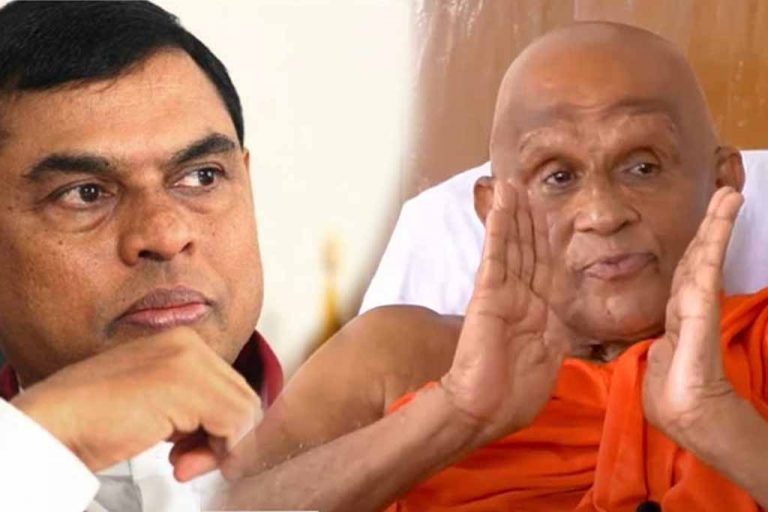
The Chief Incumbent of the Narahenpita Abhayaramaya, the Chancellor of the University of Colombo, Ven. Muruttetuwe Ananda Thera says that the people say that even what was there before the appointment of Basil Rajapaksa as the Minister of Finance has been lost after the appointment and today the people are in a position to ‘curse’ those who helped form the present government.
“We are constantly pointing out shortcomings to form a government. But now the limit has been exceeded. Many say that what was there before Basil Rajapaksa became the Finance Minister has been lost. Mr. Basil, if you please stay away from the government for at least six months. People today say that you are the biggest evil ”
Ven. Murutthettuwe Ananda Thera stated this addressing a media briefing held in Colombo yesterday (14).
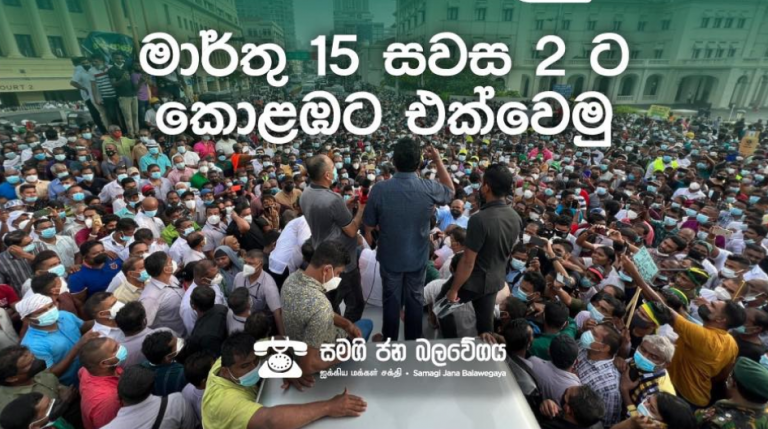
The Samagi Jana Balawegaya is scheduled to hold a massive protest in Colombo today (15) under the theme ‘Rata Winashayi – Enna Rekagamu’
According to party sources, arrangements have been made to bring the protesters to Colombo in two routes along two routes and around 300,000 people are expected to participate in the protest.
It is said that the people who came in two routes will finally gather in one place and planned to hold a massive protest.
The Central Bank has directed licensed banks to offer Higher interest rates for account holders on three transactions announced recently will come into force with immediate effect.
Commencing 14 March, CBSL stipulated maximum interest rates that can be charged by licensed commercial banks and licensed specialised banks for the credit card advances, pre-arranged temporary overdrafts and pawning advances.
The rates are 20% per annum on credit card advances commencing from the next billing cycle.2% per annum on pre-arranged temporary overdrafts and 12% per annum on the money lent for pawning advances collateralised by personal articles made of gold accepted as a pledge, for all new pawning advances and existing pawning facilities that are renewed
The hike was first announced on 4 March following the Monetary Policy Review after which policy rates were hiked sharply by 100 basis points.
CBSL said it has adopted monetary policy tightening measures in the recent past including an increase of policy interest rates to dampen the possible build-up of underlying demand pressures in the economy, which would, in turn, help ease pressures in the external sector, thus promoting greater macroeconomic stability.
CBSL said new rates for the three specified transactions are after considering the increase in overall market interest rates.
The rates are 20% per annum on credit card advances commencing from the next billing cycle, 18% per annum on pre-arranged temporary overdrafts,and 12% per annum on the money lent for pawning advances collateralised by personal articles made of gold accepted as a pledge, for all new pawning advances and existing pawning facilities that are renewed.
The hike was first announced on 4 March following the Monetary Policy Review after which policy rates were hiked sharply by 100 basis points.
CBSL said it has adopted monetary policy tightening measures in the recent past including an increase of policy interest rates to dampen the possible build-up of underlying demand pressures in the economy, which would, in turn, help ease pressures in the external sector, thus promoting greater macroeconomic stability.
CBSL said new rates for the three specified transactions are after considering the increase in overall market interest rates.
With free-floatation of the rupee the Central Bank has withdrawn the precious scheme of offering highest interest rates on foreign currency deposits by banks.
In issuing the fresh directive, CBSL said the move was after considering the recent monetary policy tightening measures and the expected macroeconomic developments and the prevailing interest rates on foreign currency deposits.
The Monetary Board issued an amendment to the Monetary Law Act Order No. 3 of 2021 on maximum interest rates on foreign currency deposits of Licenced Commercial Bank and the National Savings Bank, removing the existing maximum interest rate limits imposed on foreign currency deposits. Accordingly, Orders two and three of the cited order have been deleted.
Previously banks were told that with a maturity of less than or equal to one year shall be based on the simple average of the primary market yields of 364-days Treasury Bills determined at auctions held during the last calendar month of the previous quarter less 150 basis points, or 5%, whichever is higher and; with a maturity of more than one year shall be determined based on the market behaviour.
In the case of Special Deposit Accounts in FCY, the additional interest rate that can be offered or paid shall be over and above the interest rate applicable.
The auctions for calculating the above average rate, shall be selected based on the auction date falling within the corresponding calendar month, and not the settlement date. The maximum interest rates for the forthcoming quarter shall be computed on the last working day of the current quarter
When the earlier scheme was announced on 30 December 2021 banking analysts said maximum rate could be as high as 6.5% for normal FCY deposits and 8.5% for Special Deposit Accounts
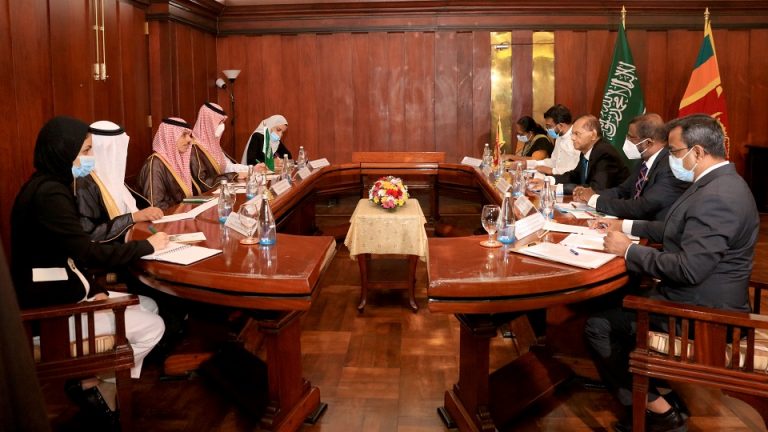
The visiting Minister of Foreign Affairs of the Kingdom of Saudi Arabia, H.H. Prince Faisal bin Farhan bin Abdulla Al Saudpaid a courtesy calls on President Gotabaya Rajapaksa and Prime Minister Mahinda Rajapaksa followed by a bilateral meeting with the Minister of Foreign Affairs, Prof. G.L. Peiris, at the Ministry of Foreign Affairs on 14 March 2022.
While welcoming the Saudi Foreign Minister, Minister Peiris expressed Sri Lanka’s keen interest to transform Sri Lanka– Saudi Arabia bilateral relations into a results-oriented, multi-faceted partnership.
The two Ministers agreed to a stronger relationship on a multitude of areas of bilateral interest for the mutual benefit, in the current global context.
Minister Peiris noted with appreciation Saudi Arabia’s strong support and empathetic approach towards Sri Lanka at the United Nations, especially during the 49th Session of the Human Rights Council in Geneva.
Foreign Minister Prof. Peiris encouraged Saudi investments in the Colombo port, Hambantota port, dedicated Pharmaceutical zones in Hambantota, newly identified IT parks, fabric/textile zone in Batticaloa and further sought more employment opportunities for Sri Lankans in the Saudi Arabian job market.
Noting that development cooperation comprises an important element in the bilateral partnership, Minister Peiris conveyed Sri Lanka’s appreciation to Saudi Arabia for providing infrastructure development assistance to Sri Lanka.
During the talks, the Saudi Foreign Minister reiterated the commitment of the Saudi Arabian Government to further deepen the already buoyant bilateral relations between the two countries and further emphasized economic cooperation. He underscored the vision of Saudi Arabia 2030 as a means to transform Saudi Arabia from the present dependency on oil to digital economy in the Middle East region.
State Minister of Regional Cooperation, Tharaka Balasuriya, Secretary to the Foreign Affairs Admiral Prof. Jayanath Colombage and senior Foreign Ministry officials were engaged with the bilateral meeting at the Ministry of Foreign Affairs. The Saudi Foreign Minister, Prince Faisal bin Farhan bin Abdulla Al- Saud was accompanied to the meeting by the Ambassador of Saudi Arabia to Sri Lanka, Abdulnaser bin Hussain Al-Harthi, Director General of the Office of the Minister of Foreign Affairs, Abdulrahaman Arkan I. Aldawood, Second Secretary, Taif Abdulkhaliq S. Kadasah and the Officer-in-Charge of Political Affairs, Afnan Fahad A. Alhumaidan.
Leader of the Opposition Sajith Premadasa speaking exclusively to LNW debunked the speculations made by critics about his visit to Yala National Park this morning (14) stating that his visit was purely educational, following the circulation of a video clip that went viral.
Many critics on Social Media were of the claim that the Opposition Leader is sight-seeing and enjoying life amidst a grave economic and political crisis befallen the country.
Reminding that 25 per cent of the 10th phase of his Masters Degree (MSc) in Environmental Science is directly linked to field studies, Premadasa revealed that he spent three hours in the field for his education at the first chance he had this morning.
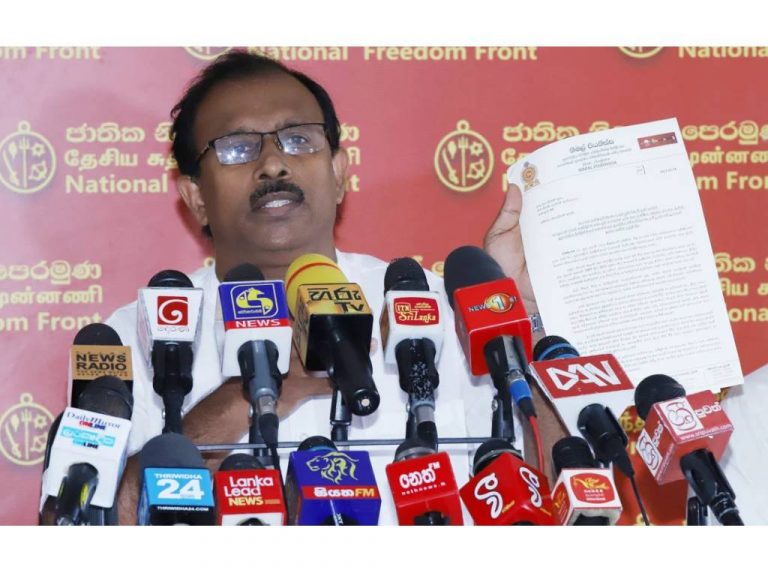
Holding a position given by a regime that violated the 6.9 million mandate is contradictory to the conscience, said Ruling Party Nuwara Eliya District MP and National Freedom Front (Jathika Nidahas Peramuna) Deputy Secretary Nimal Piyatissa, speaking to a briefing held today (14).
Accordingly, the MP has taken steps to resign from his post as the Chairman of the Regional Coordinating Committee of Kotmale in the Nuwara Eliya District.
He revealed that his resignation letter will be forwarded to President Gotabaya Rajapaksa today.
Alleging that the government and the President are defying the 6.9 million mandate given to them, Piyatissa pointed out that the decision to dismiss two leaders of political parties who had committed themselves to the creation of this mandate would be totally unacceptable.
The people’s support for the government is rapidly declining, the MP went on, adding that it is facing strong opposition the entire public, including the farming community.
In the backdrop, holding a position of a regime that moves forward in defiance of the mandate is contradictory to the conscience, he added.
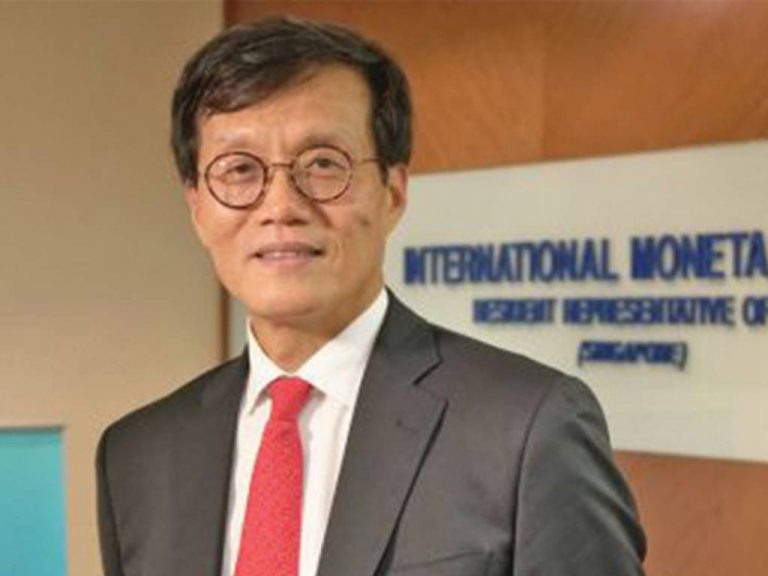
Changyong Rhee, Asia Pacific Director of the International Monetary Fund (IMF) who is currently on a visit to Sri Lanka has called on Finance Minister Basil Rajapaksa this (14) afternoon. The meeting was participated by Finance Secretary S.R. Attygalle as well.
Rhee is set to visit President Gotabaya Rajapaksa tomorrow and is expected to brief the President on the IMF’s assessment on the economic situation of the country.
The IMF Asia Pacific Director stated that no request for fiscal assistance has been received from Sri Lanka to date and that he is ready to discuss about alternatives, should such a request be received.
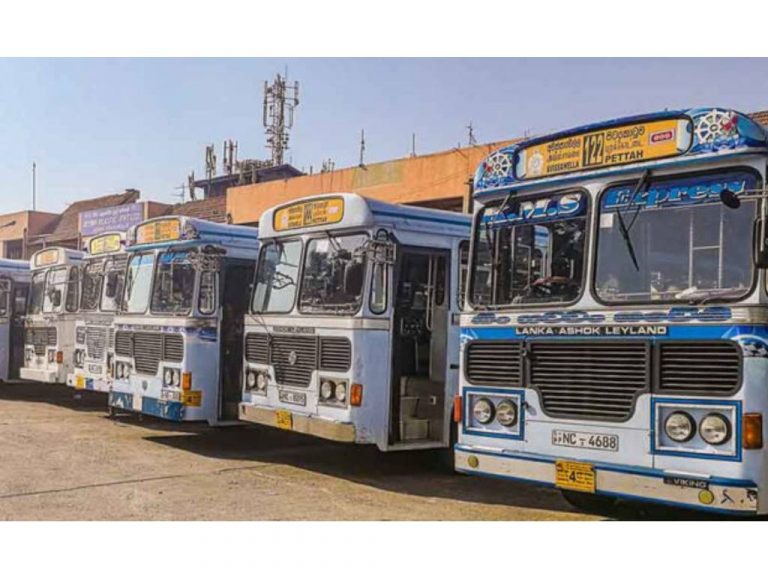
The bus fares have been revised effective from midnight today (14). Accordingly, the revised bus fares have been published by the National Transport Commission this evening.
The minimum bus fare has surged up Rs. 20, rising from Rs. 17.
The maximum bus fare has surged up to Rs. 1498, rising from Rs. 1303.
Accordingly, the bus fares have been increased by 15 per cent.
Remittances from migrant workers have surged by 400 per cent in the past week, days after the US Dollar being allowed to float, CBSL sources disclosed.
Accordingly, the decision taken by Finance Minister Basil Rajapaksa and Governor of the Central Bank of Sri Lanka (CBSL) Ajith Nivard Cabral to allow the US Dollar to float despite endless criticisms is coming into effect, believed to be having a positive impact on the country’s economy.
The surge of foreign remittances by 400 per cent has been confirmed by sources from the People’s Bank and the Bank of Ceylon (BOC) as well.
Mr Sullivan, seen here in a file picture, warned that the US would not allow China to provide a “lifeline” to Russia
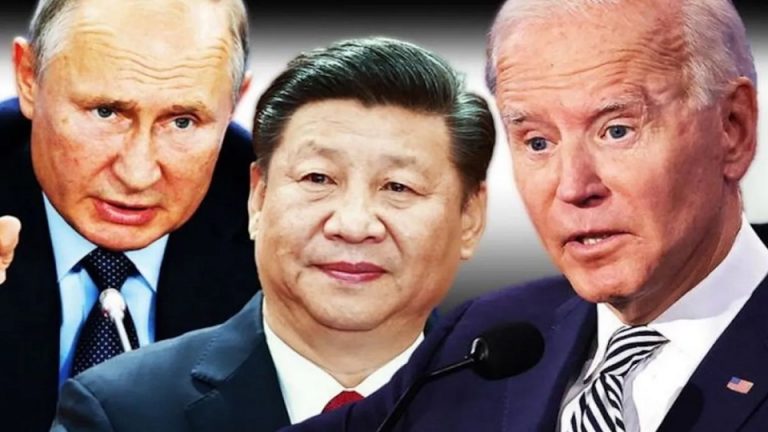
China will face consequences if it helps Russia evade sanctions in its invasion of Ukraine, the US says.
Unnamed US officials reportedly told multiple news outlets that Russia had asked China to provide military assistance after it began the invasion.
The Chinese foreign ministry did not address the allegation directly, but accused the US of maliciously spreading disinformation about China.
The exchanges come before top US and Chinese officials meet in Rome.
US media outlets, citing Washington officials, say that Russia has in recent days asked China specifically for military equipment, including drones.
In a CNN interview, US National Security Adviser Jake Sullivan said they were “communicating directly, privately to Beijing that there will absolutely be consequences for large-scale sanctions evasion efforts or support to Russia to backfill them”.
“We will not allow that to go forward and allow there to be a lifeline to Russia from these economic sanctions from any country, anywhere in the world,” he said.
He added that while the US believed China was aware that Russian leader Vladimir Putin was “planning something” before the invasion happened, Beijing “may not have understood the full extent of it”.
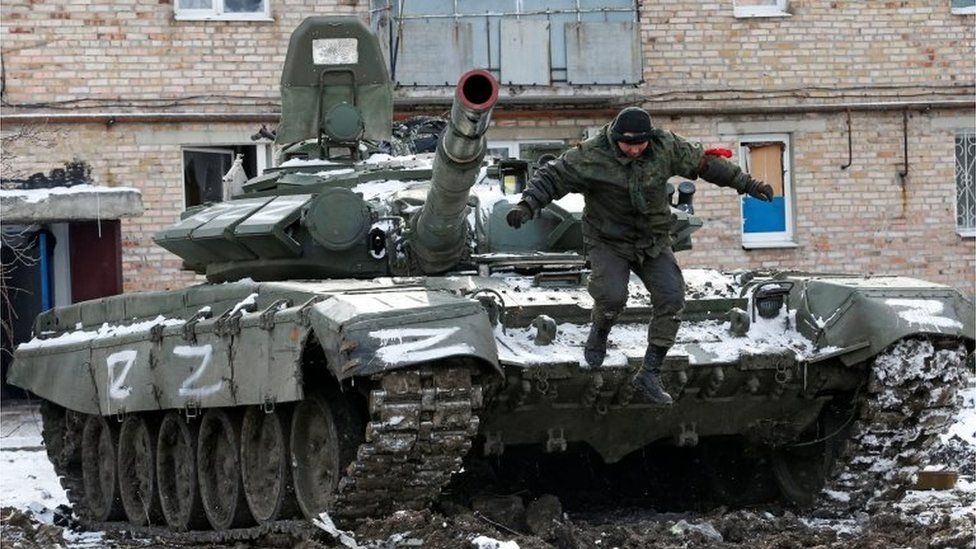
Image caption, Russia’s military action is now in its third week and has horrified much of the world
“Because it’s very possible that [Mr] Putin lied to them the same way that he lied to Europeans and others,” Mr Sullivan said.
In response, a spokesman for the foreign ministry in Beijing, Zhao Lijian, said the US had “been spreading disinformation targeting China on the Ukraine issue, with malicious intentions”.
Asked if he could clarify whether China had received a request for military help from Russia, Mr Zhao said this was “fake news” but did not deny it directly.
He added that China’s stance had always been consistent and that China was playing a constructive role in promoting talks.
Mr Sullivan is due to meet Yang Jiechi, a member of China’s top decision-making body, the Politburo, and head of the Central Foreign Affairs Commission, on Monday in Rome.
Reuters news agency quoted a US official as saying that during the meeting, Mr Sullivan would spell out the consequences and isolation China would face if it increased support for Russia.
China has so far refrained from condemning Russia for the invasion and has said Moscow’s “legitimate security concerns” should be taken seriously.
When the United Nations General Assembly voted to condemn Russia’s invasion earlier this month, China was one of 35 countries that abstained.
But Beijing at the same time has expressed “unwavering support” for Ukraine’s sovereignty. It has also called for peace and has said it is ready to help end the war through diplomacy. Several countries have urged China to do more to stop Russia’s invasion.
The EU and US help Ukraine, China helps Russia; if that’s how this goes, then it’s a delineation that will make the war in Ukraine an even more consequential one.
The White House has decided to make public its claim just as President Biden’s top security adviser is due to meet China’s most senior diplomat. It appears to be a tactical move, to put pressure on China; presumably to either confirm or deny it.
The bigger aim could be to try to make Xi Jinping weigh up the pros and cons to his current position of what was last week called a “rock solid” relationship with Moscow.
Remember that it was just weeks ago, as the Winter Olympics opened in Beijing, that Presidents Xi and Putin declared a new alliance that had “no limit”. Military aid could, clearly, be part of that.
But in the days after Russia’s invasion China has condemned the UK, the US and others for giving weapons to Ukraine’s military, saying they were adding “fuel to the fire”.
If the US intelligence assessment is correct and Beijing follows through on that request, then they too would be “adding fuel”.