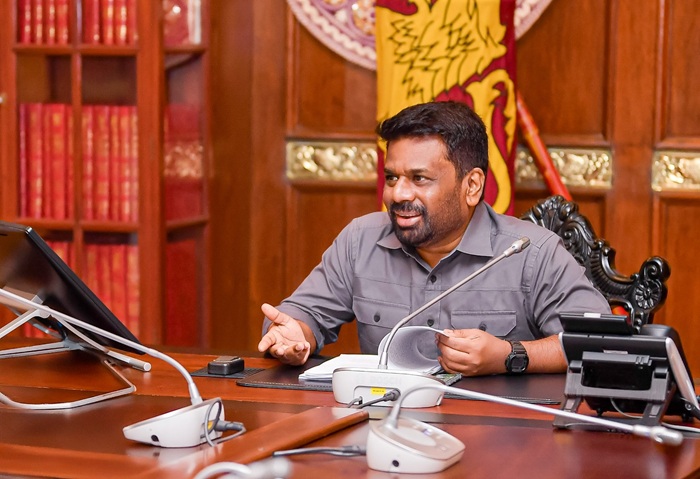
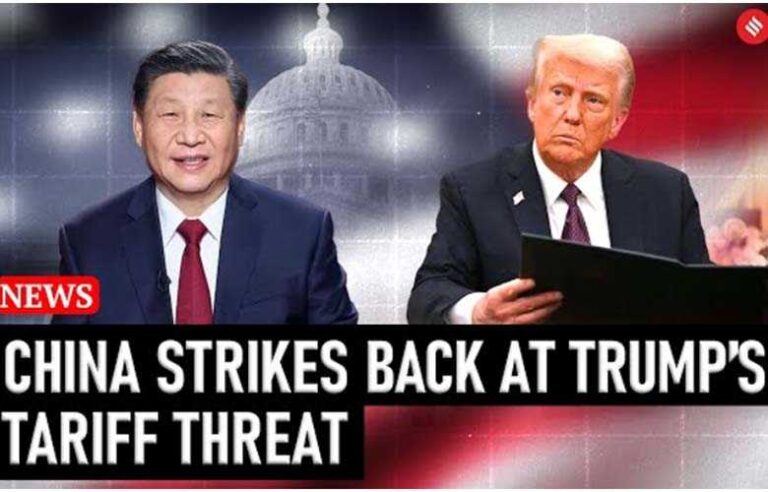
April 13, Colombo (LNW): President Anura Kumara Dissanayake has revealed that two letters have been sent to US President Donald Trump addressing the ongoing tariff issues between Sri Lanka and the United States. According to Samagi Jana Balawegaya (SJB) MP Dr. Harsha de Silva, the first letter, written by President Dissanayake, was followed by a more detailed letter from the Secretary to the Treasury outlining potential solutions to resolve the dispute.
The All-Party Conference (APC), held on Thursday, April 10, gathered key political figures, government officials, and economic advisors to discuss Sri Lanka’s response to potential economic challenges posed by US trade policies. During the meeting, Opposition Leader Sajith Premadasa emphasized the need for a unified national approach to mitigate the potential fallout, which he warned could include job losses and factory closures if no decisive action was taken.
Dr. de Silva, who chairs the parliamentary Committee on Public Finance, provided a technical analysis during the meeting. He stressed the importance of economic reforms and regional integration to enhance Sri Lanka’s economic resilience. One key proposal was to sign the Economic and Technology Cooperation Agreement (ETCA) with India, which could unlock regional growth opportunities. Additionally, he suggested a Harmonised System (HS) Code-based approach to trade negotiations with the US, which could help improve bilateral relations and address the tariff concerns.
Despite acknowledging these suggestions, President Dissanayake did not commit to any specific actions at the time. Dr. de Silva, however, stressed the need for pragmatic engagement with the US, pointing out that President Trump’s approach to trade, especially his focus on trade deficits, was fundamentally flawed but must be navigated carefully due to its transactional nature.
Addressing the concerns over the US’s imposed tariffs, Dr. de Silva pointed out that the 88% tariff figure was misleading. He explained that the number was derived by dividing the trade deficit by the value of imports from Sri Lanka, using arbitrary parameters. He argued that this calculation did not reflect the actual tariffs and that debating it on technical grounds was futile.
The APC also raised concerns about Sri Lanka’s economic future, particularly regarding the potential loss of the European Union’s GSP+ trade concessions. Dr. de Silva warned that the upcoming changes in EU regulations could result in Sri Lanka losing its preferential trade status. He emphasized the urgency of securing a transitional arrangement to prevent disruptions to Sri Lanka’s export economy.
At the conclusion of the APC, it was agreed to monitor the situation closely and reconvene for further discussions. Although no formal committee was established, there were suggestions to form a working group to continue addressing the issue. Sri Lankan officials are expected to engage with US trade representatives during the upcoming IMF and World Bank Spring Meetings in Washington, DC, to further advance the discussions.
April 13, Colombo (LNW): Despite mounting global trade pressures, Sri Lanka is holding firm on its $18.7 billion export target for 2025. The government’s stance comes amid a 44% tariff hike by the United States and the possible suspension of the European Union’s GSP+ trade benefits due to concerns over human rights practices.
The Generalised Scheme of Preferences Plus (GSP+), which allows Sri Lankan exports reduced tariffs to the EU, has been vital for key sectors such as apparel, seafood, and rubber. Any withdrawal of this preferential access could severely damage export competitiveness and lead to job losses, especially in the apparel industry—one of the country’s largest employers.
While the EU’s concerns are centered on human rights compliance, the U.S. tariff hike, announced by former President Donald Trump, forms part of a broader global trade strategy and is not exclusively aimed at Sri Lanka. However, the Ministry of Trade, Commerce, and Food Security acknowledges the potential fallout, as Sri Lanka exports nearly $3 billion worth of goods to the U.S., with apparel alone contributing $1.8 billion.
“We believe this tariff may be related to our trade imbalance with the U.S., where we import only about $300 million,” a ministry spokesperson stated. “But we remain optimistic and are seeking a diplomatic resolution.”
Officials further confirmed that even if no exemption is reached, Sri Lanka is preparing to diversify its export markets. Early discussions are underway to boost trade with Europe and Asia, ensuring resilience in case U.S. access becomes more restricted.
The Export Development Board (EDB) has projected $14.54 billion from merchandise exports and $4.16 billion from services by 2025. Despite the expected increase in competition due to rising costs, the government maintains that the U.S. market won’t be entirely lost.
Meanwhile, Colombo-based think tank Verité Research has urged a multilateral approach through the World Trade Organization (WTO) rather than isolated bilateral deals. They warn that unilateral moves like Trump’s tariff hikes weaken global trade norms. Verité recommends a “Cooperative Common Response” to defend the integrity of the international trading system.
Diplomatic efforts are ongoing. While the U.S. typically avoids direct government-to-government trade negotiations, Sri Lanka has initiated virtual discussions. Deputy Economic Minister Anil Jayantha said energy imports and tariff reforms may be used as bargaining tools during these talks.
With no plans to adjust its 2025 export ambitions, Sri Lanka is navigating the complexities of global trade with a dual strategy: defending its current markets while actively pursuing new ones. Whether through diplomacy or diversification, officials remain committed to shielding the economy from external shocks.
April 13, Colombo (LNW): Health authorities have launched widespread legal proceedings against nearly 600 retailers across Sri Lanka following a nationwide inspection campaign targeting food safety violations during the recent festive period.
The operations, led by the island’s Public Health Inspectors, were conducted between 23 March and early April, focusing on shops and food outlets suspected of breaching public health regulations.
According to Chamil Muthukuda, Secretary of the Public Health Inspectors’ Union, a total of 591 establishments were found to be in contravention of the Food Act, prompting immediate legal action.
These offences ranged from the sale of expired and mislabelled goods to poor hygiene practices and unsafe food storage.
The extensive campaign covered over 4,700 retail outlets, with officers deployed across urban and rural areas to ensure compliance with national food safety standards.
Muthukuda noted that whilst the majority of businesses operated responsibly, a significant number were found to be endangering public health through negligence or deliberate malpractice.
Meanwhile, the Health Ministry has urged consumers to remain vigilant when purchasing food and to report any suspicious products or unhygienic practices to local authorities. Officials are also encouraging businesses to undergo training and certification to ensure that their operations align with updated food safety protocols.
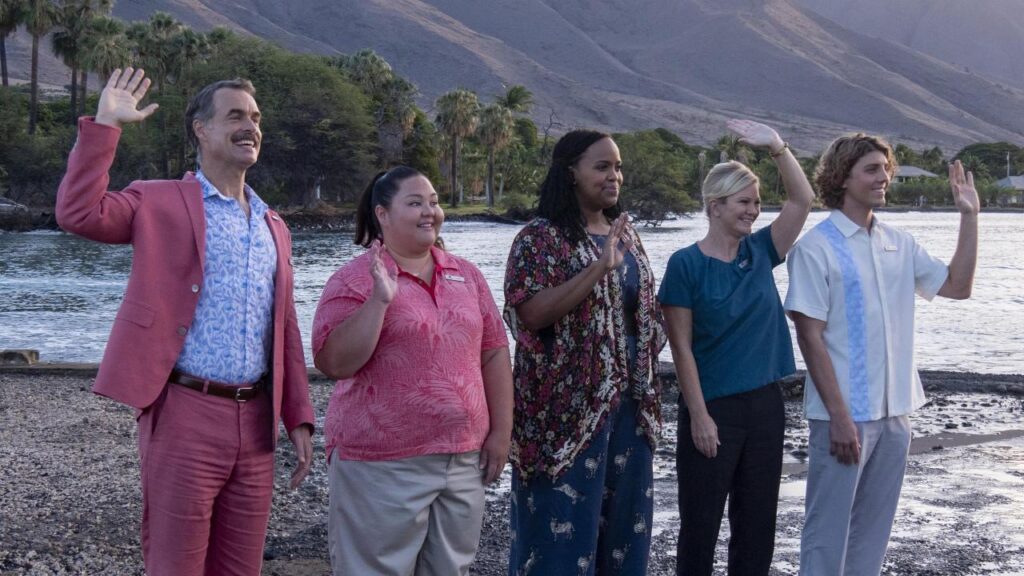
April 13, World (LNW): Mike White’s acclaimed television series The White Lotus unfolds like a luxury holiday gone wrong, yet beneath its sun-soaked resorts and picture-perfect vistas lies an astute dissection of modern capitalism and the quietly simmering tensions between the elite and the rest.
With this article exploring the depths of such social phenomena, viewer discretion is advised – spoilers ahead!
With biting satire and razor-sharp dialogue, the show pulls back the curtain on the hypocrisies, self-delusions, and unchecked power of the wealthy, revealing not only how they live in a world immune to consequence, but how their hubris often leads to their moral – and sometimes literal – downfall.
Each season of The White Lotus is meticulously set in an opulent hotel, a microcosm where class hierarchies become grotesquely visible. The staff, though superficially polite, are all too aware of their position within the hierarchy, often quietly seething beneath the surface. The wealthy guests, meanwhile, remain blissfully detached from the reality they impose on others. It is not merely a critique of wealth, but of the culture that sustains it – a capitalism that grooms its beneficiaries to believe in their inherent superiority whilst turning a blind eye to the systems that crush everyone else.
There is a subtle, persistent grudge simmering between the elite and the middle class throughout the series. The middle class is either desperate to ascend into the elite circle or resentfully aware that they never truly will. Characters like Harper in Season 2 embody this tension – sharp, observant, and critical of her surroundings, yet ultimately drawn into the very lifestyle she critiques. It is a grim commentary on how capitalism does not only oppress, it seduces. The middle class clings to morality, but once proximity to power and money is introduced, values are tested, distorted, or abandoned altogether.
Perhaps the most chilling element of the series is how the characters’ vanity leads them to ruin. From Tanya’s delusional pursuit of affection and status, to Shane’s obsessive entitlement over a hotel room, their inflated self-worth blinds them to reality. The pursuit of self-importance – whether through relationships, money, or dominance – becomes their undoing. The White Lotus does not just portray these downfalls as individual flaws, but as symptomatic of a system that rewards narcissism and punishes humility. When characters fall, it is often not due to malicious forces, but because they are trapped within their own illusions of grandeur.
Tanya’s tragic end in Season 2 is the most glaring example of this. Seduced by the charm of European aristocrats and flattered into a false sense of belonging, she is ultimately manipulated and cornered, her wealth and naïveté exploited by those who see her only as a means to an end. Her final moments – absurd, panicked, and accidental – are not just a darkly comic twist, but a metaphor for how the elite can be consumed by the very world they think they control. Tanya dies not just because she is foolish, but because the system that raised her on vanity and isolation leaves her utterly defenceless when real danger arrives.
The show’s genius lies not only in its satire of the elite, but in the way it shows how systemic behaviours repeat across social strata. Belinda Lindsey, the spa manager in Season 1, is initially portrayed as a victim of Tanya’s erratic generosity – promised support and upliftment, only to be discarded when Tanya finds a new distraction. However, in a clever turn in the Thailand-based Season 3, Belinda is shown repeating the exact same behaviour towards a local hotel employee. She, too, dangles hope – a spa business idea, a chance at upward mobility – only to abandon it in pursuit of her own ambitions. What was once oppression becomes replication. The abused, now with marginal power, becomes the abuser. The show lays bare how capitalism does not merely harm from above – it teaches people to internalise its logic and reproduce it whenever they get the chance.
Racism, sexism, and homophobia simmer beneath the glossy surface, never addressed outright but always present, woven into the fabric of elite behaviour. Paula’s experience in Season 1 as a woman of colour amongst white guests is suffused with awkward silence, well-meaning microaggressions, and ultimately, betrayal. The guests’ liberal façades crumble under pressure, revealing how deep-seated biases remain alive even amongst the wealthy who claim to be progressive. In truth, their wealth insulates them from the real work of justice – why challenge a system that benefits you, even if it disadvantages everyone else?
Sexism, too, runs rampant. Women are either trophy wives, mistresses, or struggling for autonomy in a world designed by and for men. Even characters like Tanya, who wield wealth, are not truly free. They are entangled in emotional dependencies, illusions of romance, and the manipulation of men who see them as nothing more than bank accounts in heels. Sex is transactional; relationships are power games. The show does not ask whether liberation is possible in such a world – it suggests that, within the system as it stands, it is merely a fantasy.
Homophobia, particularly in the upper echelons, is handled with similar complexity. Characters present as tolerant, open-minded cosmopolitans, but when control is at stake, old prejudices rise to the surface. The duplicity of the elite – publicly progressive, privately prejudiced – is rendered in chilling clarity, particularly in the ways they exploit, marginalise, or fetishise LGBTQIA+ individuals for their amusement, convenience, or image.
Perhaps most damning of all is the series’ portrayal of how the rich view the law: as a suggestion, not a boundary. Whether it is covering up deaths, exploiting workers, or committing fraud, the consequences are either softened or wholly evaded. Money shields them, lawyers buffer them, and the system bends around them. In contrast, the less privileged suffer the full brunt of justice, or worse, are coerced into silence. In The White Lotus, justice is not blind – it is bought.
Ultimately, the show is a bleak, brilliant exploration of a society where morality is optional for those with wealth, and consequence is something that happens to other people. Behind the Instagram-perfect holidays, beneath the designer labels and infinity pools, lies a world rotting from the inside. The White Lotus does not just invite us to sneer at the rich – it forces us to reckon with how easily we could become them, and how willingly we might trade our integrity for comfort if given the chance.
In a damning audit report, Sri Lanka’s Auditor General has uncovered a series of financial mismanagement issues, questionable spending decisions, and governance failures at the National Olympic Committee (NOC) of Sri Lanka. The findings raise serious concerns about the organisation’s stewardship of resources meant to develop the country’s Olympic athletes and sports programmes.
The report, which examined the NOC’s operations during 2023, comes at a particularly troubling time as the International Olympic Committee (IOC) has imposed financial sanctions against Sri Lanka’s NOC effective last December, with the possibility of complete suspension of membership looming.
Among the most concerning revelations was the failure of the NOC’s scholarship programme for the Paris 2024 Olympics. The Committee spent Rs. 53,009,144 on scholarships for athletes between 2022 and 2024, yet remarkably, not a single scholarship recipient qualified for the Olympic Games. Meanwhile, the six athletes who did represent Sri Lanka at the Olympics received no support from this programme.
The audit also highlighted several instances of questionable spending without proper authorisation. In one case, the NOC spent Rs. 15,450,579 on overseas training for an athlete preparing for the 2023 Asian Games without obtaining approval from the executive committee, the respective national federation, the department of sports development, or the relevant minister. The athlete subsequently failed to qualify for the Asian Games due to poor performance.
In another troubling incident, the NOC advanced US$ 1,430 (approximately Rs. 464,750) to a retired weightlifter for an overseas sports education programme without the consent of the Weightlifting Federation. The individual, who was supposedly being groomed as a coach, never returned to Sri Lanka after completing the programme and has not settled the advance payment.
The report also revealed the NOC’s failure to distribute allocated annual member grants totaling Rs. 5,400,000 and other project-related payments of Rs. 5,266,980 to 18 National Sports Associations during the year under review.
Property management issues have further compounded the NOC’s financial troubles. The gymnasium was leased to an outside party who vacated the premises without settling outstanding balances of Rs. 2,699,256 as of December 31, 2023. Similarly, a restaurant leased to a private company left Rs. 3,801,979 in unpaid annual rent by the end of 2023. Despite collecting Rs. 683,000 from the leaseholder to renew the restaurant’s bar license, the NOC failed to complete the renewal.
Questions about duplicate expenditures have also emerged. While the NOC hired an external legal consultant for a two-year period beginning February 2023 at a cost of Rs. 935,000 for the year, it simultaneously paid Rs. 6,878,219 to external legal personnel for the same matters.
Other financial irregularities included Rs. 1,602,000 spent on gifts and donations to athletes, officials, and coaches without an approved scheme, and long-standing uncollected receivables from the Cycling Federation of Sri Lanka (Rs. 271,800) and Sri Lanka Baseball/Softball Federations (Rs. 720,047) that have remained outstanding for over three years.
The IOC had granted Rs. 7,109,600 to the NOC for preparing a strategic plan for 2023-2028, yet the Committee failed to complete the plan by December 31, 2023, despite spending Rs. 9,246,111 on the effort.
Perhaps most concerning were the governance issues related to the Commonwealth Games held in 2022. The NOC arranged for 176 people to participate, with six attending without the approval of the Minister of Sports and Youth Affairs. Fourteen individuals did not return to Sri Lanka after the Games, despite the NOC spending Rs. 9,294,968 on behalf of 12 participants during 2022.
As Sri Lanka’s sports community grapples with these revelations, athletes preparing for upcoming international competitions face uncertainty about organisational support and funding. The audit report’s stark findings suggest that comprehensive reforms will be necessary to restore credibility to the National Olympic Committee and prevent further damage to the country’s sporting reputation.
April 13, Colombo (LNW): Authorities have begun a formal inquiry into a troubling incident at a Colombo-based boys’ primary school, where young students were reportedly subjected to severe physical punishment by a teacher.
The National Child Protection Authority (NCPA) confirmed that its Special Investigation Unit initiated the probe following public concern over a video that recently emerged online.
The footage, widely circulated on social media platforms, is said to depict a Grade 3 teacher meting out what appears to be violent discipline to children under his supervision.
The teacher, identified as R. Ganeshamoorthy, is accused of striking the students with a stainless steel ruler—an act allegedly carried out in response to their inability to memorise and recite a lesson.
The children involved, both aged seven, have since provided detailed statements to investigators alongside their parents and school officials.
The NCPA’s Director of Law Enforcement, Ms Sajeewani Abeykoon, noted that whilst some parents were initially reluctant to press charges, further discussions clarified that legal action would serve to protect not only their children but potentially others as well.
“Our responsibility is to uphold the rights and wellbeing of the child, irrespective of the initial hesitation from guardians,” she said.
In the course of the inquiry, investigators visited the school to examine the classroom where the incident is believed to have occurred.
Forensic medical assessments of the children have been conducted and video testimonies have been collected under judicial authorisation.
Officials confirmed that the preliminary phase of the investigation has concluded and that the matter has now been brought before court under Section 308 of the Penal Code, which addresses cruelty inflicted on children.
The teacher, believed to be a resident of Badulla, has not yet been apprehended and is reportedly evading arrest. Police have launched a targeted operation to locate and bring the individual into custody.
The incident has reignited public discourse on the persistence of corporal punishment in Sri Lanka’s education system, despite longstanding calls for reform.
Whilst the use of physical discipline in schools is officially discouraged and prohibited under child protection regulations, enforcement remains inconsistent, particularly in primary institutions.
Child rights advocates and educational experts have expressed outrage over the incident, urging stronger institutional accountability and better mechanisms for reporting abuse within schools.
Many have emphasised the need for sustained teacher training on non-violent disciplinary methods, coupled with psychological support frameworks for both students and educators.
This article is to predict the possibility of a new global monetary order that may evolve in response to the new tariff policy declared by the US President Donald Trump (announced on 2 April 2025 to be effective from 9 April 2025). Therefore, the article does not comment on its viability or fairness from any perspective.
The present global monetary order has evolved on the US dollar as the global reserve currency created largely through free and facilitative trade and balance of payment (BOP) deficits of the US economy with the support of its allies and the US-sponsored international institutional network.
However, Trump’s new tariff policy is to hack it radically by an attempt to have zero trade balances of the US with individual countries through the imposition of reciprocal tariffs and trade barriers variant on the US trade deficit with each country.
Accordingly, Trump’s new tariff policy is aimed at a zero trade balance with each country and eventually for the US. If the new tariff policy is to prevail, a new global monetary order has to evolve soon because the dollar cannot function as the major reserve currency as its supply is frozen by the balanced trade.
Key features of the new US tariff policy
It has four major tariff categories effective from 9 April 2025 as highlighted below.
A universal 10% tariff for imports from all countries
A reciprocal tariff for imports from each country based on the US trade deficit with the respective country. The tariff rate is calculated as follows.
(US trade deficit with the country/US imports from the country x100)/2
25% tariff on cars and selected imports from selected countries such as China
145% tariff on imports from China (Initially at 34%, but increased several times so far to 54%, 84%, 104%, 125% and 145% in response to Chinese retaliations)
The rationale for the design of the reciprocal tariff is as follows.
The US trade deficit calculated as the percentage of the US imports from the respective country is defined as the total loss to the US caused by tariffs, trade barriers, subsidies, tax incentives, exchange rate manipulations, etc. by the country against the US. Therefore, the US trade deficit is unfair.
Accordingly, the half of that percentage is imposed as the reciprocal tariff or discounted tariff for each country. This is intended to force the country to take necessary measures to reduce its trade surplus with the US towards zero.
The above percentage for Sri Lanka is 88%. Therefore, the half of it, i.e., 44%, is the reciprocal tariff for Sri Lanka.
The total trade deficit/total imports of the US is 37% and the half of it is 18.5%. Therefore, the universal tariff of 10% has been imposed on all countries, irrespective of trade deficit or trade surplus with each country. Therefore, countries such as Singapore who run a trade deficit with the US also are subject to the10% universal tariff rate.
Given the global panic caused by the new tariff policy, the effective date for reciprocal tariff rates was postponed on 9 April 2025 for 90 days to allow for the country authorities to agree on trade deals with the US authorities as to how the respective trade deficits would be resolved in the US interest. However, the 10% universal tariff rate is effective from 09 April 2025 as imposed.
What is the magnitude of the US trade deficit to invoke this tariff war?
The new tariff policy highlighted above is based on the US trade deficit in the BOP (see the Table below). Accordingly, the President Trump wishes to reduce the US trade deficit towards zero.
The US BOP highlights in 2024 are as follows.
Imports of goods (item 1 in the Table) were US$ 3,296.2 bn accounting for 11.1% of GDP.
The trade deficit (balance column in the Table) was US$ 1,213 bn which is 4.1% of GDP.
The current account deficit (Item 6 in the Table) (i.e., goods, services and income) was US$ 1,133.6 bn representing 3.8% of GDP.
Overall BOP deficit (Item 7 in the Table), i.e., US$ 1,128.3 bn, shows the total amount of net borrowing of the US from the rest of the world to finance the BOP deficit in 2024. This net borrowing is the amount of US Dollars created by the US banking system to finance the BOP deficit. As the US is the printer of the US Dollars being the most popular global reserve currency, the US can run any amount of BOP deficit as long as the demand for the Dollar from the rest of the world remains strong.
The trade deficit is the key driver in the US current account and overall BOP as services, income and capital trades are not that significant.
Overall, it is the US BOP deficit that supplies US Dollars to the rest of the world. This Dollar supply adds to foreign reserves of the countries which will be invested back in US banks and financial markets.
Therefore, the US benefits from the BOP deficit with the rest of the world twice. First, imports of real resources to enhance the US economy and living standards. Second, reinvestment of US Dollars created to finance the BOP deficit back in the US. This has helped the US government to fund a budget deficit of US dollar 2 trillion and rollover of debt of US dollar 36 trillion (124% of GDP) to keep the momentum of the economy and living standards.
Therefore, the proposed tariff and trade policy will shake up not only the US economy and living standards but also the global economy and global living standards.
How did the present dollarized global monetary order evolve?
The present dollar-based global monetary order is a result of the global trade and institutional network sponsored by the US and and its allies centered around the US economy and geopolitics. The major components of the institutional network are as follows.
1944 Bretton Woods exchange rate system built on the dollar-gold convertibility where exchange rates of other currencies were pegged to the Dollar and convertible into gold through the Dollar. This helped the Dollar to emerge as the global reserve currency where the US gained the world monetary power to print dollars without limits for domestic objectives.
The end of Bretton Woods system as the US suspended the dollar-gold convertibility on 15 August 1971. This freed the discretionary money printing and BOP deficit in the US as the Dollar had already gained the world’s monetary power for the US.
The emergence of IMF (International Monetary Fund), World Bank, United Nations, UNHRC (United Nations Human Rights Council), UNCTAD (United Nations Conference on Trade and Development), US AID (United States Agency for International Development), GATT (General Agreement on Tariff and Trade) and WTO (World Trade Organization) facilitating competitive trades and investments and democracies across the world. This led to a rapid globalization inclusive of the breakdown of communist governance systems towards transparency and human rights aligned to democratic values. This network sponsored by the US was instrumental in promoting the US as the global power house in all facets.
Therefore, these geopolitical developments led to largely free trade arrangements with lower tariffs and dollar-based international payment system where the US became the world power to enjoy the command and benefits.
Accordingly, developing countries became highly dollarized through the international trade and dollar reserves despite their sovereign currencies where the US became the dominant power in the world in both geopolitics and economic management. Accordingly, the developing world reformed their economic systems to earn dollars through exports to the US and its allies as well as borrowing from them. As a result, the global economy was dichotomized between the center with the US and its allies and the periphery of the developing world as the feeder to the center.
In fact, the US trade deficit agitated by the President Trump is the conduit used for this dollarized global trade and monetary order operating with the support of the global institutional network as stated above to the greater benefit of the US. Therefore, the US trade or BOP deficit has been the premium enjoyed by the US on its globalized dollar and underlying geopolitics.
Therefore, if the new tariff policy is to prevail, global institutions such as IMF, World Bank and WTO who promoted the present global trade and monetary order will soon become dormant as there will not be a room for their objectives and operations as agreed at present.
What impact is expected from the new tariff policy on countries?
In modern global economy and living standards, tariffs are brutal. As tariffs are paid by people of the importing country, they are the first victim because tariffs will raise domestic prices of imports and goods and services produced from imported inputs. The eventual effect is dependent on the import content in the economy and the price elasticity of demand for imports. If trade partner countries are to retaliate, there will be a global trade war that will shock the global economy, inflation and living standards through global supply chains. This part of tariff story is simple economics although tariffs are geopolitics.
Therefore, if Trump’s new tariff policy which is designed for making the US trade balance zero or small is to win, the dollar flow to the world will freeze and, therefore, the present dollarized global monetary order has to collapse.
The transition of the new tariff policy will panic many countries and the global economy as seen in the last two weeks. The adverse impact predicted by economists is well clear in text books. Foreign reserves to fall, currencies to depreciate, inflation to rise, interest rates to rise, economies to fall and unemployment to rise are the key predictions.
In the event the President Trump expands its new trade policy to intervene in international flows of investment and income, the global economy will freeze and dollarized debt-ridden developing countries like Sri Lanka will have no option but to collapse. In addition, dollarized monetary and fiscal policies of these countries will fail to protect or revive respective economies in the absence of dollar debt inflows disrupted or frozen by the US balanced trade policy and underlying trade barriers.
All these predictions depend on how markets, political leaders and people will respond to the new US policies. Therefore, the 90-day period given for trade negotiations with the US will entail significant volatilities across the world’s economy and geopolitics. Some developing countries may confront political and economic crises and a new round of defaults during this period.
Why the new tariff policy will push for a new global monetary order?
The present dollarized global monetary order is a geopolitically designed system by the US and its allies. Therefore, given the present trade war conditions and grave uncertainties, the US will not be able to continue with the existing world order due to stiff retaliation of its allies and other global trade leaders such as China, Japan and South Korea who have already developed own reserve currencies in sizable magnitudes. Further, emerging world powers are already in an explicit de-dollarization agenda to engage in trade on own currencies.
The President Trump also has declared a new agenda of a dollar-based cryptocurrency system through the US banking system and new legislation is in the process. Accordingly, banks have been proposed to issue own cryptocurrencies pegged to the dollar and trade them. Therefore, the President Trump seems to be planning a new global dollar system linked to own cryptocurrencies. This will delink the dollar value from real trades and currency speculations.
However, the difficulty in finding an alternative reserve currency for a sustainable global monetary order is the non-availability of a currency with an institutional system to trust the currency and its geopolitics as compared to the US dollar that has evolved during several decades. In that context, if the President Trump wishes the dollar to continue as the global reserve currency and the monetary order, he has to abandon his balanced trade policy and allow the dollar outflow to the rest of the world. Otherwise, the global economy will undergo several rounds of currency crises before markets finding a new system or a global equilibrium.
Given grave uncertainties in global trade and payments caused by Trump’s trade war, countries may look for contracts on exchange of goods and services in old fashion without involving currencies. This will help resolve geopolitics of trading currencies.
The present global order of trade and currencies is a geopolitical outcome. It has got no economics. Economists only can analyze and dispute over the past. Their predictions are highly erratic on geopolitical events. Therefore, economists cannot propose any solutions to the Trump’s trade war or a new global trade and monetary order in the event the President Trump wins the trade war. Therefore, political leaders who try to follow economists will only delay the process and expose countries to crises.
In that context, national leaders of many developing countries in the global periphery have no option but to wait and see what political leaders of the US and its allies will agree on and then to follow suit passively. Finally, in the absence of bargaining powers, they will have to accomplish or deliver what the US authorities require them to do.
However, all national leaders have got a new opportunity for a fresh round of politics in respective countries for them to agitate and flourish. In that context, the President Trump’s tariff policy is a disguised blessing to them who always look for such escapegoats.
(This article is released in the interest of participating in the professional dialogue to find out solutions to economic issues affecting living standards. All are personal views of the author based on his research and knowledge on the subject and, therefore, the author has no intension to personally or maliciously discredit views and characters of any individuals.)
P Samarasiri
(BA (Hons) in Economics and MA in Economics) (Former Deputy Governor, Central Bank of Sri Lanka)
(Former Deputy Governor, Assistant Governor, Secretary to the Monetary Board, Compliance Officer and Director of Bank Supervision of the Central Bank, Former Chairman of the Sri Lanka Accounting and Auditing Standards Board and Credit Information Bureau, Former Chairman and Vice Chairman of the Institute of Bankers of Sri Lanka, Former Member of the Securities and Exchange Commission and Insurance Regulatory Commission and the Author of 13 Economics and Banking Books and a large number of articles published.)
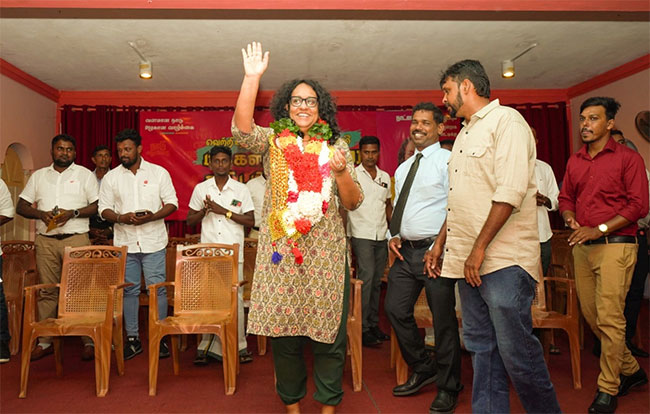
April 13, Colombo (LNW): Prime Minister Dr Harini Amarasuriya has reaffirmed her administration’s focus on reshaping Sri Lanka’s future by revitalising rural economies, tackling corruption, and laying the groundwork for sustained development through inclusive governance and people-centred policies.
Speaking at a public event in Nanattan, Mannar, the Prime Minister said the government was in the process of launching new development projects across the island, particularly in underdeveloped regions, with the aim of ensuring wider community participation in national economic progress.
The event was attended by Members of Parliament, local representatives, and aspiring councillors under the banner of the National People’s Power (NPP).
Reflecting on the recent political transition, Dr Amarasuriya described the current administration as a watershed in Sri Lankan politics. She credited the diverse electorate for rising above longstanding ethnic and religious divisions to reject political corruption and inefficiency, ultimately paving the way for Anura Kumara Dissanayake’s election as President in 2024.
She noted that, within a month of his victory, a new Parliament was formed with a 159-member majority, which she described as a “single-party government that represents every community and every region of the country.”
Dr Amarasuriya said that the NPP’s rise to power was rooted in the people’s desire for change after decades of mismanagement and political opportunism. She pointed to the previous government’s economic failures—highlighting the collapse of the tourism industry, a deepening debt crisis, and the international classification of Sri Lanka as a bankrupt state—as examples of the scale of the challenge the current administration had inherited.
However, the Prime Minister struck an optimistic tone about recent developments, noting that the country had begun to shed its crisis-ridden image.
“We have succeeded in removing the stain of bankruptcy and regaining international confidence. Investment is returning, and there is clear progress in economic stabilisation,” she said.
She emphasised the importance of channelling investments into rural areas to ensure that economic recovery is broadly shared. Infrastructure development and targeted social support were identified as the dual pillars of the government’s first budget.
Notably, programmes such as the extended Aswesuma welfare payments and schoolbook voucher schemes for smaller schools were cited as early examples of the government’s commitment to social protection.
The Prime Minister also addressed broader structural reforms, stating that her government had significantly reduced the size of the Cabinet to cut unnecessary expenditure and curtail waste.
“This government is no longer a burden on the people,” she said. “Public funds are being used more responsibly. Corruption is being tackled, and efficiency is being prioritised.”
In her remarks, Dr Amarasuriya advocated for a data-driven, depoliticised public service that functions independently and serves the public interest. She underscored the need for civil servants to operate in an environment free from political interference, enabling them to act fairly and professionally in delivering services.
Turning her attention to local governance, the Prime Minister acknowledged that while funding had been earmarked for rural development, the proper utilisation of such resources required a functioning and accountable local administration.
She warned that corrupt local officials could derail even the best-intentioned programmes, underlining the critical nature of the forthcoming local government elections.
“We need honest leadership at the grassroots level to translate our national vision into real improvements in people’s lives. That’s why these elections are so important. Only with clean, community-focused leadership can we ensure that public funds truly benefit the people they are meant for,” she concluded.
The Prime Minister’s speech was warmly received by the crowd, which included MPs Jegadeeswaran and S. Thilakanadan, alongside NPP candidates and community leaders.
The event marked another step in the government’s continued outreach to rural constituencies, underscoring its pledge to reshape governance and bring tangible improvements to everyday lives.
April 13, Colombo (LNW): Showers or thundershowers will occur at a few places in Central, Sabaragamuwa, Western, Southern and Uva provinces and in Ampara and Batticaloa districts during the afternoon or night, the Department of Meteorology said in its daily weather forecast today (13).
Showers may occur in the coastal areas of Western and North-western provinces and Galle and Matara districts in the morning as well, the statement added.
The general public is kindly requested to take adequate precautions to minimise damages caused by temporary localised strong winds and lightning during thundershowers.
On the apparent northward relative motion of the sun, it is going to be directly over the latitudes of Sri Lanka during April 05 to 14 in this year. The nearest areas of Sri Lanka over which the sun is overhead today are Thunukkai, Olumadu, Oddusudan, Kumulamunei, Chemmalei at about 12:11 noon.
Marine Weather:
Condition of Rain:
Showers or thundershowers will occur at several places in the sea areas off the coast extending from Puttalam to Hambantota via Colombo and Galle. Showers or thundershowers may occur at a few places in the sea areas off the coast extending from Trincomalee to Hambantota via Batticaloa during the evening or night.
Winds:
Winds will be westerly to south-westerly and wind speed will be (25-35)kmph. Wind speed may increase up to 50 kmph at times in the sea areas off the coasts extending from Kankasanthurai to Puttalam via Mannar and from Matara to Pottuvil via Hambantota.
State of Sea:
The sea areas off the coasts extending from Kankasanthurai to Puttalam via Mannar and from Matara to Pottuvil via Hambantota will be fairly rough at times. Temporarily strong gusty winds and very rough seas can be expected during thundershowers.
(NEXSTAR) — This week, a Texas-based biosciences company, which aims to “de-extinct” animal species of the past (and ones that will go extinct in the future), said it managed to engineer three dire wolves — which have been extinct for over 10,000 years.
Though Colossal Biosciences has described the scientific feat as “bringing back the first animal from extinction,” there are others in the community who disagree with the viability of the concept. This includes University of Buffalo biologist Vincent Lynch, who told the Associated Press that current technology can only “make something look superficially like something else.”This casual dining chain just dethroned Olive Garden as U.S.’ most popular
Scientific disputes aside, the possibility of the return of the dire wolf has set the internet aflutter with more talk about the idea of a real “Jurassic Park.” With that in mind, here are a few extinct species we hope scientists never revive.
Deinosuchus
The ancient crocodiles of the Deinosuchus genus grew as large as a school bus and are notably believed to prey on large dinosaurs — like the T-rex — by ambushing them near prehistoric shores. These “super croc” apex predators had six-inch teeth and were, at one time, the largest predator in North America, according to the Western Australian Museum. They weighed up to 7 tons and scientists note that fossils of other apex predators even show bite marks believed to be exacted by this ancient monster.
Tyrannosaurus rex attacked by deinosuchus crocodile – 3D render (Elenarts108/Getty Images)
Meganeura
These giant predatory dragonfly-like insects are one of the largest-known flying insect species of all-time (if not the) with a wingspan of up to 2.5 feet, according to Furman University. If a mega flying insect isn’t scary enough for you, it’s also a carnivore, though Meganeura mostly ate only other insects and small animals.
Meganeura insects of the Carboniferous Period. Meganeura insects were very large predators during the Carboniferous Period of France and England (Credit: Corey Ford/Stocktrek Images/Getty Images)
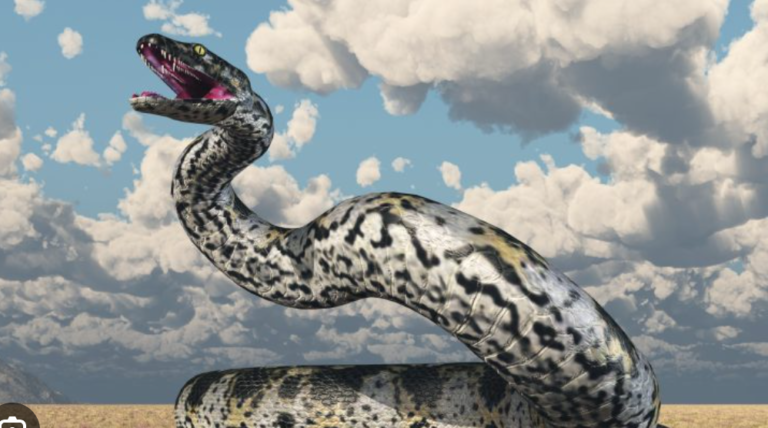
At one point, Titanoboa was the largest known predator on the planet, the museum explains, and likely weighed at least one ton. Of Titanoboa’s size and heft, Smithsonian Magazine says “the thickest part of its body would be nearly as high as a man’s waist.” The creature (which is just begging to be the subject of an action-thriller) was known to lurk in swampy waters, where it preyed on crocodiles and other aquatic predators.
Computer generated 3D illustration of the prehistoric giant snake Titanoboa (Credit: MR1805/Getty Images)
‘Terror birds’
The flightless, carnivorous birds of the Phorusrhacidae family were truly the stuff of nightmares. “Terror birds,” as they’re most commonly referred to, stood at up to 10 feet, weighed up to 300 pounds, and had the ability to run up to 30 mph after its prey, according to University of Maryland. These sharp-taloned and aggressive birds likely crushed their prey with their slightly hook-ended beaks and were able to kill both big and small targets with ease.
Kelenken dinosaur fighting a saber-toothed tiger Smilodon (Credit: Kurt Miller/Stocktrek Images/Getty Images)
Again, though the creature resembles a shark, research shows it’s closer in relation to ratfish. University of Idaho explains that some helicoprion grew to over 30 feet (the average modern-day male great white shark only grows to around 13 feet) and ate squids, sharks and other fish.
Helicoprion from side underwater, illustration. (Credit: Hypersphere/Science Photo Library/Getty Images)
Finally, there were a slew of other extinct creatures we wanted to highlight but just couldn’t find the perfect pictures for. For next steps, do a Google search of gigantopithecus blacki (a 10-foot tall ape) and the giant short-faced bears of the Arctodus family, which also grew up to about 10 feet tall.