Home Blog Page 627

Global Plastics Treaty expected to address maritime disasters: UN Environment Chief

0

By: Isuru Parakrama

October 20, Colombo (LNW): As the final negotiations for the Global Plastics Treaty approach, the United Nations is expected to focus on tackling plastic pollution from maritime disasters, such as the devastating Xpress Pearl incident.

The final discussions will take place in November in Busan, South Korea, as part of efforts to establish the first comprehensive global treaty aimed at addressing plastic waste.

UN Environment Programme (UNEP) Executive Director Inger Andersen, speaking ahead of the negotiations, indicated that the treaty would prioritise measures to “prevent” nurdle spills, a type of microplastic pollution that has wreaked havoc on marine ecosystems.

Nurdles, which are small plastic pellets used in manufacturing, were heavily released into Sri Lankan waters during the Xpress Pearl disaster, causing significant long-term damage to the marine environment.

Although Andersen clarified that the treaty may not directly address specific past incidents like the Xpress Pearl, she noted that its language would target broader concerns related to “legacy plastics” and “accidental releases.”

This signals a strong commitment from the United Nations to preventing future plastic pollution from maritime sources.

The Global Plastics Treaty will mark a milestone in international environmental policy, bringing together member states to confront the growing threat of plastic pollution.

It is expected to include measures aimed at reducing plastic waste across global supply chains, as well as addressing accidents like nurdle spills, which have previously lacked international regulation.

Environmental advocates hope that the treaty’s outcome will lead to stricter preventive measures and greater accountability for industries contributing to plastic waste.

With global awareness of plastic pollution on the rise, the upcoming treaty discussions represent a crucial step towards safeguarding marine environments and promoting sustainability.

Debt restructuring justice. Sugar high profit to creditors justified? Re-default imminent?

0

Article’s background

  • I happened to  read the attached article (Read the Article here) titled “Bondholders could make $14bn from emerging market restructurings, says Debt Justice” published in the UK Financial Times, yesterday, based on research findings by Debt Justice, a UK debt campaigner.
  • These findings are made on expected risks and returns of foreign bond restructuring of several countries including Sri Lanka mediated by the IMF under its bailout programmes.
  • Therefore, the purpose of this article is to share the highlights of the research, mainly on undue restructuring profit to bondholders, as published in the Financial Times as this research provides a good eye-opener to assess the benefits of the ongoing debt restructuring methodology to the country.
  • However, no attempt is made to comment on Sri Lankan debt restructuring progress or profit/loss as relevant official agreements or facts approved by the Parliament are not yet available.

Highlights of the article

  • An estimated debt relief of $30 bn in the years ahead for the countries in debt crisis.
  • An estimated profit of $14 bn to bondholders from restructuring of same debt.
  • Assumptions for $ 14 bn profit estimation to bondholders are as follows.
  • Present bondholders comprise 50% in original investment at face value and other 50% who bought bonds at lower market prices pending default.
  • Restructured bonds will be repaid. Therefore, profit is a theoretical estimate.
  • Estimated profit reflects both high interest payment before default and benefit of buying bonds at low market prices after default.
  • Profit will be as low as $1.9 bn if all restructured bonds had been bought at the face value and attracted no upside payments. 
  • Profit will be as high as $ 26 bn if all restructured bonds had been bought at low market prices and attracted the maximum possible upside payment.
  • A further sizable gain to investors/bondholders over time if governments avoid further defaults in years ahead.
  • Such profits to bondholders could be more than a third of original bondholders’ investment value (generally the face value).
  • Therefore, defaulted countries are not receiving a sufficient debt relief or reduction in their borrowing.
  • These countries do not have enough negotiating powers to get sufficient relief to avoid restructuring in future.
  • Therefore, there are dangers of having to restructure bonds again in future.
  • Bondholders have got a substantial upside from deals with Sri Lanka and Zambia.
  • Provision of contingent payments to bridge disagreements over official projections of post-restructured path of economies and to continue negotiations.
  • Rewarding bondholders with higher interest payment if their economies outperform targets in the years ahead.
  • Some of countries such as Sri Lanka to reduce interest payments in the event of future economic troubles.

Remarks

  • Country authorities have been painting a rosy picture of debt sustainability to be achieved through ongoing debt restructuring gains, especially foreign debt, under the IMF loan programme.
  • However, research findings listed above show substantial costs as well as dangers of having to restructure debt again in future. Therefore, it is doubted whether those who hanled debt rework genuinely assessed and balanced the risks and returns to respective countries in long-term interests.
  • Serious concerns are already raised by some political leaders of Sri Lanka over a possible re-default in 2028 when repayments start under the restructured terms.
  • Another public concern is that those who raised debt under unsustainable terms and mismanaged debt are dealing with default and restructuring of same debt that accrues further benefits to creditors (see above highlights). Therefore, debt restructuring governance faces serious lapses.
  • Warren Buffet, a well known, global investor, once stated that creditors who lent unsustainably must bear the loss and managers who borrowed unsustainably must be sacked. This view made irrelevant to business companies is also applicable to any debt whether private or public.
  • Grave mismanagement of public debt in Sri Lanka is popular at political platforms. However, no leaders seem to commence investigating and addressing relevant public concerns, other than continuing to borrow in rising amounts under same systems that have made debt unsustainable and unproductive. The fact that debt is a heritage in succession is a great relief to those who govern the country and is a great privilege to them to compete for gaining the government power.
  • Restructuring of debt alone without restructuring or replacing of systems and managers that raised and mismanaged debt to default is the very source of the danger of the default again in the years ahead. Therefore, talks over re-emergence from the the bankruptcy immediately after debt restructuring would be futile.

(This article is released in the interest of participating in the professional dialogue to find out solutions to present economic crisis confronted by the general public consequent to the global Corona pandemic, subsequent economic disruptions and shocks both local and global and policy failures. All are personal views of the author based on his research in the subject of Economics which have no intension to personally or maliciously discredit characters of any individuals.)

P Samarasiri

Former Deputy Governor, Central Bank of Sri Lanka

(35 years of staff grade service in the Central Bank, a former Director of Bank Supervision, Assistant Governor, Secretary to the Monetary Board and Compliance Officer of the Central Bank, Former Chairman of the Sri Lanka Accounting and Auditing Standards Board and Credit Information Bureau, Former Chairman and Vice Chairman of the Institute of Bankers of Sri Lanka, Former Member of the Securities and Exchange Commission and Insurance Regulatory Commission and the Author of 13 Economics and Banking Books and a large number of articles published.)

Source: Economy Forward

Four fatalities in separate road accidents across SL

0

By: Isuru Parakrama

October 20, Colombo (LNW): Over the past 24 hours, four individuals, including a woman, tragically lost their lives in separate road accidents across different regions of Sri Lanka, Police said.

The incidents occurred in Moronthuduwa, Kopai, Karandeniya, and Kadawatha, marking a concerning rise in fatal road crashes.

In Moronthuduwa, a 21-year-old motorcyclist lost his life after losing control of his bike on the Moronthuduwa-Horana road.

The young man collided with a culvert, sustaining severe injuries. Despite being rushed to Gonaduwa Hospital, he succumbed to his injuries shortly after.

In another incident in Jaffna’s Kopai area, a three-wheeler struck a 68-year-old woman from Kattapirai while she was crossing the road.

The victim was immediately transported to Jaffna Hospital, where she was treated for critical injuries.

In Borakanda, tragedy struck when an 81-year-old cyclist was involved in a fatal head-on collision with a motorcycle.

The elderly man sustained life-threatening injuries and passed away at the scene of the accident.

Meanwhile, on the Kandy-Colombo main road near Kadawatha, a 74-year-old motorcyclist lost his life when a lorry struck his vehicle.

The collision caused the man to fall under the rear wheels of the lorry, resulting in his death on the spot.

The Police have urged motorists to exercise caution and adhere to traffic regulations to avoid such tragic accidents, especially given the recent increase in road fatalities across the country.

Indian-supported STEM Teacher-Training Programme for SL plantation schools concludes

0

By: Isuru Parakrama

October 20, Colombo (LNW): The closing ceremony of a three-month STEM teacher-training initiative, funded through Indian grant assistance, was recently held at the Ministry of Environment, Wildlife, and Plantation Infrastructure in Sri Lanka.

The programme was designed to improve the quality of education in plantation areas by equipping teachers with advanced knowledge in key STEM subjects.

The event saw the participation of several distinguished figures, including the Indian High Commissioner to Sri Lanka, Santosh Jha, and senior officials from the Ministry of Education and Science and Technology, as well as the Ministry of Environment.

This initiative, a response to a request from the Sri Lankan Government, was part of India’s multi-sectoral grant of INR 750 million, commemorating 200 years since the arrival of the Indian-origin Tamil community in Sri Lanka.

The programme commenced in July 2024 with the arrival of 19 Indian educators specialising in STEM (Physics, Chemistry, Mathematics, English, and Biology).

After an orientation hosted by Sri Lanka’s National Institute of Education, these teachers began their work in plantation schools, offering training to over 2,000 local teachers across 40 centres in Central, Uva, Sabaragamuwa, and Western provinces.

Spanning 10 weeks, the initiative aimed to modernise teaching approaches and enhance the quality of STEM education in under-resourced schools.

The trained teachers and schools expressed great satisfaction with the programme’s impact and called for its continuation in the future.

During the closing ceremony on 18th October 2024, Secretary of the Ministry of Education, Mrs. J.M. Thilaka Jayasundara, praised the effectiveness of the programme, noting its significant contribution to improving the education system in the region.

She extended heartfelt thanks to the Indian Government for its support.

Indian High Commissioner Santosh Jha remarked that this teacher-training initiative further strengthened the historic ties between India and Sri Lanka, adding to a long list of India-supported development projects in sectors such as education, housing, healthcare, and renewable energy.

He highlighted that such collaborations reflect India’s commitment to supporting Sri Lanka’s national priorities and positively influencing the everyday lives of its people.

President rejects Wickremesinghe’s request for excessive privileges

0

By: Isuru Parakrama

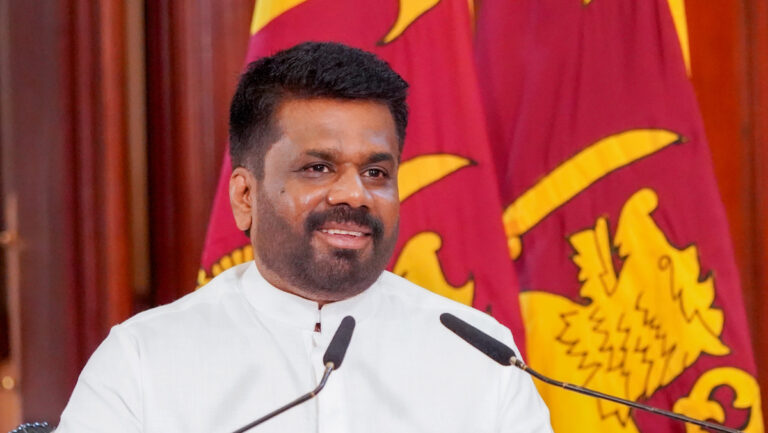
October 20, Colombo (LNW): President Anura Kumara Dissanayake has publicly revealed his decision to deny a request from former President Ranil Wickremesinghe for an extensive array of privileges.

These included an unusually large number of staff and resources, such as 16 chefs, 163 security personnel, 30 umbrellas, and more than 20 vehicles.

Addressing a public gathering, President Dissanayake made it clear that future entitlements for former Presidents would be strictly regulated, starting with Wickremesinghe’s allowance being reduced to just three vehicles, in accordance with current government policies.

Dissanayake further announced plans to introduce new legislation aimed at curbing excessive privileges for former Presidents, ensuring that public funds are used more responsibly.

He emphasised that the government should not be burdened with providing lavish benefits to those who have left office, especially during times of economic difficulty.

In addition to scaling back vehicle entitlements, the President also ordered the retrieval of two ambulances that had been stationed at the residences of both Wickremesinghe and former President Mahinda Rajapaksa.

These ambulances should be part of the national healthcare infrastructure, not treated as personal property by former leaders, according to Dissanayake.

However, the standard privileges entitled to former presidents under the Constitution will remain unchanged.

Showers, thundershowers to continue: Multi-day boats issued warning (Oct 20)

0

By: Isuru Parakrama

October 20, Colombo (LNW): Showers or thundershowers will occur at times in Northern province, and several spells of showers may occur in Western, Sabaragamuwa, Southern and North-western provinces and in Kandy and Nuwara-Eliya districts, the Department of Meteorology said in its daily weather forecast today (20).

Showers or thundershowers may occur at several places in Uva, Eastern and North-central provinces during the evening or night.

The general public is kindly requested to take adequate precautions to minimise damages caused by temporary localised strong winds and lightning during thundershowers.

Marine Weather:

Condition of Rain:
Several spells of showers will occur in the sea areas off the coast extending from Puttalam to Matara via Colombo and Galle. Showers or thundershowers may occur at several places in the other sea areas around the Island.
Winds:
Winds will be South-westerly in direction in the sea areas around the island and wind speed will be (25-35) kmph. Wind speed can increase up to (40-45) kmph at times in the sea areas off the coasts extending from Kankasanthurai to Puttalam via Mannar and from Hambanthota to Pottuvil.
State of Sea:
The sea areas off the coasts extending from Kankasanthurai to Puttalam via Mannar and from Hambanthota to Pottuvil can be fairly rough at times. The other sea areas around the island can be slight to moderate. Temporarily strong gusty winds and very rough seas can be expected during thundershowers.

Sri Lanka Original Narrative Summary: 20/10

0
  1. President Anura Kumara Dissanayake announces the 2025 Budget proposal will be presented in February or March 2025, focusing on increasing state sector salaries, schoolchildren allowances, and support for underprivileged and differently-abled communities: Additionally, a Vote on Account will be presented by the new government in December 2024 to manage interim expenses.
  2. Former Deputy Minister Vincent Dias criticises former MP Harin Fernando for neglecting the Badulla district for five years and expresses disappointment with his political choices: claims Harin’s alliance with the UNP and leader Ranil Wickremesinghe undermined SJB leader Sajith Premadasa and will cost Harin politically in the upcoming election.
  3. The ‘Sarvajana Balaya’ alliance, led by entrepreneur Dilith Jayaweera, launches its election campaign in Anuradhapura: seeks blessings at Jaya Sri Maha Bodhi and Ruwanweli Maha Saya: emphasises self-funded politics and highlighted the upcoming election as a significant opportunity, suggesting its outcome could be surprising.
  4. The Central Bank mandates banks to establish business revival units to aid customers in reviving failed businesses: These units will offer services like financial grants, reduced loan interest, and extended repayment periods: CBSL has previously lowered policy interest rates, encouraging banks to pass on benefits to customers: The Bank of Ceylon has already launched 12 such centres across the country.
  5. EU Ambassador Carmen Moreno meets Prime Minister Dr. Harini Amarasuriya to reaffirm strong ties between the EU and Sri Lanka, with discussions focusing on the GSP+ trade scheme and attracting foreign investment: The Prime Minister also met with Asian Development Bank representatives, expressing gratitude for their support in Sri Lanka’s development projects and seeking continued collaboration for future goals.
  6. The People’s Action For Free and Fair Election (PAFFREL) recommends that general election candidates appoint an individual to manage their expense and income reports: Executive Director Rohana Hettiarachchi highlights that failing to do so could lead to difficulties, as seen in the last presidential election: Appointing someone promptly after the election could minimise financial reporting challenges, ensuring smoother compliance with regulations.
  7. Indian Navy ship INS Kalpeni arrives in Colombo on 19 October, warmly welcomed by the Sri Lanka Navy: The visit, part of India’s ‘Neighbourhood First’ policy, aims to enhance naval cooperation: The ship, specialising in coastal surveillance and anti-smuggling, brought technical support tools for the Sri Lanka Navy: The crew will engage in local visits during their stay until 21 October.
  8. The Government Information Department clarifies former Presidents’ privileges have not been withdrawn, contrary to media reports: Only additional vehicles provided to them have been returned: Former President Mahinda Rajapaksa returned 8 of 16 vehicles, while former President Ranil Wickremesinghe retains 11 vehicles: The statement reaffirms that ex-Presidents still hold their privileges.
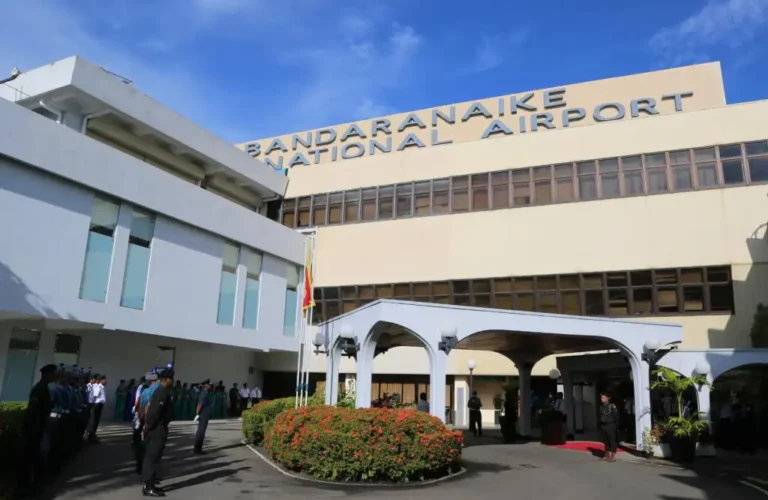
  9. An emergency was declared at Bandaranaike International Airport after a bomb hoax on a Vistara flight from Mumbai, minutes before landing: The captain received a non-specific threat, triggering a protocol response: All 96 passengers and eight crew members landed safely and were evacuated as authorities conducted a thorough search of the aircraft, ensuring safety.
  10. Pathum Nissanka is expected to be rested for the first ODI in Pallekele today due to an injury from the recent T20I series: Kusal Mendis is likely to open with Avishka Fernando, while Kamindu Mendis will bat at No. 3: Star spinner Wanindu Hasaranga returns from injury to bolster Sri Lanka’s spin attack, joining Jeffrey Vandersay and Dunith Wellalage.

BAD OMEN TO THE PLAYERS’ EARS AND THE HEADS OF OFFICIALS WHO TURN A BLIND EYE TO THAT

0


October 19, (LNW) Colombo :
Nowadays, there’s much discussion about coaches in Sri
Lanka, particularly since Sri Lankan Chandika
Hathurusingha has had to resign from his coaching position
in Bangladesh. Chandika Hathurusingha was the coach
who helped take Bangladesh cricket to new heights,
reaching milestones previously unattainable.
Bangladesh cricket has decided to remove him because he
punched a player in the ear. Such acts of violence are not
condoned in today’s moral landscape.
The word admonishment is substituted for such behavior
by our traditional beliefs. As well as the myth that ‘to teach
someone, you have to hit them’, we have been keeping it as
a ritual for a long time. Because of the habit of behaving
like slaves in the presence of superiors, a person who
preaches any teaching is thought to have the right to slap
someone in the ear.
As a result, the behavior that suggests a license to attack
others within our society particularly those in teaching
positions or in authority may have influenced
Hathurusingha as well.
If this had occurred in Sri Lanka, Hathurusingha could
have been a valuable teacher or coach for those in positions
of authority within the Sports Ministry (the current status
of the Sports Minister is still unclear). There has been no
investigation or punishment. It is also possible to
congratulate Hathurusingha for allowing the flowing
mistakes to flow.
This indicates that the Sports Ministry has dissolved and
retained administrative power for itself. Even with videos
of a rugby coach slapping a school player’s ear circulating
multiple times, there has been no action taken to penalize
that coach. No inquiries have been conducted. If this is the
kind of reporting coming from those who oversee all sports
in Sri Lanka, we must consider the potential impact on the
future of sports in the country.
Meanwhile, a recent incident highlights that the Ministry
of Sports is making decisions about coaches without
considering the players, particularly evident in the recent
selection of coaches for the Hong Kong cross-country race.
The coach there is brilliant. He has a great history but has
not had many opportunities. But it is not the coach of the
athlete or athlete representing the cross-country
competition. Therefore, we agree about Sajith Jayalal or
Upali Wickramasinghe going on that tour, but we do not
agree about Pandula Silva going on that tour. It is also
difficult to imagine how the Ministry of Sports decides it.
We agree with one heart to fight against not getting the
proper place. But they cannot be praised for accepting
someone else’s opportunity to succeed.
Consequently, sports in Sri Lanka cannot thrive in an
environment that lacks the vision to reject such unmerited
actions and fight for what has been lost.
The fault of the officials who think that the players’ ears are
not hurt must be their heads. If the thoughts of those heads
are not correct, the game may fall down without being able
to rise again from the blows that hit the ears of the sport. In
this regard, higher political authorities that refrain from
making decisions or investigating the actions of officials
are stalling these matters until after their votes are cast,
resulting in considerable damage.
For instance, the cross-country competition in Hong Kong
cannot be held following the voting process. Also, if the
privilege of hitting the ear of the licensee before the
election is followed by the same person who attacked him
or another person who took him as an example, it is
possible that ear-splitting will become normal during the
voting and the trainers will be using it as their right.

Significant Increase in Income Tax Registrations with TIN Implementation for 2023/2024

0

October 19, Colombo (LNW) The implementation of the Taxpayer Identification Number (TIN) and Individual Registration Programme for Income Tax has resulted in a substantial increase in income tax registration files for the 2023/2024 tax year, as compared to the previous year. Inland Revenue Commissioner General Sepalika Chandrasekara announced that the number of income tax reports submitted for the 2022/2023 assessment year was 333,313, but this figure has surged by 868,009 during 2023/2024.

The expansion of income tax registration has targeted various groups, with increased focus on businessmen, professionals, and individuals who own assets. Those registered are required to submit their income reports through the online system. Payment slips have also been mailed to taxpayers for use if any payment is due.

Chandrasekara noted that individuals who are registered for income tax but do not have sufficient income or profits due to reasons like business closures or lack of income sources can request deactivation of their registration. This process requires submission of supporting documents to the nearest inland revenue office.

As per the tax regulations, individuals earning more than Rs. 100,000 per month or Rs. 1.2 million annually are required to pay income tax.

CBSL Directs Banks to Establish Business Revival Units for Struggling Enterprises

0

October 19, Colombo (LNW) The Central Bank of Sri Lanka (CBSL) has issued a directive to all banks to establish dedicated business revival units aimed at helping customers revive failed businesses. These units offer a range of services, including financial grants, reduced loan interest rates, and extended loan repayment periods to support business recovery.

It was noted that some banks had already set up such units prior to the CBSL’s directive. These existing units are now being upgraded to enhance their efficiency and provide more customer-friendly services. New systems are being implemented to further improve the effectiveness of these units.

The CBSL has also reduced its policy interest rates on several occasions, emphasizing the responsibility of banks to pass on the benefits of these reductions to their customers. CBSL Governor Dr. Nandalal Weerasinghe has urged banks to use the lower policy interest rates to reduce loan interest rates, providing relief to businesses and encouraging economic recovery.

In response to the CBSL’s directive, many banks have already begun offering loans at lower interest rates. For instance, Russell Fonseka, Chief Executive Officer and General Manager of the Bank of Ceylon (BOC), confirmed that BOC currently operates 11 such business revival centres across provincial levels, with one additional centre located at the BOC headquarters in Colombo.