August 20, Colombo (LNW): The Election Commission is set to issue a Gazette notification outlining a limit on campaign spending per voter for the upcoming presidential election.
According to Commissioner General of Elections Saman Sri Ratnayake, candidates will be restricted to a maximum expenditure of Rs. 109 per voter.
The introduction of this cap is part of broader campaign finance reforms aimed at ensuring fairer elections.
These regulations will apply to all future national elections, imposing stricter limits on campaign spending for candidates, political parties, and independent groups.
In preparation for the presidential election, the Election Commission has held consultations with various stakeholders to discuss the new legislation.
The objective was to determine the spending limit and establish a framework for effective implementation, drawing on feedback and recommendations from these discussions.
This marks a significant step towards more transparent and regulated election campaigns in Sri Lanka, aligning with global standards on campaign finance governance.
August 20, Colombo (LNW): Showers or thundershowers will occur at times in Western, Sabaragamuwa, Southern and North-western provinces and in Kandy and Nuwara-Eliya districts, with heavy showers above 100 mm being likely to occur at some places in Western and Sabaragamuwa provinces and in Galle and Matara districts, the Department of Meteorology said in its daily weather forecast today (20).
Showers or thundershowers will occur at several places in Eastern, Uva and North-Central Provinces during the evening or night.
Fairly strong winds about (30-40) kmph can be expected at times over Western slopes of the central hills and in Northern, North-central and North-western provinces and in Hambantota district.
General public is kindly requested to take adequate precautions to minimise damages caused by temporary localised strong winds and lightning during thundershowers.
Marine Weather:
Condition of Rain:
Showers or thundershowers will occur at times in the sea areas off the coast extending from Puttalam to Hambantota via Colombo and Galle. Showers or thundershowers will occur at a few places in the other sea areas around the island during the afternoon or night.
Winds:
Winds will be south-westerly and wind speed will be (30-40) kmph. Wind speed can increase up to (55–60) kmph at times in the sea areas off the coasts extending from Kankasanthurai to Puttalam via Mannar and from Hambantota to Pottuvil. Wind speed can increase up to 50 kmph at times in the sea areas off the coasts extending from Puttalam to Hambantota via Colombo and Galle.
State of Sea:
The sea areas off the coasts extending from Kankasanthurai to Puttalam via Mannar and from Hambantota to Pottuvil will be rough at times. The sea areas off the coasts extending from Puttalam to Hambantota via Colombo and Galle may be fairly rough at times. The swell wave heights may increase (about 2.5m–3.0m) in the sea areas off the coast extending from Kalpitiya to Hambantota via Colombo and Galle (this is not for land area). Temporarily strong gusty winds and very rough seas can be expected during thundershowers.
August 19, Colombo (LNW): Sri Lanka and the Kingdom of Saudi Arabia have agreed to enter into a Memorandum of Understanding (MoU) in a bid to bolster economic ties and attracting direct investments.
The Cabinet of Ministers has endorsed the MoU, viewing it as a critical step towards harnessing foreign direct investment (FDI) to drive sustainable economic development.
Ambassador of Sri Lanka to the Kingdom of Saudi Arabia Omar Lebbe Ameer Ajwad met with Saudi Arabia’s General Authority of Foreign Trade (GAFT) Governor Mohammad Alabduljabar at GAFT Headquarters in Riyadh on 7 August.
While welcoming Ambassador Ameer Ajwad to the Kingdom of Saudi Arabia, GAFT Governor Mohammad Alabduljabar stressed the importance of enhancing bilateral cooperation between the two countries in potential sectors for win-win benefits. He extended GAFT’s support towards this end.
The MoU, signed during a special meeting of the World Economic Forum in Riyadh, Saudi Arabia, recently, marks a pivotal moment in the bilateral relations between the two nations.
The agreement was inked by Sri Lanka’s Minister of Foreign Affairs in the presence of global leaders and economic stakeholders.
Key provisions of the MoU include collaborative efforts towards policy and legal reforms aimed at creating a conducive environment for investments. In addition, both nations intend to focus on upgrading infrastructure facilities and streamlining bureaucratic processes to facilitate smoother business operations
Recalling ancient international trade links between Sri Lanka and Arab nations, Ambassador Ameer Ajwad highlighted promising areas for cooperation between the two countries and proposed collaboration in specific sectors such as food, agriculture, IT, manufacturing, hospitality, real estate, constructions, etc., for trade and investment.
The Ambassador expressed Sri Lanka’s readiness to partner with Saudi Arabia in the realisation of its Vision 2030 and invited a trade delegation from Saudi Arabia’s General Authority of Foreign Trade to visit Sri Lanka on a fact-finding mission.
Deputy Governor of International Relations Abdulaziz Alsakran and senior officials of GAFT and First Secretary (Commerce) of the Embassy of Sri Lanka in Riyadh Tashma Vithanawasam also participated in the meeting.
The agreement “aims to attract direct investment to the country and improve the investment environment of both countries through policy and legal reforms, provision of advanced and integrated infrastructure, process redesign, etc.”
Sri Lanka lagged behind regional nations in attracting foreign direct investment, the minister said. “Compared to Singapore which last year attracted FDIs of 140 billion dollars, India 70 billion dollars, Vietnam 28 billion dollars, and Thailand 20 billion dollars, Sri Lanka only attracted 1 billion dollars.”
August 19, Colombo (LNW): The Sri Lanka Tourism Promotion Bureau has been steadily advancing its efforts to promote the country as a prime destination through various campaigns and marketing strategies in 2024. A major focus has been on the new tourism brand identity, “Sri Lanka: You Will Come Back for More,” symbolizing a fresh start towards success.
According to the Central Bank of Sri Lanka, tourism earnings surged to over $1.5 billion in the first half of 2024, representing a 78% year-on-year increase. Tourist arrivals also saw a significant rise, reaching 1.01 million—a 62% jump compared to the same period in 2023.
As the country rebounds from its recent economic challenges, the “Seeing is Believing” campaign has been a cornerstone of promotional activities. Continued into 2024, this initiative brought nearly 58 foreign media professionals, including travel influencers and bloggers, to Sri Lanka, generating media publicity valued at over $550 million.
Up until August this year, Sri Lanka Tourism participated in 16 international travel shows, including major events like ITB-Germany, FITUR-Spain, ATM-Dubai, and IFTM-France. Additionally, 16 roadshows were organized across India, China, Australia, and Turkey, with a focus on B2B sessions in various cities.
Sri Lanka Tourism also played a pivotal role in supporting key national events such as the Duruthu Perahera, Gangarama Navam Perahera, Buddha Rashmi Vesak Festival, and Kandy Esala Perahera.
A significant achievement this year was the launch of PR and digital campaigns in India, China, the UK, Germany, and France. These campaigns, set to run for one year in India and China and six months in the European countries, aim to increase awareness about Sri Lanka, particularly during the winter season and into 2025.
In 2024, Sri Lanka Tourism received 15 international endorsements, including being named the fourth most popular solo travel destination by Forbes, ranking as the fifth-fastest-growing tourism destination, and topping the list of best places for solo female travel. Additionally, Sri Lanka Tourism was awarded the “Best International Tourism Board” at the Global Tourism Awards in New Delhi, India.
These extensive promotional efforts have contributed to the arrival of 1,289,693 tourists in Sri Lanka by August 14th, primarily from key markets such as India, the UK, Russia, Germany, France, and China. Countries like Australia, the USA, the Netherlands, and Poland also showed strong growth potential.
With these successes, Sri Lanka Tourism is optimistic about achieving its target of 2.3 million tourists by the end of the year.
President Ranil Wickremesinghe callas for greater regional cooperation and economic integration from Japan to India, with a special focus on strengthening ties with India: emphasises Sri Lanka’s strategic role in expanding Asian partnerships, particularly through BIMSTEC: highlights the diminishing global influence of the West and stresses the importance of regional collaboration: acknowledges India’s critical support during Sri Lanka’s recent economic crisis, expressing optimism for deeper bilateral integration and regional stability.
Opposition Leader and presidential candidate Sajith Premadasa reiterates his commitment to unveiling the truth behind the 2019 Easter Sunday terror attacks, addressing the Catholic community’s longstanding concerns: During a visit to Cardinal Malcolm Ranjith in Colombo, Premadasa sought blessings and pledged justice: emphasises his strategy, already presented in Parliament, to ensure transparent investigations and accountability: assures religious leaders that he remains determined to deliver justice, pledging comprehensive action against those responsible if elected: This stance aligns with his broader campaign to gain support from key religious and community figures.
NPP leader Anura Kumara Dissanayake vows to prioritise the extradition of former Central Bank Governor Arjuna Mahendran from Singapore if his party assumes power: outlines the NPP’s plans to combat fraud and corruption, aiming to recover Rs. 1,100 billion in defaulted taxes: proposes legal reforms to expedite tax collection and pledges to raise the Pay As You Earn (PAYE) tax threshold to Rs. 200,000: plans to provide low-income families with a Rs. 10,000 monthly allowance and limit the Cabinet to 25 members without appointing State Ministers.
A joint delegation from the European Union (EU) and the Commonwealth arrives in Sri Lanka to monitor the upcoming presidential election on 21 September: Invited by the Election Commission, the mission highlights global backing for transparent elections during Sri Lanka’s recovery: This is the EU’s seventh monitoring effort in the country, with a team comprising experts and observers stationed nationwide: The election is seen as a critical step in stabilising Sri Lanka’s democracy post-2022 crisis.
Cabinet Spokesperson Bandula Gunawardhana addresses concerns regarding the proposed public sector salary increase, clarifying during a media briefing on 18 August that all public employees will receive an additional Rs. 25,000 monthly allowance for three years, along with significant base salary adjustments: explains these increments, mandated by the IMF, are fixed and will apply regardless of future governments: From January 2025, public sector employees will receive a minimum monthly income of Rs. 55,000: emphasises adhering to the IMF’s Extended Fund Facility agreement is crucial for budgetary support until 2027: Non-compliance could delay salary and pension payments: highlights the new fiscal laws—Central Bank Act, Public Debt Management Act, and others—intended to stabilise the economy and prevent past financial failures: urges cross-party cooperation to ensure long-term economic stability and prosperity.
Commissioner of Elections Saman Sri Ratnayake urges political parties and the public to avoid using the national flag in election activities, stating that it disrespects a national symbol: warns legal actions could follow against those misusing the flag: also criticises the inappropriate display of the national flag at events like cricket matches, where it’s often wrapped around bodies or held by individuals consuming alcohol: Rohana Hettiarachchi of PAFFREL also emphasises the need to respect the national and Buddhist flags during elections, urging political groups to adhere to ethical standards and legal frameworks.
The Indian and Sri Lankan armies incorporate specially trained dogs into their ongoing Mitra Shakti exercise at the Army Training School in Maduru Oya, Sri Lanka: Running from August 12 to 25, this 10th edition of the joint drill focuses on enhancing counter-insurgency operations and military cooperation: India deploys Zac, a Belgian Malinois skilled in urban combat and jungle reconnaissance, while Sri Lanka fields two trained dogs: The exercise also involves joint drills in semi-urban environments, aiming to boost interoperability and readiness under UN peacekeeping mandates.
Sri Lanka’s retail sector shows signs of recovery as private credit is expected to rise in late 2024 if businesses begin expanding: Although private credit remains slow, firms are focusing on deleveraging to strengthen financial positions, especially in the SME sector: Retail growth, a key driver for economic expansion, is vital as it contributes over 30% of GDP: With inflation stabilising, consumer spending and investment are likely to boost the sector, although election uncertainties in late 2024 may impact confidence: Economists forecast 3.5% growth for 2024.
The grand Randoli Maha Perahera of the Kandy Esala Perahera festival is set to take place today (19), marking the peak of this revered cultural event: The festivities conclude with the traditional water-cutting ceremony at Getambe the following morning and a final noon procession on 20 August: Afterwards, the Diyawadana Nilame will present the Perahera Sandeshaya to the President, formally closing the festival: This year’s Esala Perahera began on 5 August with the ‘Kap Situweema’ ceremony and featured a series of processions showcasing Sri Lanka’s rich cultural heritage, drawing large crowds locally and internationally.
The Dialog Presidents Gold Cup Volleyball tournament concluded at the Air Force Indoor Stadium in Colombo, with Golden Birds Sports Club and MAS Sports Club claiming titles in the Men’s and Women’s categories, respectively: Golden Birds SC secured a straight-set victory over Rajasinghe SC, led by MVP Dulanjan Sandeepa: In the Women’s final, MAS SC overcame Hirdaramani SC in a 3-1 contest, with Sulakshana Pasinduni named MVP: The tournament, organised by the Sri Lanka Volleyball Federation, showcased outstanding individual performances across various positions.
August 19, Colombo (LNW): President Ranil Wickremesinghe of Sri Lanka has underscored the necessity of enhancing economic cooperation and regional integration across Asia, particularly from Japan to India, with a focus on strengthening ties with India.
His remarks were made during the Head of State Session at the 3rd Voice of Global South Summit, which was themed “An Empowered Global South for a Sustainable Future.”
During his virtual address from the President’s House in Anuradhapura, Wickremesinghe highlighted Sri Lanka’s strategic intent to expand its economic partnerships throughout Asia, with special attention on the Bay of Bengal Initiative for Multi-Sectoral Technical and Economic Cooperation (BIMSTEC).
He pointed out that as the Bay of Bengal region is becoming an economic growth hub, BIMSTEC’s importance is also increasing.
Sri Lanka, being a member of this regional organization, is seeking to deepen its economic integration with India and is exploring potential economic cooperation agreements spanning from Japan to India.
The summit, led by Indian Prime Minister Narendra Modi, saw participation from various heads of state. Wickremesinghe praised India’s leadership in strengthening the Global South, acknowledging that Western dominance in global leadership is declining.
He commended the Voice of the Global South Summit as a critical platform for achieving consensus on the challenges faced by developing nations.
President Wickremesinghe also expressed his deep appreciation to Prime Minister Modi and the Indian people for their support during Sri Lanka’s recent economic crisis.
He credited India’s assistance as crucial in helping Sri Lanka navigate the challenges of the past two years and recover from bankruptcy.
In his address, Wickremesinghe mentioned that Sri Lanka has reached agreements with various international financial institutions and creditor countries to overcome its economic difficulties.
He specifically acknowledged the role of India’s support in enabling Sri Lanka to survive the challenging period of bankruptcy, which had imposed significant hardships on its population.
The President reiterated that the Vision Statement agreed upon by Sri Lanka and India would facilitate closer relations, emphasizing their long history of cooperation.
He also highlighted ongoing initiatives, such as the finalization of the Comprehensive Economic and Technological
Agreement, and projects like the development of Trincomalee Harbour, which would help Sri Lanka advance towards a digital economy. Additionally,
Wickremesinghe noted that Sri Lanka, as a member of BIMSTEC, aims to establish economic cooperation agreements extending from Japan to India, recognizing the Bay of Bengal as a critical area for economic development.
Finally, he reflected on the shifting global order, noting that the dominance of the Western system, which began after the collapse of the Soviet Union, is coming to an end.
He expressed hope that summits like this, along with the expansion of groups such as BRICS and the G20, would pave the way for a new global order led by the Global South.
August 19, Colombo (LNW): Sri Lanka’s retail sales are showing signs of improvement, and private credit is anticipated to follow suit in the latter half of the year 2024 if businesses begin to invest in expansion, according to the Central Bank.
Although private credit is growing, it remains sluggish, with most borrowing currently focused on working capital. Businesses are in a phase of de-leveraging after a currency crisis, seeking to improve their financial positions by renegotiating old loans at lower interest rates, particularly in the SME sector.
De-leveraging is a natural part of the credit cycle that strengthens business balance sheets, positioning them for future growth. For expansion to occur, retail sales must increase, which would prompt capital investments as existing capacity becomes fully utilized, and confidence in future prospects grows.
By 2023, many of the earlier restrictions were lifted, but Sri Lanka continued to face significant challenges due to strict fiscal policies from the Central Bank and external factors like Russia’s war with Ukraine, which disrupted global supply chains.
Peppercube, a Sri Lankan market research firm, reported that in 2021, there were around 270,000 retail stores across the island. Informal retailing, especially for fresh produce, cooked food, and clothing, remains robust.
Local markets, known as “Pola,” are prevalent in both urban and rural areas, often serving as the primary source for essentials like vegetables, fruit, meat, and fish.
In 2022, the Sri Lanka Retailers’ Association (SLRA) expressed concerns about the retail sector’s health, warning that a collapse would have far-reaching consequences for the economy, including unprecedented financial and social repercussions and significant job losses.
The retail sector accounts for over 30% of the national GDP and provides 14% of direct employment. Over 10% of Sri Lankan households depend on retail sector jobs, which are crucial for maintaining the country’s economy and ensuring widespread income distribution.
Sri Lanka’s economy began to recover in the third quarter of 2023, with economists forecasting 3.5% growth in 2024. Inflation, which returned to single digits in 2023, is expected to stabilize further, easing economic pressures and boosting the retail sector.
The economic recovery is likely to be driven by increased consumer spending, a revival in tourism, and investment spending. Although household incomes were severely impacted by the sharp devaluation of the Sri Lankan rupee, inflation has eased, allowing households to rebuild purchasing power and stimulate consumption.
Inflation is projected to average 6.6% in 2024 and decrease to 5.0% in 2025. However, the retail sector remains cautious ahead of the Presidential election in the second half of the year, with potential changes in economic policy depending on the election outcome. Despite this, the business community views the macroeconomic stability of 2023 positively.
August 19, Colombo (LNW): Cabinet Spokesperson and Minister Dr. Bandula Gunawardhana addressed concerns over the proposed public sector salary increase, clarifying key points during a special media briefing on 18 August.
He emphasised that all public employees will receive an additional Rs. 25,000 monthly allowance for three years, alongside significant base salary adjustments.
Dr. Gunawardhana explained that the salary increments are part of an International Monetary Fund (IMF) mandate and will remain consistent, regardless of which Government is in power.
Media reports have focused narrowly on the allowance increase, overlooking the broader salary adjustment, he noted. Public sector employees will see a minimum monthly income of Rs. 55,000 or more from January 2025.
The Minister underscored that the IMF’s Extended Fund Facility agreement is binding on future administrations and essential for budgetary support until 2027.
Failure to comply with these financial provisions could result in delayed payments of salaries, pensions, and other entitlements. He urged the importance of adhering to the new fiscal management laws to prevent repeating past economic failures.
The Minister highlighted the crucial laws now shaping Sri Lanka’s economic future, including the Central Bank Act, Public Debt Management Act, Fiscal Responsibility Act, Economic Transformation Act, and Anti-Corruption Act.
These laws are designed to stabilise the economy by restricting money printing, regulating debt, and enforcing responsible fiscal management.
Dr. Gunawardhana called on all political leaders to engage in discussions about the economic framework that will guide the nation’s future.
He emphasised that cooperation across political divides is vital to achieving long-term prosperity and avoiding past economic pitfalls.
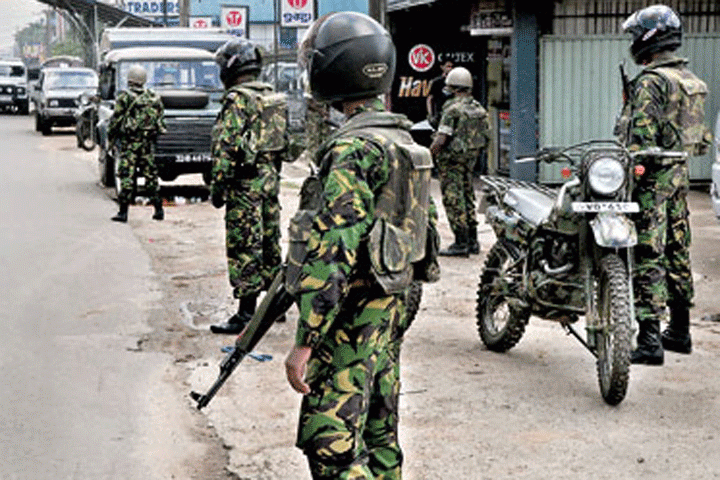
August 19, Colombo (LNW): The Indian and Sri Lankan armies have incorporated highly trained canines into their ongoing Mitra Shakti bilateral exercise, currently taking place at the Army Training School in Maduru Oya, Sri Lanka.
The 10th edition of this joint military drill, running from August 12 to 25, aims to bolster counter-insurgency capabilities and foster deeper military cooperation between the two nations.
India has fielded Zac, a two-and-a-half-year-old Belgian Malinois known for his advanced tactical skills, while Sri Lanka has deployed two specially trained dogs.
Zac is proficient in operations such as cordon-and-search, search-and-destroy missions, urban combat, and jungle reconnaissance.
Additionally, his specialised training includes laser-guided assaults and weapon retrieval, making him a critical asset during tactical operations.
Zac was trained at the Remount Veterinary Corps (RVC) Centre and College in Meerut, where he developed into an “assault K9” capable of handling high-risk scenarios.
According to Major Rishi Sharma, the K9 Detachment Commander, Zac plays a pivotal role as both a force multiplier and first responder.
During the exercise, Zac will be engaged in a variety of tasks, ranging from house interventions to jungle searches, demonstrating his capability in counter-insurgency operations.
Notably, in a recent scenario, Zac successfully apprehended an assailant attempting to flee a roadblock.
Modern military dogs like Zac are routinely utilised in urban operations for vehicle inspections, explosive detection, and search-and-assault missions.
Equipped with head-mounted tactical cameras, these dogs can provide real-time surveillance and execute stealth attacks, enhancing the effectiveness of the operations.
The Indian contingent, comprising 106 personnel from the Rajputana Rifles and other units, joins forces with the Sri Lankan Gajaba Regiment in this exercise.
According to the Indian Army, the joint training focuses on semi-urban environments and covers drills such as counter-terrorism responses, intelligence gathering, and securing key locations like helipads.
The broader aim of Exercise Mitra Shakti is to enhance inter-operability and strengthen joint operational readiness.
Both sides view this collaboration as an opportunity to exchange best practices and foster camaraderie, with a focus on improving tactics and techniques under United Nations Chapter VII mandates for peacekeeping.
August 19, Colombo (LNW): Commissioner of Elections Saman Sri Ratnayake has strongly urged political parties and the public to refrain from using the national flag for election-related activities, warning that such actions constitute disrespect towards a national symbol.
Speaking at a forum in Colombo, Ratnayake highlighted the growing trend of misusing the flag in political campaigns and warned that legal measures would be taken against offenders.
He expressed concern that the national flag, along with the national anthem, risks becoming tools of political propaganda, compromising their symbolic value.
Ratnayake also pointed out the inappropriate display of the national flag during events like cricket matches, where it is often wrapped around bodies or held by individuals consuming alcohol, actions he described as disrespectful.
In a related remark, Executive Director of the People’s Action for Free and Fair Election (PAFFREL), Rohana Hettiarachchi, stressed the need for a respectful approach towards both the national flag and the Buddhist flag during elections.
He reminded political entities that national ethics, the Constitution, and election laws must be upheld, urging an end to the misuse of these symbols in political propaganda.