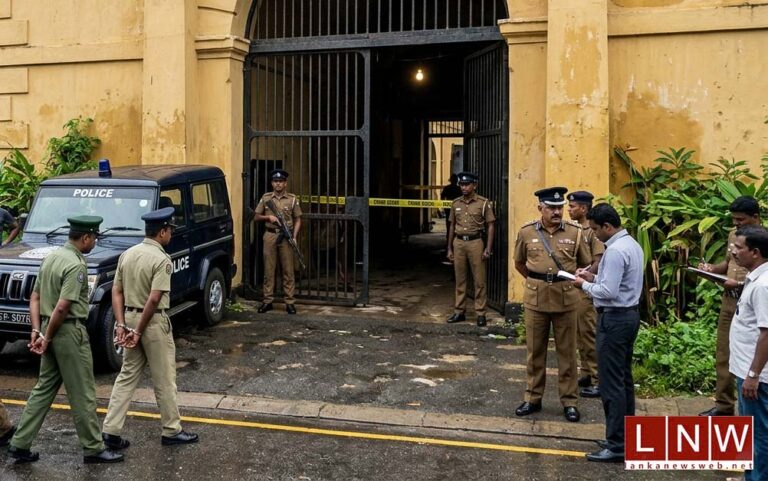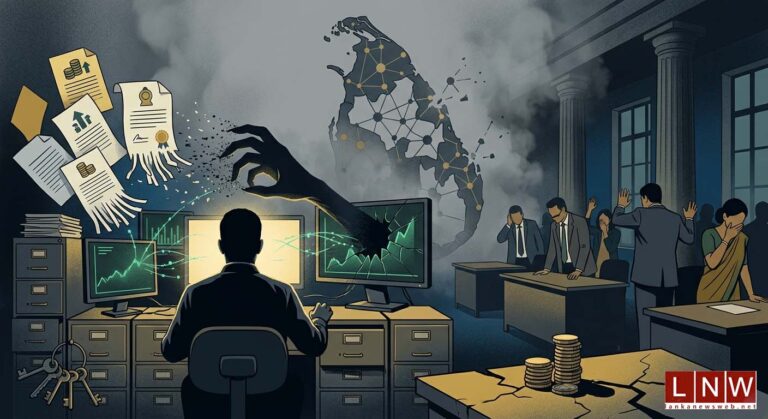
January 27, Colombo (LNW): The Parliamentary Select Committee appointed to investigate the release of 323 shipping containers from the Colombo Harbour without mandatory inspection has agreed to hold regular sittings every Wednesday.
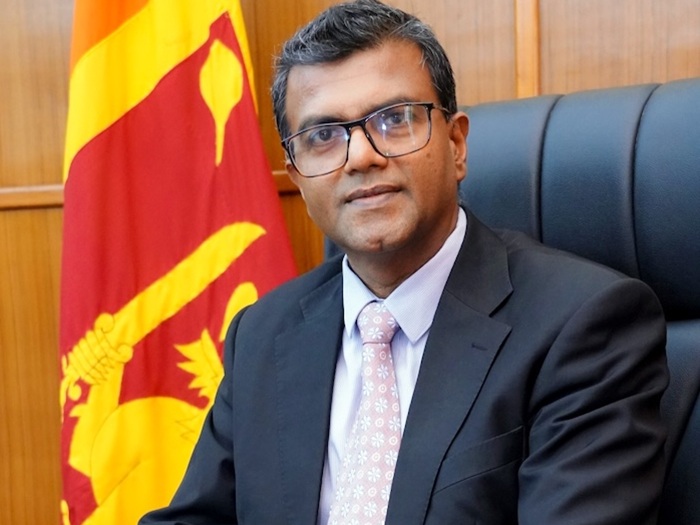
The committee will convene at 2.00 p.m. each week to carry out its inquiry. This schedule was finalised at the panel’s first meeting, which was chaired by Minister of Justice and National Integration Harshana Nanayakkara. The committee is due to reconvene tomorrow as part of this timetable.
During the inaugural session, members held initial discussions on the scope of the investigation, procedural arrangements and the range of individuals and institutions expected to be called to give evidence.
The Chair informed members that the committee aims to complete its findings and submit a report to Parliament within a three-month timeframe, signalling an intention to move swiftly while conducting a thorough examination of the matter.
Parliamentary Panel Sets Weekly Schedule to Probe Unchecked Port Container Release
New Authority Planned to Safeguard Sri Lanka’s Central Highlands
January 27, Colombo (LNW): President Anura Kumara Dissanayake has announced plans to establish a dedicated authority this year to oversee and protect the environmentally sensitive Central Highlands.
The President made the announcement while attending the launch of the Godanagamu Adhishtanaye Sanhinda national initiative, a programme designed to fast-track the restoration of religious places damaged by Cyclone Ditwah and reopen them for worship and community use.
The ceremony took place today at the Sri Bodhirukkarama Viharaya in Gampola under his patronage.
Addressing the gathering, President Dissanayake said the proposed body would be entrusted with the responsibility of planning and regulating all key activities within the Central Highlands, including agriculture-related industries, irrigation projects, wildlife protection and resettlement programmes. He stressed that the aim is to ensure development takes place without compromising the region’s ecological balance.
He added that comprehensive legislation will be introduced to grant the new authority wide-ranging legal powers, enabling it to function independently and enforce compliance. Support from the Asian Development Bank is also expected to strengthen the initiative, particularly in technical and planning aspects.
Under the proposed framework, any development project within the Central Highlands will require prior approval from the authority. The President further noted that the body will be empowered to initiate firm legal action against individuals or institutions that violate approved plans, underscoring the government’s intention to adopt a zero-tolerance approach to environmental degradation in the region.
Overseas Crime Figures Signal Willingness to Surrender as Crackdown Intensifies
January 27, Colombo (LNW): Sri Lanka’s expanded offensive against organised crime is beginning to show tangible results, with several criminal figures based overseas now indicating a readiness to return and surrender voluntarily, according to information received by the Criminal Investigation Department (CID).
Deputy Minister of Public Security and Parliamentary Affairs, Attorney-at-Law Sunil Watagala, disclosed that the CID has been officially notified of this emerging trend, suggesting that pressure from recent enforcement efforts is being felt beyond the country’s borders. He made the remarks while chairing a meeting of the Colombo Public Security Committee yesterday.
Addressing officials at the meeting, the Deputy Minister said a long-planned national public security structure has now been fully put in place and is ready for active deployment. This framework brings together a National Policy Committee, along with district, divisional and community-level public security committees, forming a coordinated network operating across the island.
He explained that the emphasis has now shifted from establishing institutions to taking direct action, using this nationwide system to confront organised criminal activity more effectively. Particular attention, he said, is being paid to dismantling narcotics supply chains that have operated in Sri Lanka for decades.
Mr Watagala noted that these networks had historically thrived with political protection, allowing them to become deeply embedded over time. He said the situation has changed markedly under the current administration, with law enforcement agencies now tracing drug operations to their highest levels.
Investigations have revealed that many of the most influential figures controlling the trade are based overseas, prompting the government to extend its operations internationally. The Deputy Minister confirmed that action is now being taken through global law enforcement mechanisms, including red notice procedures, to pursue these individuals abroad.
Against this backdrop, he said, a number of foreign-based suspects have contacted the CID, signalling their intention to surrender. The Deputy Minister attributed this shift to a growing recognition among organised criminals that escape routes are rapidly closing as the net tightens both locally and internationally.
STF Arrests Suspected Drug Operative with Heroin in Panadura
January 27, Colombo (LNW): A man believed to be a key local link in an international narcotics network has been taken into custody in the Panadura area following a targeted operation by the Police Special Task Force.
According to the STF, officers recovered just over 126 grams of heroin from the suspect at the time of his arrest. The individual, aged 43, is suspected of playing a central role in coordinating drug-related activities within Sri Lanka.
Investigators say the suspect was allegedly acting on instructions from an overseas-based figure known as “Gayya,” who is described as a close associate of “Panadura Salidu,” a notorious organised crime figure and large-scale drug trafficker currently believed to be operating from abroad.
Further inquiries are underway to trace the wider network and identify additional individuals connected to the operation.
Police Launch Nationwide Crackdown on Unsafe Vehicles
January 27, Colombo (LNW): Law enforcement authorities have rolled out countrywide inspections aimed at identifying vehicles that do not meet basic roadworthiness standards, police said.
Deputy Inspector General of Police overseeing Traffic and Road Safety, W.P.J. Senadheera, explained that the initiative is being conducted jointly with officials from the Department of Motor Traffic.
The inspections will focus on vehicles that pose safety risks due to mechanical faults, poor maintenance or failure to comply with registration and safety requirements.
Authorities say the operation is part of a broader effort to reduce accidents and improve overall road discipline, warning that vehicles found to be unfit for use will face legal action in accordance with existing traffic laws.
Seat Belt Offences Now Penalised as Police Tighten Enforcement Nationwide
January 27, Colombo (LNW): Motorists across Sri Lanka are now being fined for failing to wear seat belts, as police move to strictly enforce road safety regulations following the end of a three-month adjustment period, the National Council for Road Safety has announced.
Council Chairman Manjula Kularatne said the grace period, which was introduced to give drivers and passengers time to familiarise themselves with the updated rules, came to an end on 24 December.
Since then, law enforcement officers have been directed to apply the law without leniency, amid ongoing concerns over the country’s high rate of road accidents and fatalities.
Under the current regulations, seat belt use is mandatory for all occupants travelling on expressways, including those seated in the rear. On other roads, the requirement applies to drivers and passengers seated in the front.
Kularatne stressed that the measure is a key element of efforts to improve road safety, noting that seat belts are proven to dramatically reduce the likelihood of death or serious injury in a crash. He urged motorists to comply with the law, describing it as a straightforward step that can save lives and prevent life-altering injuries.
Radiologic Technologists to Begin Indefinite Nationwide Strike from Tomorrow
January 27, Colombo (LNW): Radiologic technologists attached to government hospitals are set to commence an island-wide continuous strike from 8.00 a.m. tomorrow (28), according to the Government Radiologic Technologists’ Association.
The association’s President, Chanaka Dharmawickrama, said the action is expected to severely disrupt radiology services across the public health system. He warned that key procedures such as CT and MRI scans, mammography and surgical interventions requiring the use of radiation in operating theatres are likely to be affected while the strike continues.
Dharmawickrama explained that the decision to escalate the protest was taken after authorities failed to offer a satisfactory response following a 24-hour token strike held earlier this month. He said repeated appeals for corrective action had not produced concrete results.
The dispute centres on allegations that radiological examinations are being carried out by individuals lacking the required qualifications at Maligawatta Hospital. The association maintains that patient safety is at risk and insists that proper standards and professional oversight must be enforced before normal services can resume.
From Boardroom to Balancing the State: Why Binod Chaudhary Could Matter at Nepal’s Political Crossroads
By: Staff Writer
January 27, World (LNW): Nepal stands at a moment of rare political openness. After the youth-led protests of 2025, the fall of an elected government, and the stewardship of an interim technocratic administration, the country is heading towards elections amidst public fatigue with instability and corruption. Voters are not merely choosing parties; they are searching for competence, credibility, and economic direction.
In this context, the idea of Binod Chaudhary as a national leader — even a potential prime ministerial contender — deserves serious, analytical consideration rather than reflexive praise or dismissal.
Chaudhary’s most obvious distinction is his record as Nepal’s most globally successful entrepreneur. As chairman of CG Corp Global, he has built a multinational conglomerate spanning food, banking, hospitality, energy, education, and infrastructure, with operations across five continents.
In a country where political leadership has often struggled to translate policy into delivery, this matters. Nepal’s core economic challenge today is not inflation or reserves — both are relatively stable — but weak private investment, youth unemployment, and low industrial depth. Chaudhary’s career speaks directly to these gaps.
A Chaudhary-led administration would likely prioritise investment-led growth rather than rhetoric-driven redistribution. His long-standing advocacy for predictable regulation, investor confidence, and public–private partnerships aligns closely with what Nepal’s economy currently needs: job creation at scale, value-added manufacturing, and export diversification.
With unemployment still hovering near double digits and youth frustration fuelling political volatility, a leader who understands how jobs are actually created — rather than merely promised — could reset the national conversation.
Crucially, Chaudhary is not a political novice parachuting into public life. His involvement in Nepal’s democratic journey stretches back decades, from supporting reform movements to contributing to economic policy discussions during the constitution-making process. His time as a Constituent Assembly member under CPN-UML and later as a parliamentarian with the Nepali Congress reflects a pragmatic, cross-ideological approach.
Critics may frame this as opportunism; supporters see it as flexibility in a fragmented political system. In a country paralysed by rigid party lines, pragmatism may be an asset rather than a flaw.
Where Chaudhary’s candidacy becomes particularly relevant is governance reform. Nepal’s 2025 protests were not ideological uprisings but accountability revolts — driven by anger over corruption, inefficiency, and elite insulation. Chaudhary’s reputation as a results-oriented manager could resonate with a generation less interested in revolutionary slogans and more focused on delivery. His experience managing complex, multinational operations could translate into stronger institutional coordination, clearer accountability mechanisms, and performance-based public administration.
That said, legitimate concerns must be addressed openly. The concentration of wealth and power in one individual raises questions about conflicts of interest, regulatory capture, and equitable policy-making. Any serious leadership bid would require Chaudhary to commit unequivocally to transparency: blind trusts, clear separation between business and state, and strengthened anti-corruption institutions. Without these safeguards, his strengths could easily become liabilities in the public eye.
His philanthropic track record offers some reassurance. Through the Chaudhary Foundation, he has supported disaster relief, education, and sustainable development initiatives, including significant contributions after the 2015 earthquake. While philanthropy is no substitute for policy, it does suggest a long-term stake in Nepal’s social fabric rather than a purely extractive relationship with the state.
Politically, Chaudhary could also serve as a bridge figure. Nepal’s current landscape is polarised between traditional parties and emerging protest-driven alliances. A leader with economic credibility, cross-party experience, and international exposure might stabilise this fragmentation — not by silencing dissent, but by shifting debate towards outcomes: growth, jobs, and governance.
Ultimately, the case for Binod Chaudhary as a national leader is not that he is flawless, but that he represents a different leadership proposition at a time when the old formulas have clearly failed. Nepal does not merely need another prime minister; it needs a governing philosophy that treats economic strength as a foundation for democracy rather than an afterthought.
If Chaudhary can convincingly align his business acumen with public accountability and social inclusion, he could emerge as a serious contender for leading Nepal through its next, and perhaps most decisive, chapter.
ECA Alleges Daily Rs. 75 Mn Loss Due to Substandard Coal at Norochcholai
By: Puli
January 27, LNW (Colombo): The Electricity Consumers’ Association (ECA) has called on the government to release survey reports from India and the Lakvijaya Coal Power Plant in Norochcholai, alleging that the Ceylon Electricity Board (CEB) is incurring a daily loss of Rs. 75 million due to the use of substandard coal.
ECA General Secretary Sanjeewa Dhammika claimed that investigations into coal tenders were halted and reports suppressed, despite laboratory tests showing that the imported coal failed to meet the required calorific value of 19,100 kilocalories (kcal).
According to the ECA, the use of coal from one shipment resulted in power generation losses of up to 100 megawatts, causing significant financial losses.
Meanwhile, Minister Nalinda Jayatissa confirmed that the coal stock did not meet required quality standards, stating that samples tested in India were deficient in kilocalories. He said fines, including double penalties, would be recovered from the supplier if standards are not met, while stressing that there was no issue in the procurement process.
President to Launch ‘Godanagamu Adhishtanaye Sanhinda’ Programme for Restoration of Religious Sites
By: Puli
January 27, LNW (Colombo): The government will today (27) launch a national programme titled “Godanagamu Adhishtanaye Sanhinda” to rapidly restore religious sites damaged by Cyclone Ditwah and make them available once again for worship and religious activities, the President’s Media Division (PMD) said.
The programme will be launched under the patronage of President Anura Kumara Dissanayake and coordinated by the Ministry of Buddhasasana, Religious and Cultural Affairs. It is scheduled to commence at 10.00 a.m. at Sri Bodhirukkarama Viharaya in Peacock Hill, Doragalla, Gampola, and at 3.00 p.m. at the Kawatayamuna Purana Rajamaha Viharaya in Matale.
According to the statement, more than 1,000 religious, cultural and archaeological sites were damaged by the disaster.
The government aims to initiate immediate restoration efforts to return these sites to their original condition while preserving their historical and cultural significance.
Restoration work will be carried out under the guidance of the Venerable Maha Sangha and other religious leaders, with the active participation of all relevant stakeholders, the PMD added.