
LISTEN TO STORY
WATCH STORY
For an entire century, Attenborough has done something few human beings ever achieve — he changed the way humanity sees the living world. To generations raised on his documentaries, he was never merely a television presenter; he became the voice of forests, oceans, deserts, and endangered creatures struggling to survive in a rapidly collapsing world. This memoir explores how one gentle voice shaped our understanding of nature, inspired environmental consciousness across continents, and left an indelible mark even on a young journalist growing up beside the monsoon-soaked landscapes of Sri Lanka.
By: Isuru Parakrama
May 10, Colombo (LNW): There are some voices that do not merely narrate the world — they become part of it. For me, growing up in Sri Lanka with the scent of rain-soaked earth drifting through open windows and the distant cry of koels at dawn, the voice of David Attenborough was one of them.
On May 08, 2026, Attenborough turned 100. A century. It is difficult to comprehend that one man could spend nearly an entire hundred years not simply observing nature, but persuading billions of people to fall in love with it. Yet that is precisely what he has done.
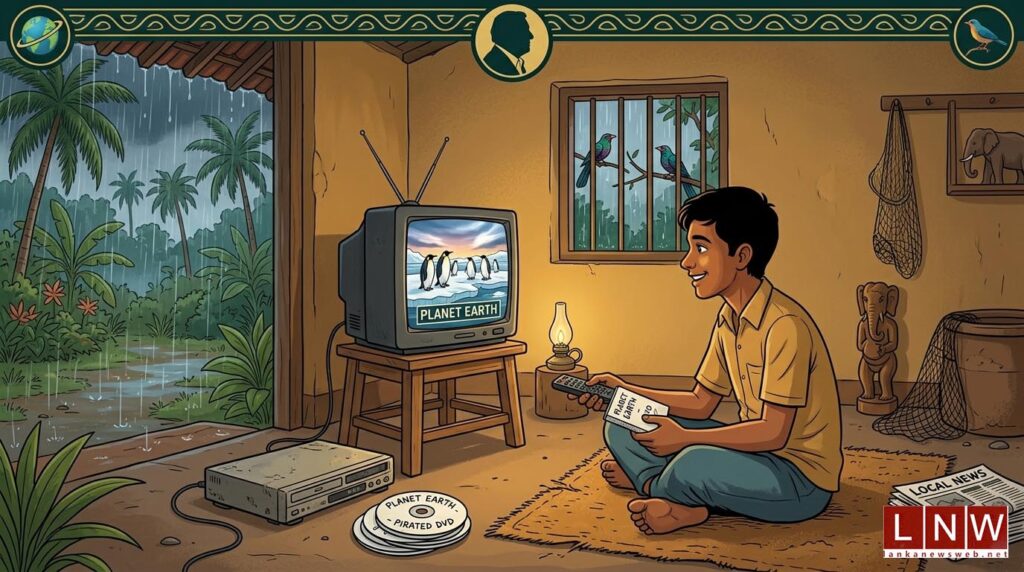
As a teenager in Warakapola, I remember watching pirated DVD copies of Planet Earth on an ageing television while monsoon rain hammered our roof. I did not understand then how extraordinary those documentaries were. I only knew that a man with a calm, reverent voice could make me care deeply about penguins in Antarctica, insects in the Amazon, and whales beneath dark oceans I would probably never see.
Attenborough’s journey began far from the tropical chaos of Sri Lanka. Born David Frederick Attenborough on May 08, 1926, in Isleworth, London, he was the son of a university principal. Even as a boy, he collected fossils and stones, developing an obsession with the natural sciences long before the world knew his name. After earning a degree from Cambridge University in 1947, serving in the navy, and working in publishing, he joined the BBC as a trainee producer in 1952.
It is astonishing to think how much modern environmental consciousness can be traced back to that decision.
His television breakthrough came with Zoo Quest in 1954, a programme that sent him travelling across remote parts of the world to capture wildlife on film. Today, wildlife documentaries are everywhere, often bloated with dramatic music and artificial suspense. But Attenborough approached nature differently. He carried wonder into every frame. He made audiences feel as though the Earth itself was speaking.
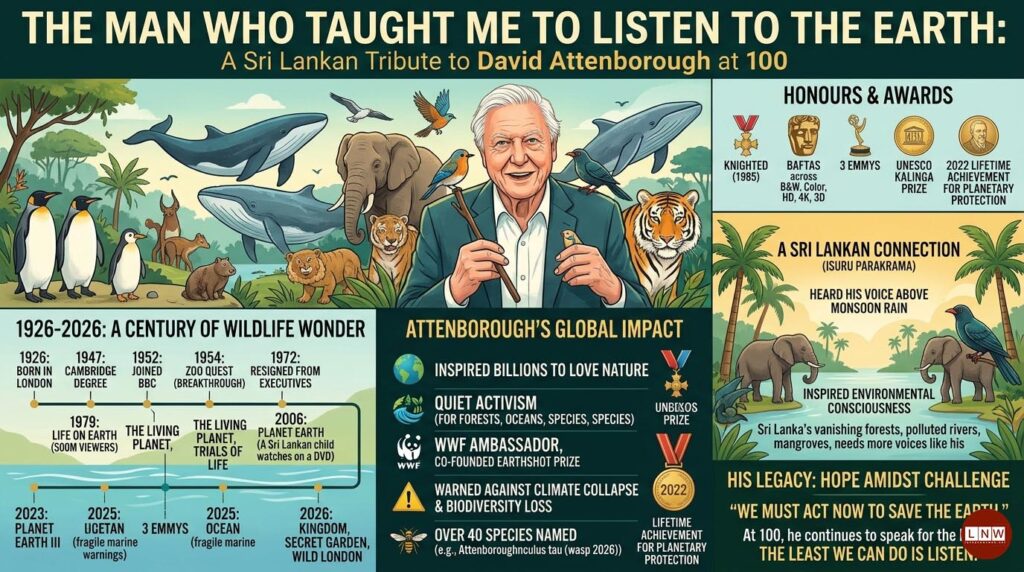
By the mid-1960s, he had risen to become controller of BBC2, helping introduce colour television to Britain while commissioning programmes such as Monty Python’s Flying Circus. Yet perhaps his greatest act of wisdom was resigning from executive positions in 1972 to focus entirely on documentary filmmaking.
That decision changed natural history broadcasting forever.
His landmark series Life on Earth in 1979 attracted an astonishing 500 million viewers and launched a trilogy that continued with The Living Planet in 1984 and The Trials of Life in 1990. Later came The Private Life of Plants, The Blue Planet, Frozen Planet, and the visually breathtaking Planet Earth series, culminating most recently in Planet Earth III in 2023.
Even at 99, Attenborough refused to slow down. His 2025 documentary Ocean with David Attenborough once again focused on fragile marine ecosystems, combining breathtaking cinematography with a sombre warning about humanity’s destruction of the seas. Upcoming productions for 2026 include Kingdom, focusing on African animal families, alongside Secret Garden and Wild London.
There is something profoundly moving about a man nearing a century of life still dedicating himself to the future of a planet he may not live long enough to see healed.
What separates Attenborough from many broadcasters is that he evolved morally alongside his work. In his earlier years, he was primarily an observer of nature. But as forests vanished, oceans warmed, and species disappeared, neutrality became impossible. Gradually, his documentaries transformed into acts of quiet activism.
He never became preachy. He understood that awe can often persuade people more effectively than anger. Still, the urgency in his recent work is unmistakable.
He has served as an ambassador for the World Wide Fund for Nature, co-founded the Earthshot Prize with Prince William in 2019, and consistently urged global leaders to confront climate collapse and biodiversity loss. More than 40 species now carry his name, including the newly identified wasp Attenboroughnculus tau in 2026 and the British wildflower Hieracium attenboroughianum.
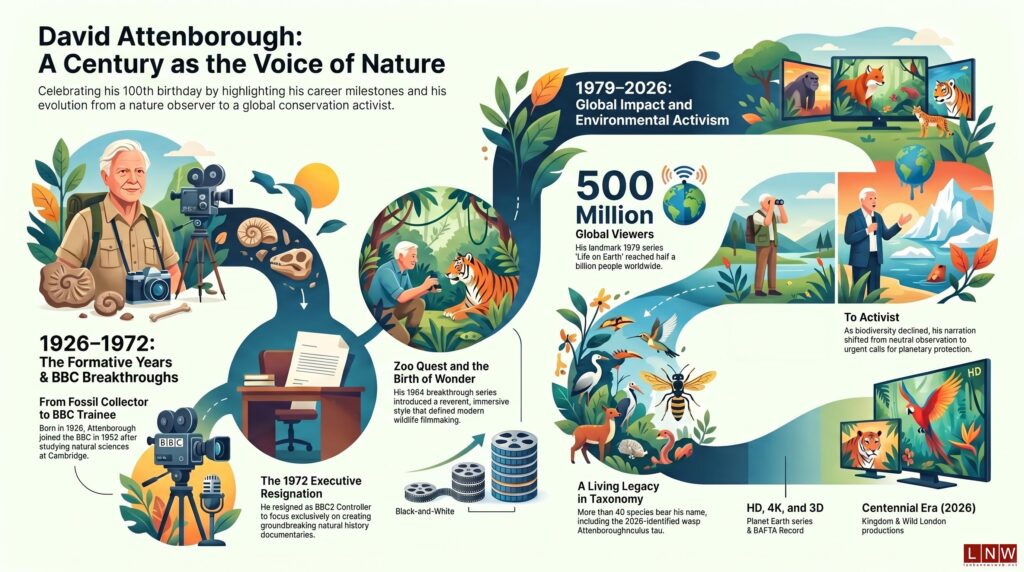
The honours he has received barely seem adequate for his contribution. Knighted in 1985, Attenborough has won BAFTAs across black-and-white, colour, HD, 4K, and 3D broadcasting formats — a record that mirrors the technological evolution of television itself. He has also received three Emmy Awards, UNESCO’s Kalinga Prize, the Royal Television Society Silver Medal, the Descartes Prize for science communication, and a 2022 Lifetime Achievement Award for planetary protection.
Yet perhaps his greatest achievement cannot be measured in awards.
It lies in the millions of children who looked at forests differently because of him. In the people who began recycling, planting trees, or questioning environmental destruction because his documentaries made the crisis feel personal. In young journalists like me, who learned that storytelling can be an act of conservation.
Sri Lanka, with its collapsing forests, polluted rivers, vanishing mangroves, and reckless development projects, desperately needs more voices like Attenborough’s. We are a country blessed with astonishing biodiversity, yet cursed with a political culture that often treats nature as expendable. Watching Attenborough at 100 is both inspiring and uncomfortable. He reminds us what stewardship looks like — and how badly we are failing at it.
There is an old sadness in many of his recent narrations. You can hear it between the pauses. It is the sorrow of a man who has spent a lifetime documenting beauty while witnessing its destruction in real time.
And yet, somehow, he still sounds hopeful.
Perhaps that is his final lesson to us.
At 100 years old, David Attenborough continues to speak for the Earth. The least we can do is listen.