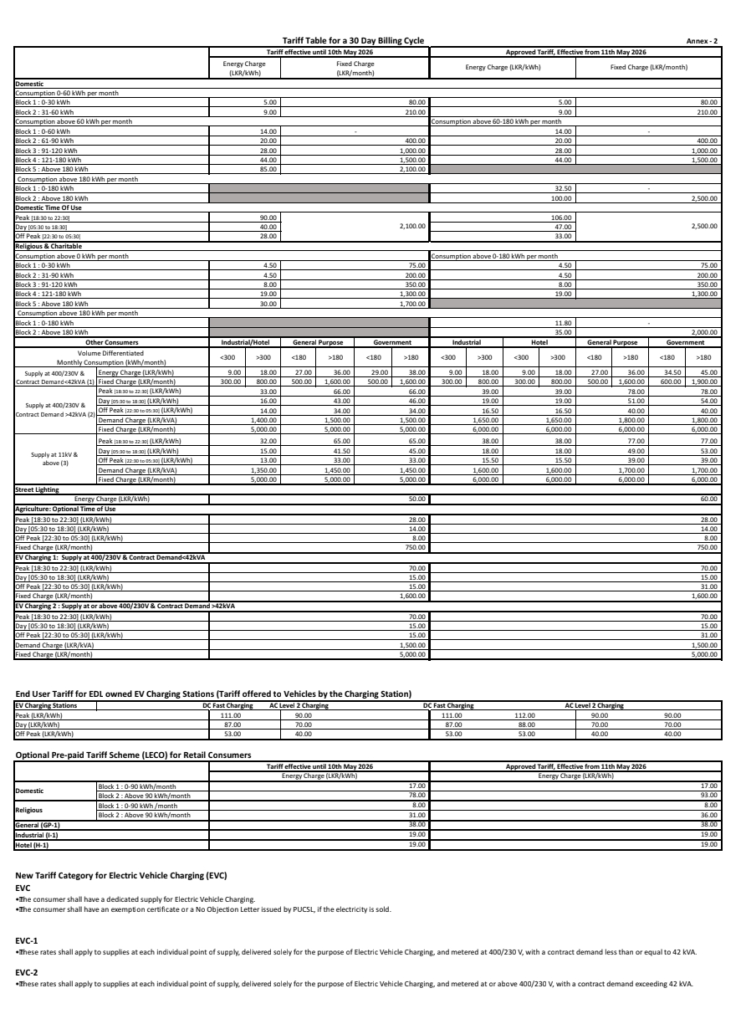
May 10, Colombo (LNW): The Public Utilities Commission of Sri Lanka has approved an increase in electricity charges for selected consumer groups, with revised tariffs set to come into force from midnight tomorrow.
Under the latest revision, electricity bills will rise by 18 per cent during the second and third quarters of 2026 for domestic consumers whose monthly usage exceeds 180 units. Officials said the adjustment is aimed at easing mounting financial pressure on the power sector amid escalating generation and operational costs.
Despite the increase, the Commission stressed that the vast majority of households would not be affected. Domestic users consuming below the 180-unit threshold will continue to pay existing rates, a move intended to protect ordinary families from additional financial strain during the ongoing cost-of-living challenges.
According to regulators, the decision was taken following projections of a revenue gap estimated at nearly Rs. 38 billion, driven largely by higher fuel and electricity generation expenses expected over the coming months. Authorities noted that Government intervention helped soften the impact of the proposed revision, with the State agreeing to provide a subsidy of Rs. 15 billion to support the sector.
As a result, only a relatively small segment of consumers — estimated at around five per cent of total electricity users — will face higher charges, while approximately 95 per cent of customers are expected to remain unaffected by the adjustment.
The revised pricing structure will also apply to a number of institutional and commercial categories. Government establishments, large-scale industrial operations and consumers classified under General Purpose GP2 and GP3 categories will all be subject to the full 18 per cent increase.
In addition, religious institutions and GP1 category consumers exceeding the 180-unit consumption level will see corresponding increases in their electricity bills.
Meanwhile, several sectors considered economically sensitive have been exempted from the revision for the time being. Small and medium-sized enterprises, along with hotels operating under the H1 and H2 classifications, will continue under existing tariff rates unless their electricity consumption rises substantially beyond standard levels.
Energy analysts say the selective adjustment reflects an effort to stabilise the country’s electricity supply system while limiting the burden on lower and middle-income households. Officials have also indicated that future tariff reviews will depend on fuel prices, rainfall conditions and national power demand trends later in the year.