
By: Staff Writer
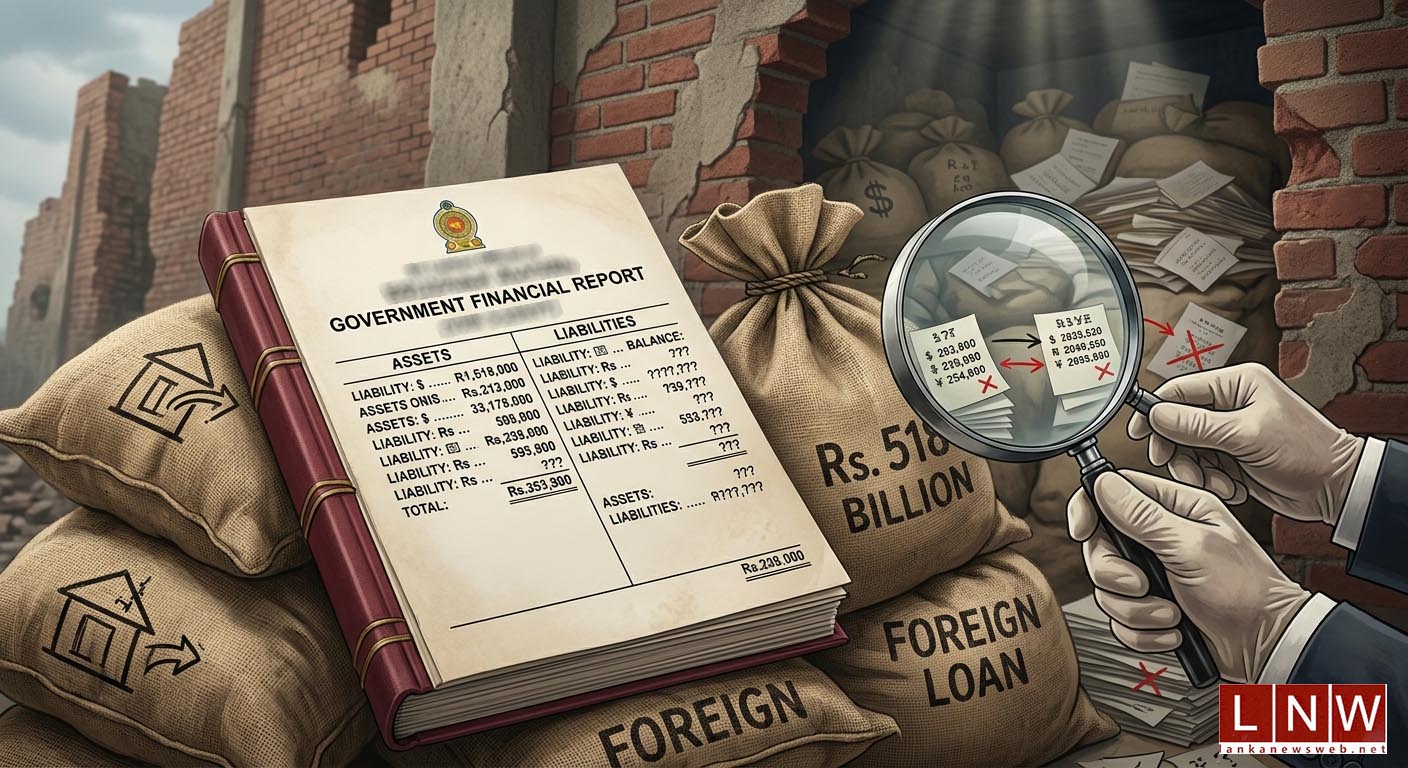
June 11, Colombo (LNW): A startling audit finding has revealed that foreign loan balances exceeding Rs. 518 billion continue to remain outside Sri Lanka’s Statement of Financial Position, exposing deeper concerns about how public borrowings are accounted for and how Government assets are reported.
The disclosure forms part of the Auditor General’s review of the Government’s 2025 Financial Statements and highlights what auditors describe as continuing weaknesses in the accounting treatment of foreign debt despite years of financial reforms and the recent restructuring of the country’s sovereign obligations.
According to the audit, loan balances amounting to Rs. 518.293 billion, representing eight categories of foreign borrowings obtained during 2022, were still being maintained outside the Government’s main financial position statement at the end of 2025. Even more significantly, no corresponding assets acquired through these loans had been identified in the Financial Statements.
Auditors warned that recording liabilities without recognising the associated assets had contributed directly to a worsening negative balance in the Government’s General Fund. The observation raises important questions about whether public assets financed through foreign borrowing have been properly documented and reflected in official accounts.
The audit also highlighted numerous inconsistencies affecting debt reporting and financial disclosures.
One notable discrepancy involved an International Sovereign Bond. Debt records maintained in the Debt Management System showed an opening balance of approximately Rs. 448 billion at the start of 2025. However, the Financial Statements reported a higher figure of nearly Rs. 452 billion, creating an unexplained difference of Rs. 3.27 billion.
Repayment figures linked to the same bond showed a similar mismatch. The Debt Management System recorded debt service payments of approximately Rs. 98.4 billion, while the Financial Statements reported repayments exceeding Rs. 101.8 billion. Once again, no explanation was provided for the difference.
Auditors also identified inconsistencies between Government records and information supplied directly by lenders. In one case, a lender confirmed an outstanding balance that was nearly $7 million lower than the amount recorded by the Government. Smaller discrepancies were also found in two additional foreign loans.
Questions were further raised about the accuracy of creditor identification. Two loans listed in the Debt Management System as having been obtained from one international lender were attributed to an entirely different institution in the Financial Statements.
The audit uncovered additional errors involving foreign currency conversions, undisclosed balance adjustments, and conflicting exchange-loss calculations. These issues stemmed partly from differences in how loan disbursements were recorded in foreign currency and local currency terms across separate reporting systems.
Taken together, the findings paint a picture of a debt-reporting framework still struggling with reconciliation, consistency, and transparency. At a time when Sri Lanka is attempting to rebuild investor confidence and strengthen fiscal governance, the Auditor General’s observations underscore the urgency of establishing more reliable and unified systems for tracking the country’s foreign debt and the assets financed through it.