
By: Staff Writer
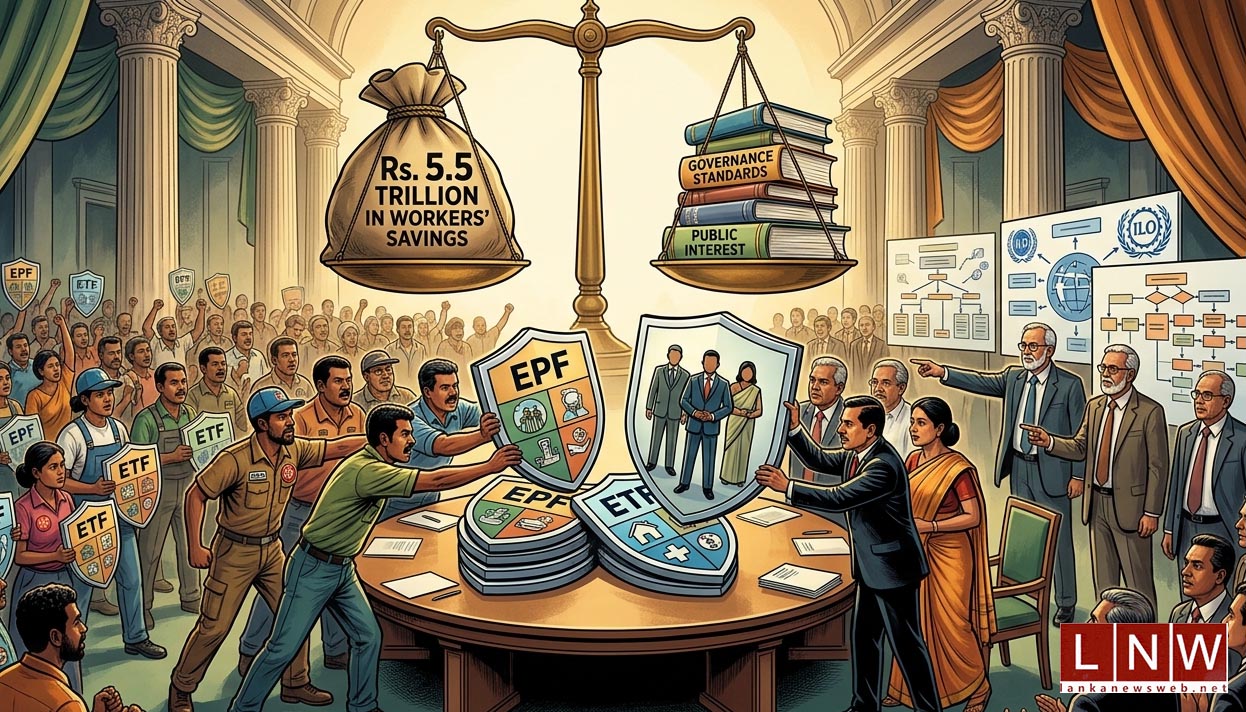
July 06, Colombo (LNW): Behind the growing political controversy over Sri Lanka’s proposed EPF-ETF governance reforms lies a much broader debate about efficiency, accountability and the future management of more than Rs.5.5 trillion belonging to private sector workers.
While trade unions warn that merging governance structures could weaken safeguards surrounding workers’ savings, several former Central Bank officials and economic analysts argue the existing framework has become increasingly outdated and inefficient.
The Employees’ Provident Fund, the country’s largest retirement fund with assets nearing Rs.4.9 trillion, currently operates under a split management model. The Central Bank manages investments and custody, while the Department of Labour administers compliance.
The Employees’ Trust Fund, valued at over Rs.637 billion, functions separately under its own governing board.
The government’s proposal does not seek to merge the assets themselves but instead aims to establish a unified tripartite governance framework comprising representatives of the government, employers and employees.
Officials say such a model would bring Sri Lanka closer to governance practices promoted internationally, particularly by the International Labour Organisation, where workers and employers participate directly in decision-making.
According to government officials, one of the principal objectives is preventing future governments from exercising unchecked authority over workers’ funds.
Supporters argue that introducing representatives from all three stakeholder groups would create institutional checks that currently do not exist.
Former Central Bank officials familiar with fund management say the present dual-agency arrangement has often created administrative bottlenecks.
They note that responsibilities divided between two separate institutions have historically resulted in delays in decision-making, slower implementation of investment strategies and overlapping administrative processes.
However, trade unions remain unconvinced.
Anton Marcus, Joint Secretary of the Free Trade Zones and General Services Employees Union, maintains that efficiency arguments overlook the fundamental differences between the two funds.
“Every employer contributes to both funds, but they serve different purposes,” he said.
“The EPF represents long-term retirement savings accumulated over an employee’s working life. The ETF provides workers with access to various short-term benefits during employment.”
Union representatives argue that combining governance structures risks gradually eroding these distinctions and could eventually pave the way for wider structural integration.
The issue has now been formally placed before the National Labour Advisory Council, where unions have requested that the Cabinet-appointed Senior Officials Committee first release its recommendations for public discussion before legislation proceeds.
Their demand reflects broader concerns over transparency in one of the largest financial reforms affecting Sri Lanka’s workforce in recent years.
With over five million memberships spread across the two schemes and assets exceeding Rs.5.5 trillion, the stakes extend well beyond administrative reform.
Whether the government succeeds in convincing workers that the proposal strengthens rather than weakens protections may ultimately determine the fate of a reform that could redefine the governance of Sri Lanka’s largest employee savings institutions for decades to come.