By: Isuru Parakrama
July 14, Colombo (LNW): Global oil prices surged by more than nine per cent on Monday (13), reaching their highest levels in a month after renewed geopolitical tensions in the Middle East fuelled concerns over the security of energy supplies through the strategically important Strait of Hormuz.
Brent crude climbed by $7.29, or 9.59 per cent, to settle at $83.30 a barrel, while US West Texas Intermediate (WTI) gained $6.73, or 9.42 per cent, ending the session at $78.14 a barrel.
The sharp rise marked the strongest single-day gain for both benchmarks in several months.
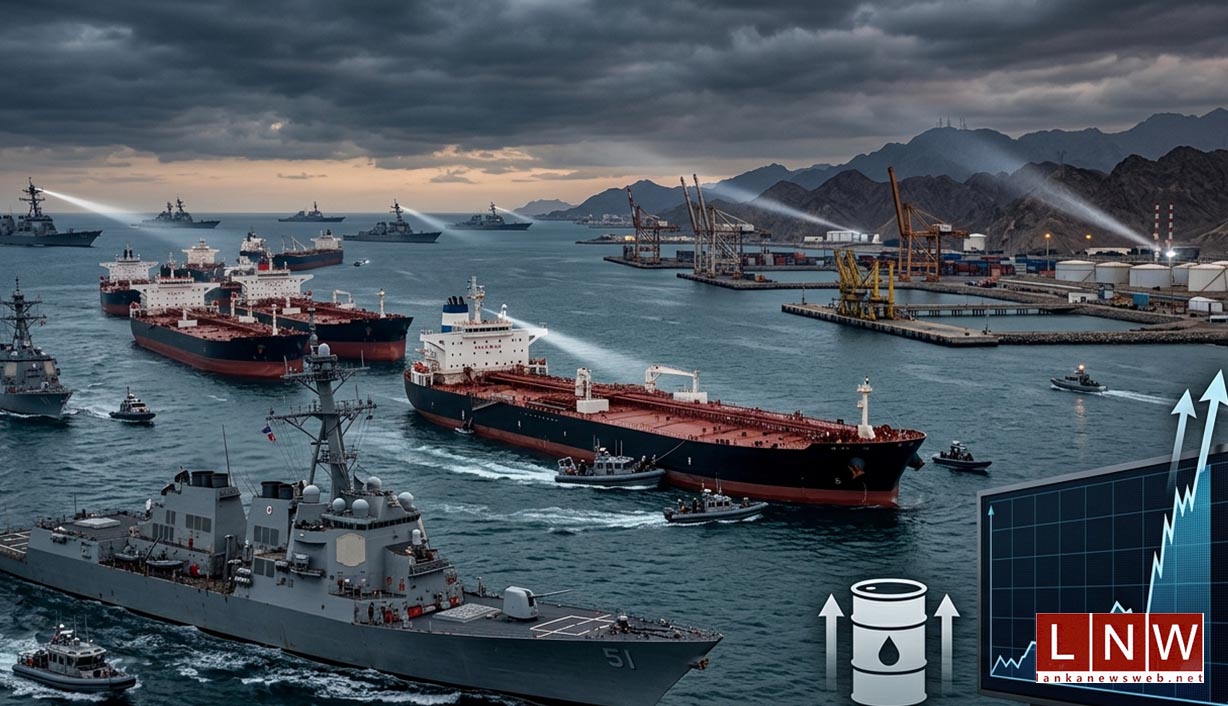
The rally followed confirmation that the United States intends to reintroduce a naval blockade from July 14 at 2000 GMT. According to the US Navy-led Joint Maritime Information Centre, the operation will cover Iran’s coastline, ports and oil terminals, and apply to vessels of all nationalities.
The move has renewed fears of disruptions to shipping through the Strait of Hormuz, one of the world’s busiest energy corridors.
US President Donald Trump also announced that Washington would impose new restrictions on maritime traffic linked to Iran and seek a 20 per cent reimbursement on cargo transported through the strait. The announcement came amid a fresh escalation in military tensions between the United States and Iran.
Energy market analysts said the latest developments have significantly increased concerns over short-term oil supplies. Reduced tanker movements through the Strait of Hormuz, combined with the possibility of further military action, have prompted traders to factor a higher geopolitical risk premium into crude prices.
Iran’s senior military leadership warned that it would oppose any unauthorised US involvement in the management of the waterway, signalling the potential for further confrontation. Meanwhile, the United Nations’ shipping agency rejected proposals to impose mandatory transit charges on vessels using international straits, maintaining that such measures have no basis under international maritime law.
Before hostilities intensified earlier this year, roughly one-fifth of the world’s daily oil and liquefied natural gas shipments passed through the Strait of Hormuz. Although shipping activity had begun to recover following a temporary ceasefire in June, recent developments have once again slowed vessel movements and unsettled global energy markets.
Analysts believe prolonged instability could accelerate investment in alternative export routes. Goldman Sachs estimates that planned pipeline expansions across the Gulf region could enable more than 60 per cent of oil exports that previously relied on the Strait of Hormuz to bypass the route by the end of 2028, reducing the impact of any future disruption.
Iran has also increased crude exports during the recent pause in fighting, resulting in larger volumes of oil being stored aboard tankers. However, demand has softened as independent Chinese refiners increasingly favour lower-priced crude supplies from Iraq, the United Arab Emirates and Qatar.
Elsewhere, concerns over supply have also been heightened by disruptions in Russia. Ukrainian authorities said overnight strikes targeted an oil depot in Russia’s Stavropol region and storage facilities at the port of Kavkaz in Krasnodar.
Separately, the Caspian Pipeline Consortium reported a seven per cent reduction in exports last month due to maintenance at Kazakhstan’s Tengiz oilfield and lower Russian production.
In the United States, government data showed that crude oil reserves held in the Strategic Petroleum Reserve declined by around three million barrels last week to 316.5 million barrels, the lowest level since April 1983. The reduction forms part of Washington’s ongoing programme to release emergency stockpiles to help stabilise global energy markets.