
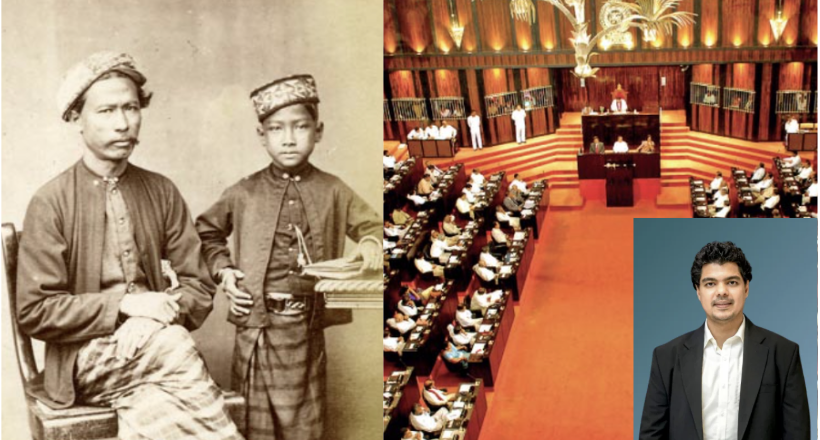
By Thanzyl Thajudeen, a Sri Lankan Malay
There is a mosque on Slave Island in Colombo that has stood for more than three centuries. Masjidul Jamiya was not built by merchants or pilgrims. It was built by soldiers, Malay soldiers who came to this island in service to the Dutch crown and, after 1796, to the British, and who stayed, raised families, and made Ceylon their permanent home. That mosque, and the neighborhood that grew quietly around it, is perhaps the most visible monument to something the rest of this country has largely forgotten: that the Malays of Sri Lanka have been here, contributing and serving, for longer than the modern republic has existed.
Today the community that built that mosque numbers approximately 40,000 people. We are 0.2 percent of the population. We hold no seat in Parliament. We have no dedicated political voice. With each passing decade our language, our culture and our civic presence grow a little quieter. This is not an appeal for sympathy. It is a case, resting on history and on democratic principle, for a recognition that is long overdue. The Malays of Sri Lanka are not asking for charity. We are asking to be counted in the nation we helped build
A Community of Soldiers, Scholars and Statesmen
The Sri Lankan Malay story does not begin in the colonial footnotes. Austronesian seafarers reached these shores as early as 200 BC. The 13th century brought Chandrabhanu Sridhamaraja, a Javanese ruler who led an invasion from Tambralinga and briefly held dominion over northern Sri Lanka. The community that exists today, however, traces its roots most concretely to the Dutch colonial era, when soldiers, nobles and political exiles from across the Indonesian archipelago, from Sulawesi, Java, Bali, Ambon and Madura, arrived in Ceylon and never returned.
These were not passive arrivals waiting for history to happen around them. The Malays became the backbone of Ceylon’s colonial military, serving with enough distinction that the British formalized their role through the Ceylon Rifle Regiment, a unit staffed almost entirely by Malays. The regiment’s influence extended far beyond the barracks. Malay soldiers in Colombo published the first Malay-language newspaper issued anywhere in the Eastern world. They built mosques across Kandy, Badulla, Kurunegala and Hambantota. They left their mark on the Sinhala language in ways that persist to this day: the words sarong, rabana, botale, kamara, bonchi and soldaduwa all trace their roots to Malay. The nation’s beloved dodol is a Malay contribution.
In the legal and civic sphere, the record is equally substantial. Justice Maas Thajoon Akbar became the first Malay Justice of the Supreme Court of Sri Lanka in the 1920s. Tuan Burhanudeen Jayah, known as T. B. Jayah, served in the Legislative Council, the State Council and in the first post-independence Parliament. Dr. P. Drahaman, a physician who founded the All Ceylon Malay Congress in 1944, won a parliamentary seat in 1956 and argued with striking clarity that Malays deserved representation in their own right, distinct from any other community. In the armed forces, Brigadier T. S. B. Sally rose to become Chief of Staff of the Sri Lanka Army, the highest rank any Malay officer has ever held.
This is not a peripheral community. This is a community that has served at every level of Sri Lankan public life and has been rendered progressively invisible in the democratic structures of the state it helped to build. We shaped this nation’s language, defended its sovereignty and administered its laws. Yet today we hold no seat in its Parliament.
The Slow Erasure
The 2024 Census records the Malay community within a combined category alongside Burghers, Chetties, Bharathas and Veddas that together account for just 0.3 percent of Sri Lanka’s total population of 21.7 million. Within that fraction, the Malays number fewer than 40,000. Under Sri Lanka’s proportional representation system, where votes are cast for parties across multi-member electoral districts, a community of this size has no realistic prospect of parliamentary representation through any community-specific route.
The practical consequence has been absorption into broader Muslim political formations that do not always attend to the specific cultural, linguistic and civic concerns of the Malay community. The All Ceylon Malay Political Union, which fought explicitly and consistently for a distinct Malay political voice, faded from active political life decades ago. The last Malay to hold a parliamentary seat of any kind was a nominated member in 1989. That is 37 years without representation.
The Sri Lanka Malay language, a creole blending Austronesian, Sinhala and Tamil in proportions found nowhere else on earth, is classified as endangered. Senior academics who are themselves Malay acknowledge that they rarely speak it at home. The Malay Club at Slave Island, the Sri Lanka Malay Association, the Conference of Sri Lanka Malays: these institutions remain active and their members dedicated, but cultural associations cannot substitute for political representation. Without a voice in policy, a community has no mechanism to advocate for its own language, its schools or its civic recognition.
The Bonds That Remain
What makes the Malay political case distinctive, and worth the attention of any serious Sri Lankan political leader, is the particular character of the community’s relationship with the Sinhalese majority. Unlike many of the fault lines that have defined Sri Lankan politics for decades, the Malay connection with Sinhalese society runs deep and is rooted in centuries of genuine proximity. Sri Lankan scholars have documented significant intermarriage between early Malay settlers and Sinhalese communities, particularly in the south and west of the island. The linguistic overlap is not incidental; it reflects generations of neighbors, colleagues and extended family.
The Malays were never a party to this country’s most devastating ethnic conflicts. A community that is small in number and dispersed across Colombo and the western coast has always been obliged to build relationships across communal lines rather than retreat behind them. That quality of bridge-building is not weakness, nor is it political neutrality born of indifference. It is the earned disposition of a people who have always understood that their future in Sri Lanka is inseparable from the future of the country as a whole.
In a political moment when Sri Lanka is actively pursuing national reconciliation and inclusive governance under the NPP administration of President Anura Kumara Dissanayake, that disposition is not a liability. It is a genuine political asset. The Malay community has never been an adversary in Sri Lanka’s story. We have always been partners. It is time the state recognized us as such.
What Representation Would Look Like
This is not an argument for a return to communal politics or ethnic bloc-building. Sri Lanka has paid an enormous price for that history and nobody with any sense wants to revisit it. What is being argued here is a model of civic representation rooted in culture, in documented contribution and in constitutional possibility.
The National List, the 29 proportionally allocated parliamentary seats distributed after each general election, has been used before to include communities and voices that the direct electoral system cannot accommodate. A major political party that chose to place a credible Malay representative on its National List would bear no electoral cost for doing so and would signal something genuine about its understanding of Sri Lanka’s full diversity. That is not a complicated ask.
At the local level, the Colombo Municipal Council and the relevant Pradeshiya Sabhas offer a more immediate pathway. The Malay community is concentrated enough in Slave Island, Wellawatte and the broader Colombo district that a well-organized ward-level campaign is a realistic proposition. Local government has historically been where minority community members establish the credibility that national politics eventually recognizes.
Beyond elections, there is a straightforward case for formal state recognition of the Sri Lankan Malay community’s cultural and linguistic heritage, including support for language preservation, inclusion in national school curricula and proper documentation of Malay contributions to Sri Lankan history. When Mahatma Gandhi visited Sri Lanka in 1927, he reportedly mentioned the Malays in nearly every public address he gave on the island. It would be a particular kind of failure if the modern Sri Lankan state knew less about its own communities than a visiting guest did, a century ago.
A Voice Worth Having
I write this as a Sri Lankan Malay who has a great deal of affection for this country and a clear-eyed view of both what it has been and what it can become. The NPP government came to power on a conviction that the old patterns of Sri Lankan politics needed to be broken and that the state should answer to all of its people. If that conviction is real rather than rhetorical, it must eventually reckon with the communities that have slipped through the architecture of the electoral system through no failure of their own but through the simple arithmetic of smallness.
Forty thousand Malays. Three centuries of documented service. No seat in Parliament.
That is not a record that should be comfortable for any government that takes representation seriously. It is, however, one that is entirely possible to change.
ABOUT THE AUTHOR
Thanzyl Thajudeen FCIPR FCIM FCMI is a Chartered PR Practitioner, Managing Director of Mark and Comm (Pvt) Ltd, and a board member of PRCA Asia Pacific. He was named Campaign Asia-Pacific 40 Under 40 in 2024. He is a Sri Lankan Malay. The views expressed are his own.