
By: Isuru Parakrama
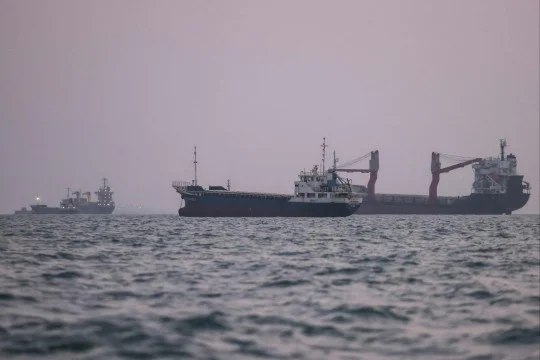
September 15, World (LNW): Tensions around the Strait of Hormuz have intensified after Iran and the United States gave sharply different accounts of what happened to an oil tanker in the strategically vital waterway.
Iran’s Islamic Revolutionary Guard Corps (IRGC) said the Panama-registered tanker El Gaia had struck a sea mine in the strait and caught fire. Iranian state broadcaster IRIB, citing the IRGC, reported that the vessel had been using the southern passage, which Tehran had previously warned shipping operators to avoid.
The IRGC said the explosion caused the tanker to become engulfed in flames and maintained that the strait remained under Iranian control. Iranian naval authorities have reportedly designated a northern passage closer to the Iranian coast as the permitted route, while imposing charges on vessels using it.
Washington strongly disputed the Iranian version of events.
US Central Command said the El Gaia had been hit by an Iranian missile in the previous month, leaving it unable to operate normally. According to the US military, the tanker was subsequently attacked by an Iranian drone while anchored in waters off Oman.
CENTCOM said the vessel was now being towed with assistance from a regional partner and accused Tehran of using misleading claims and intimidation to restrict commercial shipping through the waterway.
The dispute comes as the Strait of Hormuz has become one of the most sensitive flashpoints in the wider conflict involving Iran and the United States. Before the latest escalation, the narrow maritime corridor carried roughly one-fifth of global oil supplies, while significant quantities of liquefied natural gas and other commodities from Gulf producers also passed through it.
A planned meeting of Gulf foreign ministers on Monday to address the growing risks surrounding the strait was cancelled at short notice, underlining the uncertainty facing regional governments and energy markets.
The security situation has also deteriorated beyond the Gulf.
Yemen’s Iran-aligned Houthi movement claimed responsibility for launching a large-scale missile and drone assault against a military facility in the southern Saudi Arabian city of Khamis Mushait. The group said the attack was aimed at installations including aircraft shelters, radar equipment, runways and ammunition storage areas.
Saudi authorities subsequently activated emergency warning systems in Khamis Mushait and three other cities in the country’s south.
The latest confrontation follows an attack on Saudi territory on Friday, which Riyadh attributed to Iran-backed fighters operating from Iraq. The incident reportedly disrupted the country’s east-west oil pipeline, an important alternative export route that allows some Gulf crude to avoid the Strait of Hormuz.
Meanwhile, the conflict in Yemen has entered a new and increasingly volatile phase. Houthi forces have reportedly made rapid territorial advances in recent days, including the seizure of Perim Island at the entrance to the Red Sea. Their forces also moved into the historic port of Mocha last week.
The renewed fighting presents another difficult challenge for US President Donald Trump, who is under pressure from Saudi Arabia and other Gulf partners to help contain the Houthi advance while seeking to avoid a broader military commitment in the region.
Saudi Arabia has led military operations against the Houthis since 2015, although hostilities had eased considerably following a period of relative calm and a ceasefire. Fighting has now resumed, with Houthi forces confronting groups aligned with Yemen’s internationally recognised government.
Three sources cited by Reuters said Washington had so far declined requests from Riyadh for direct military involvement beyond intelligence assistance. Trump said over the weekend that he had spoken with Saudi Crown Prince Mohammed bin Salman and claimed the Houthis had also contacted the US administration, asking Washington to remain outside the conflict.
The Saudi state media agency reported that the Crown Prince subsequently met US regional commander Admiral Brad Cooper in Jeddah on Monday.
The humanitarian consequences are also mounting. The International Organisation for Migration estimates that about 82,000 people have been displaced in Yemen since the beginning of the month as fighting spread into several population centres.
Among those affected are civilians trapped in areas where access to food, water and safe passage has become increasingly difficult.
Aisha Muhammad, an elderly woman living near Taiz in south-western Yemen, told Reuters that several of her children had been left behind after she managed to flee. She said those remaining were unable to reach markets or travel to safer areas because of fighting and restrictions on movement.
The widening confrontation across the Gulf, Yemen and the Red Sea is raising fresh concerns over the security of vital energy routes and the possibility that disruption to regional shipping could have consequences well beyond the Middle East.
