
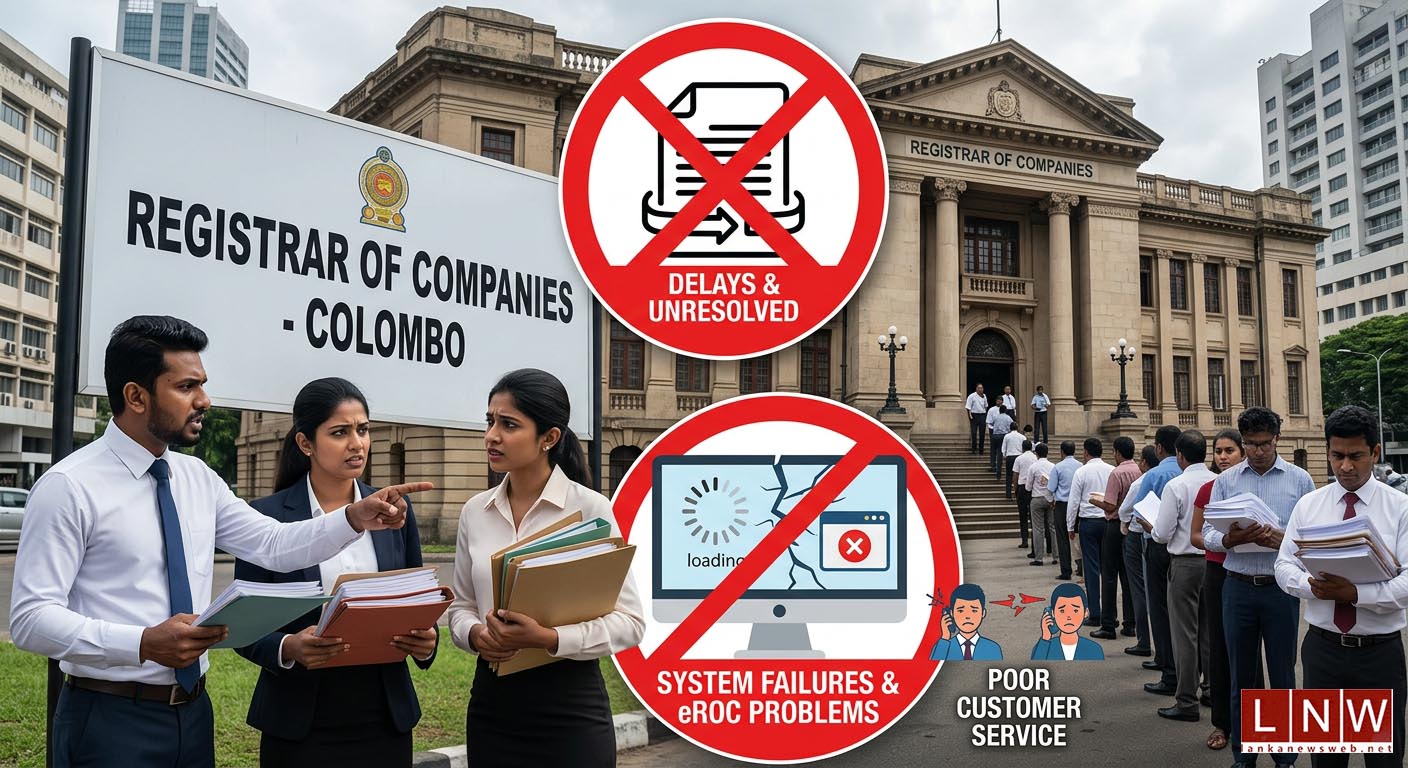
Concerns over incorporation delays, system failures and poor customer service raise questions about Sri Lanka’s business registration infrastructure
Colombo — Growing concerns over delays, technical failures and difficulties in accessing services at Sri Lanka’s Department of the Registrar of Companies (ROC) are prompting calls for urgent intervention by the Government, as businesses and company secretaries complain that problems at one of the country’s most important business-facing public institutions are obstructing routine corporate activities.
The concerns include lengthy delays in incorporating companies and approving statutory documents, difficulties in submitting beneficial ownership (BO) documentation, frequent problems accessing the eROC online platform, poor responsiveness to telephone inquiries and difficulties obtaining timely assistance from officials.
Some users report that company incorporations which should be routine have, in certain cases, remained unresolved for more than three months. Similar complaints concern documents submitted for approval or processing remaining pending for extended periods, creating uncertainty for businesses that depend upon timely registration and regulatory services.
eROC Problems Disrupt Business
Particular concern surrounds the reliability of the eROC system, which was introduced as the web-based single-window platform for company registration services.
The Department itself has published service alerts concerning eROC access problems. Public reporting has also highlighted technical failures affecting company incorporations, director filings and document certifications, as well as system overload, slowness and service unavailability.
The practical consequences can be substantial. A person seeking to establish a new company may need the incorporation documents before opening or regularising bank accounts, entering into contracts, obtaining finance, registering for other government services, bringing investors into the business or commencing certain commercial activities.
An inefficient company registration system therefore does not merely inconvenience company secretaries—it can delay actual economic activity.
Difficulties in Filing BO Forms
Another area requiring urgent attention is the submission and processing of beneficial ownership (BO) forms.
Businesses and professional service providers need a system that enables statutory documents to be filed correctly, efficiently and within prescribed deadlines. Where technical or administrative difficulties prevent or delay filing, companies can find themselves in the unreasonable position of attempting to comply with their legal obligations while being unable to complete the required process efficiently.
The Government should therefore ensure that BO filing facilities are technically stable, clearly explained and adequately supported by officials who can promptly resolve difficulties encountered by users.
Telephone Calls and Customer Service
There are also complaints that telephone calls to the Department frequently go unanswered and that obtaining assistance from officials can be difficult.
Such complaints are particularly serious for an institution increasingly dependent upon an online system. When an electronic filing encounters a technical or administrative problem, users require an effective support channel to resolve it.
A digital system cannot be considered an effective public service merely because documents can theoretically be submitted electronically. Digitalisation must be accompanied by reliability, accountability and effective customer support.
Businesses Pay for These Services
A further source of frustration is that many ROC services are provided against payment of prescribed fees.
Companies and members of the public are therefore entitled to expect a reasonable standard of service in return.
Where a customer pays the required government fee but then encounters prolonged delays, inaccessible systems, unanswered inquiries or inadequate assistance, legitimate questions arise about value for money, fairness and administrative accountability.
The issue is especially significant because companies have little practical alternative. Statutory filings and registrations required under company law must ultimately be dealt with through the Registrar of Companies. Businesses cannot simply select another service provider when the Government’s system fails.
Concerns Have Reached Parliament
The performance of the Department has also attracted attention in Parliament.
MP Ravi Karunanayake has formally questioned the Government regarding the operations of the Registrar of Companies. Parliamentary questions have addressed matters including the average time taken to incorporate a company, revenue earned through incorporations and the extent of automation at the Department.
More recently, on 24 July 2026, Mr. Karunanayake raised a question concerning the implementation of the digital transformation system at the Department of the Registrar of Companies.
The fact that the matter has reached Parliament reinforces the need for the difficulties confronting businesses and professionals to be examined at policy level rather than treated simply as isolated complaints by individual users.
ROC Is Critical to Sri Lanka’s Business Environment
The Registrar of Companies is not an ordinary administrative department.
It occupies a central position in Sri Lanka’s business infrastructure. Entrepreneurs, investors, local companies, foreign investors, directors, company secretaries, accountants, lawyers, banks and other financial institutions depend upon its records and services.
An entrepreneur’s experience with the ROC may also be one of his or her first interactions with the Government when establishing a business in Sri Lanka.
If incorporating a company takes months, statutory documents remain pending, the electronic system is unreliable and inquiries cannot be resolved promptly, the consequences extend beyond administrative inconvenience. They affect Sri Lanka’s broader objective of creating an environment in which businesses can be established and operated efficiently.
Government Intervention Needed
The difficulties therefore warrant the immediate attention of the Minister responsible for the Department, the Secretary to the relevant Ministry, the Registrar of Companies and the Presidential Secretariat.
The objective should not be to assign blame to individual officers. What is required is an urgent examination of whether the Department has adequate IT infrastructure, staffing, workflow controls, service standards, technical support and management accountability to perform its statutory functions efficiently.
A practical reform programme should include measurable turnaround times for incorporations and statutory filings; a reliable eROC platform with appropriate backup and disaster-recovery arrangements; an effective helpdesk and telephone support system; proper tracking of pending applications; escalation procedures for documents remaining unresolved beyond established time limits; improved BO filing facilities; and publication of service-performance statistics.
The Government should also consider an independent review of the eROC platform and the Department’s processing procedures to identify the causes of recurring delays and system failures.
Businesses Deserve a Reliable Service
Sri Lanka is seeking investment, entrepreneurship, economic growth and greater formalisation of business activity. Those objectives cannot be pursued effectively while businesses encounter avoidable administrative barriers at the very institution responsible for facilitating their legal establishment and maintaining their corporate records.
The public is not asking for preferential treatment. Businesses and professionals are asking for something considerably simpler: a reliable online system, reasonable processing times, accessible officials and the service for which they have paid.
The problems at the Registrar of Companies should therefore receive urgent attention at the highest administrative and political levels.
Improving the Department would not merely solve an administrative problem. It would remove an unnecessary obstacle to doing business in Sri Lanka and strengthen confidence in the country’s public-sector business infrastructure.
