
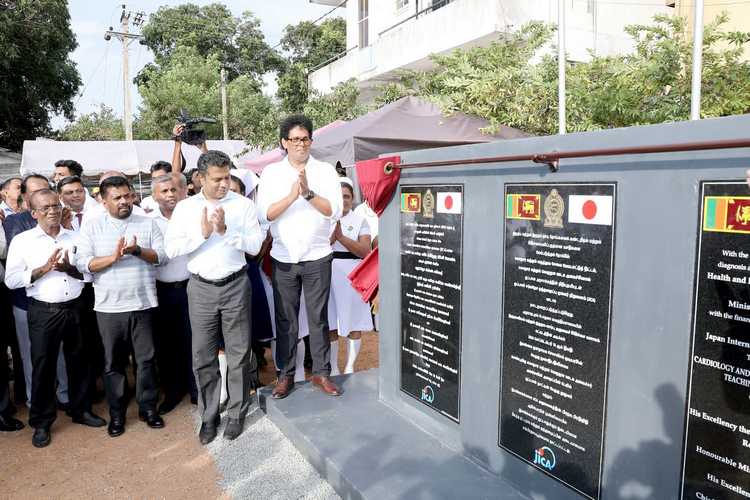
September 17, Colombo (LNW): President Anura Kumara Dissanayake has outlined a three-pronged approach to upgrading Sri Lanka’s health sector, with greater access to free medical care, modern technology and stronger administration identified as the main priorities.
The President said the Government’s healthcare strategy was designed not only to expand medical facilities, but also to ensure that improvements in the economy translate into better living standards for ordinary citizens.
He was speaking on 16 September at the launch of construction work on a new Cardiac Care Complex at Anuradhapura Teaching Hospital.
The eight-storey facility is being developed with financial assistance from the Japan International Cooperation Agency (JICA) at a construction cost of Rs. 3.545 billion. Once completed, it is expected to provide patients in the region with access to advanced cardiac and cardiothoracic treatment through the state healthcare system.
The complex will include coronary and intensive care units, catheterisation laboratories, X-ray and ECG facilities, specialist clinics, wards, laboratories, an auditorium and a library.
The President said the Government’s health policy was centred on bringing free medical services closer to communities, introducing modern equipment and treatment methods, and improving the management of healthcare institutions.
He said the Arogya programme was intended to strengthen access to basic healthcare, particularly in rural areas, while advances in medical technology would be incorporated into the wider public health system.
Dissanayake also stressed the importance of avoiding delays in major development projects. He said prolonged construction schedules could result in two forms of loss: the public would be deprived of the intended service for longer, while the eventual cost of completing the project could rise substantially.
Referring to an example cited by the Health Minister, he said a ministry project initially estimated at Rs. 28 billion had subsequently risen to around Rs. 58 billion. He said such cost increases placed an additional burden on public finances and reduced the scope for investing in other projects.
The President attributed some of the delays to the country’s recent economic crisis, while saying Government officials had made progress in clearing obstacles affecting stalled projects.
He expressed confidence that the new cardiac complex in Anuradhapura could be completed within 18 months and urged all parties involved in the project to maintain that timetable.
Dissanayake also placed considerable emphasis on strengthening the health workforce, saying modern buildings and equipment would have limited value without sufficient numbers of trained professionals.
He said 3,000 doctors had been recruited for internship training during August, September and October, describing the move as a significant expansion of the medical workforce. Sixty-four dental surgeons had also been recruited, he said.
According to the President, 3,978 nurses had already been recruited, with another 2,820 expected to be added by 31 October. This would bring the total number of new nursing personnel recruited during the period to 6,798.
He further said 4,869 student nurses had entered training, while another 3,000 were expected to be admitted to nursing colleges by January 2027.
Additional recruitment was also under way in several other categories, including health assistants, para-medical services and allied health professions, according to the President.
The Government, he said, was seeking to address long-standing shortages in the public health workforce while maintaining the country’s commitment to providing free healthcare.
Dissanayake said the Anuradhapura Teaching Hospital was already benefiting from several major development projects. The eight-storey Cardiology and Cardiothoracic Surgery Complex, including equipment, represents an overall investment of Rs. 8.035 billion, with Rs. 3.545 billion allocated for construction and Rs. 4.49 billion for medical equipment.
Other projects include a medical supplies storage complex costing more than Rs. 1 billion and a further Rs. 1.186 billion allocation for intensive care and medical ward facilities.
The President said projects valued at approximately Rs. 19 billion were scheduled to begin at the Anuradhapura hospital during 2027 and 2028, while work worth about Rs. 9.7 billion was already under way.
Taken together, he said, the projects already in progress and those planned for the coming years would represent an investment of close to Rs. 34 billion in the development of the hospital.
Health Ministry Secretary Dr Anil Jasinghe, meanwhile, highlighted the growing burden of non-communicable diseases, saying they account for about 80 per cent of deaths in Sri Lanka.
He identified hypertension and diabetes as two of the principal contributors and said poor control of both conditions was increasing the risk of serious complications, particularly heart attacks.
Dr Jasinghe said only around half of people with high blood pressure were believed to have their condition effectively controlled, while the figure for diabetes was about 25 per cent.
He said changes in Sri Lanka’s population structure and disease patterns meant that the healthcare system could no longer rely solely on traditional approaches. The country, he said, needed a system capable of responding to the growing demand for specialised and technologically advanced treatment.
The Ministry is therefore pursuing its health sector programme through three broad areas — Arogya, Cluster Systems and High-End Care Institutions — with the aim of improving access, modernising treatment and strengthening the overall delivery of public healthcare.
