
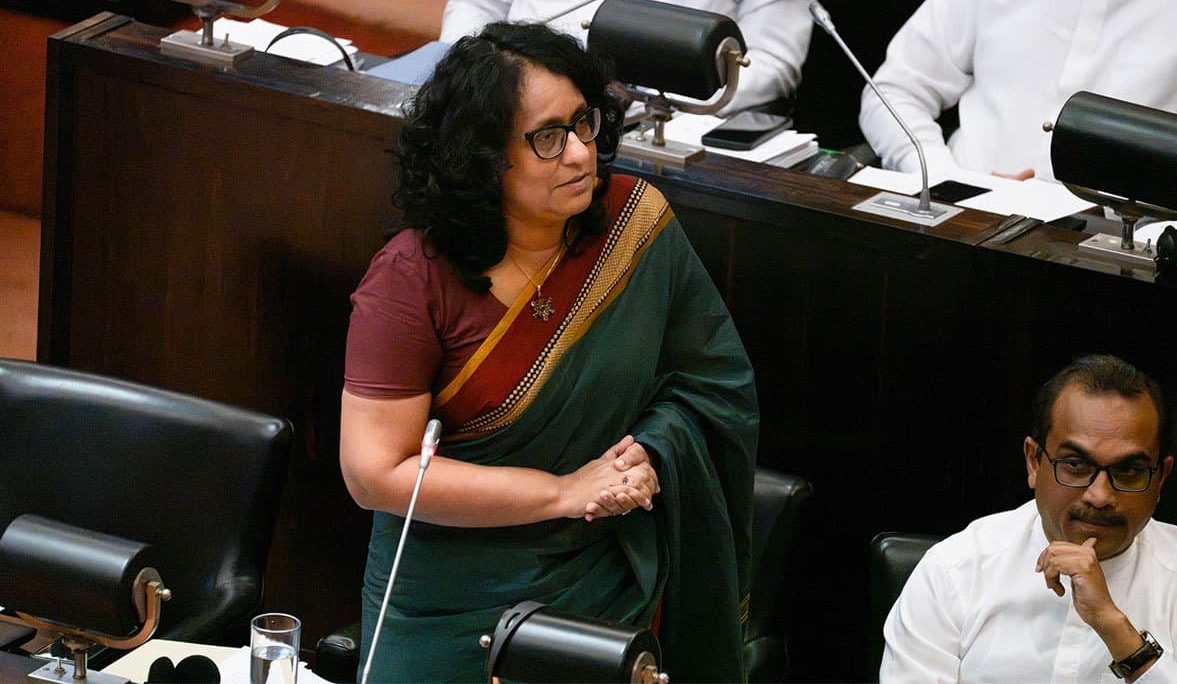
September 24, Colombo (LNW): Prime Minister Dr Harini Amarasuriya has said the Government’s efforts to strengthen the rule of law are centred on ensuring that every citizen can obtain justice without discrimination.
Speaking in Parliament on Thursday (24), the Prime Minister said the constitutional amendment currently being considered should not be viewed in isolation, but as one element of a wider programme aimed at improving Sri Lanka’s justice system.
She said meaningful improvements would require changes across several institutions rather than relying on a single legislative measure. Over the past two years, the Government has taken steps to strengthen independent investigations and improve the ability of the Police and Criminal Investigation Department (CID) to conduct inquiries fairly and impartially.
According to the Prime Minister, efforts have also been made to promote greater fairness in recruitment, promotions and appointments within the relevant institutions.
Measures are meanwhile being introduced to tackle delays within the courts. These include filling vacant posts, expanding hearing capacity, directing additional resources towards courts facing heavy workloads, introducing technology and increasing the number of support staff.
Amarasuriya also said longstanding vacancies in the Government Analyst’s Department were being addressed, noting that shortages in the department had contributed to delays in investigations.
The proposed constitutional amendment would also provide for the creation of Courts of Appeal in provinces where they are considered necessary, with the stated aim of bringing judicial services closer to communities outside Colombo and other major centres.
The Prime Minister said prolonged delays in investigations and court proceedings had imposed a significant burden on ordinary citizens. She also argued that weaknesses in the justice process had, over time, made it harder to maintain accountability when political administrations changed.
Addressing concerns surrounding the proposed changes to the retirement age of judges, Amarasuriya said the measure would apply generally and was not designed around any particular judge or court. She pointed to international precedents, including the United Kingdom, where the judicial retirement age was raised from 70 to 75 in 2021, and Hong Kong, where it was increased from 65 to 70 in 2019.
She further maintained that the proposed amendment would not give the Executive additional authority over the Judiciary or change the existing constitutional balance among the branches of government.
Responding to criticism, the Prime Minister urged that the amendment be considered as part of the Government’s broader programme to improve judicial independence, efficiency and access to justice.
She also linked the reforms to what she described as a wider change in public attitudes towards state institutions. As an example, she referred to the response of young people following the recent railway strike, when some passengers bought additional tickets after train services resumed. She described the gesture as a modest indication of growing public responsibility towards public institutions.
Amarasuriya said such developments reflected a broader expectation for stronger institutions, greater accountability and a justice system capable of serving citizens more effectively.