
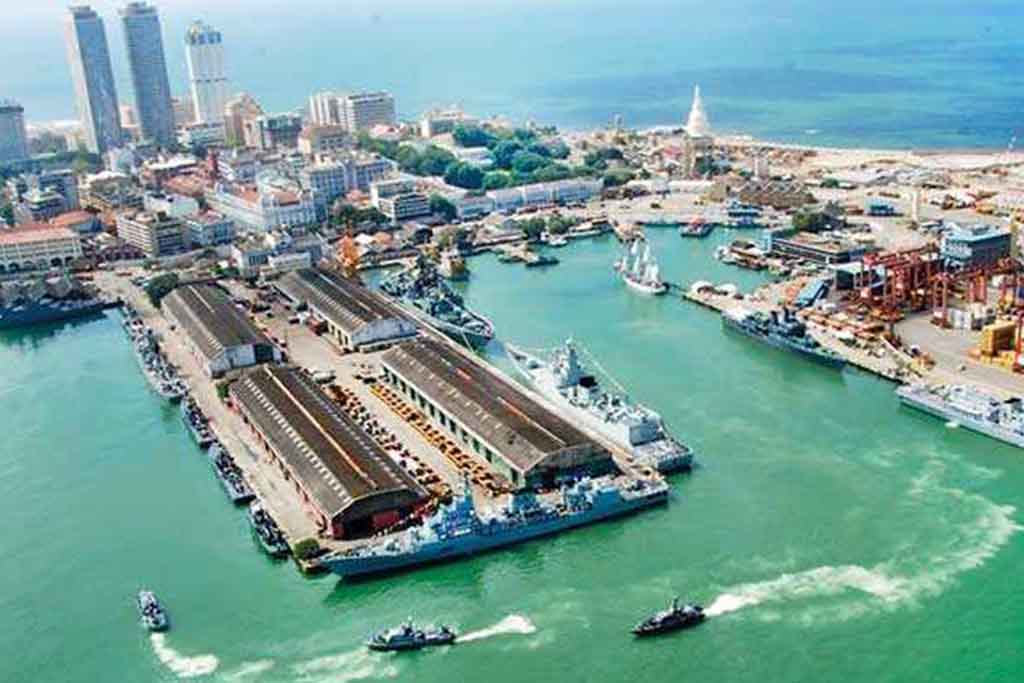
The Colombo East Container Terminal (ECT), conceived as a strategic gateway to transform Sri Lanka into an even more powerful Indian Ocean transshipment hub, is increasingly facing questions over why its enormous potential remains trapped by delays, procurement controversies and institutional inertia.
The state-owned Sri Lanka Ports Authority (SLPA) has already committed hundreds of millions of dollars to the terminal, with the overall investment estimated at around US$500–600 million. Hitherto the gap between the terminal’s engineered capacity and its operational performance is becoming increasingly difficult to ignore.
The latest development is the Government’s exploration of a partnership with major international shipping lines to improve ECT’s capacity. Port Minister Anura Karunathilaka has disclosed that at least five leading shipping companies have expressed interest. Following Cabinet approval, the Government intends to call for Expressions of Interest, with a possible partnership to be finalised during the first half of next year.
The proposal raises a fundamental question: why does a strategically located state-owned terminal requiring such massive investment still need outside shipping-line participation to unlock its full potential?
ECT occupies a critical position within Colombo Port, located along an Indian Ocean shipping route through which more than US$1 trillion in annual global trade passes. Designed to accommodate Ultra-Large Container Vessels carrying between 18,000 and 22,000 containers, it was expected to become a cornerstone of Sri Lanka’s maritime strategy.
Its eventual blueprint is formidable. The completed terminal is expected to have a 1,320-metre quay wall and an 18–20-metre water depth. Its annual capacity is projected at between 2.4 million and three million TEUs, pushing Colombo Port’s overall capacity beyond seven million TEUs.
But the promised transformation has been slowed by delays in equipment procurement.
The terminal’s planned high-density operation depends on 12 Ship-to-Shore Super-Post-Panamax cranes and 40 Automated Rail-Mounted Gantry cranes. Yet equipment tenders have reportedly encountered repeated difficulties, while several international manufacturers have withdrawn from bidding.
Questions have consequently emerged regarding tender criteria, procurement procedures and whether the process created an environment that discouraged established international manufacturers.
The controversy is particularly serious because transshipment represents roughly 75–80 percent of Colombo Port’s total cargo, while India-related cargo accounts for more than 70 percent of that transshipment business.
Every delay at ECT therefore carries consequences extending far beyond the terminal itself.
The 2021 cancellation of the trilateral arrangement involving India and Japan further disrupted the original development trajectory, forcing Sri Lanka to pursue an independent funding and construction path at a time when its foreign-exchange position was deteriorating sharply.
ECT’s completion, originally targeted for 2026, has now effectively moved into 2027.
The Government’s proposed shipping-line partnership could provide a route forward. But before another major arrangement is concluded, transparency over procurement failures, equipment delays and accountability for repeated setbacks must become central.
Otherwise, ECT risks becoming a costly symbol of infrastructure ambition undermined by administrative failure.