
By: Staff Writer
November 10, Colombo (LNW): Sri Lanka approaches the presentation of its third NPP Government Budget on November 12 with one of the strongest foreign exchange inflow performances in its post-crisis history. Official reserves have crossed US$7 billion, workers’ remittances have reached unprecedented levels and private-sector credit continues to expand.
Nevertheless the underlying economic picture remains complicated by the country’s dependence on overseas employment, slowing annual private-sector credit growth and declining commercial banking foreign assets.
The critical challenge for the Government is whether this recovery can be transformed into a broader productive economic structure capable of generating sustainable foreign exchange rather than relying disproportionately on earnings generated by Sri Lankan workers overseas.
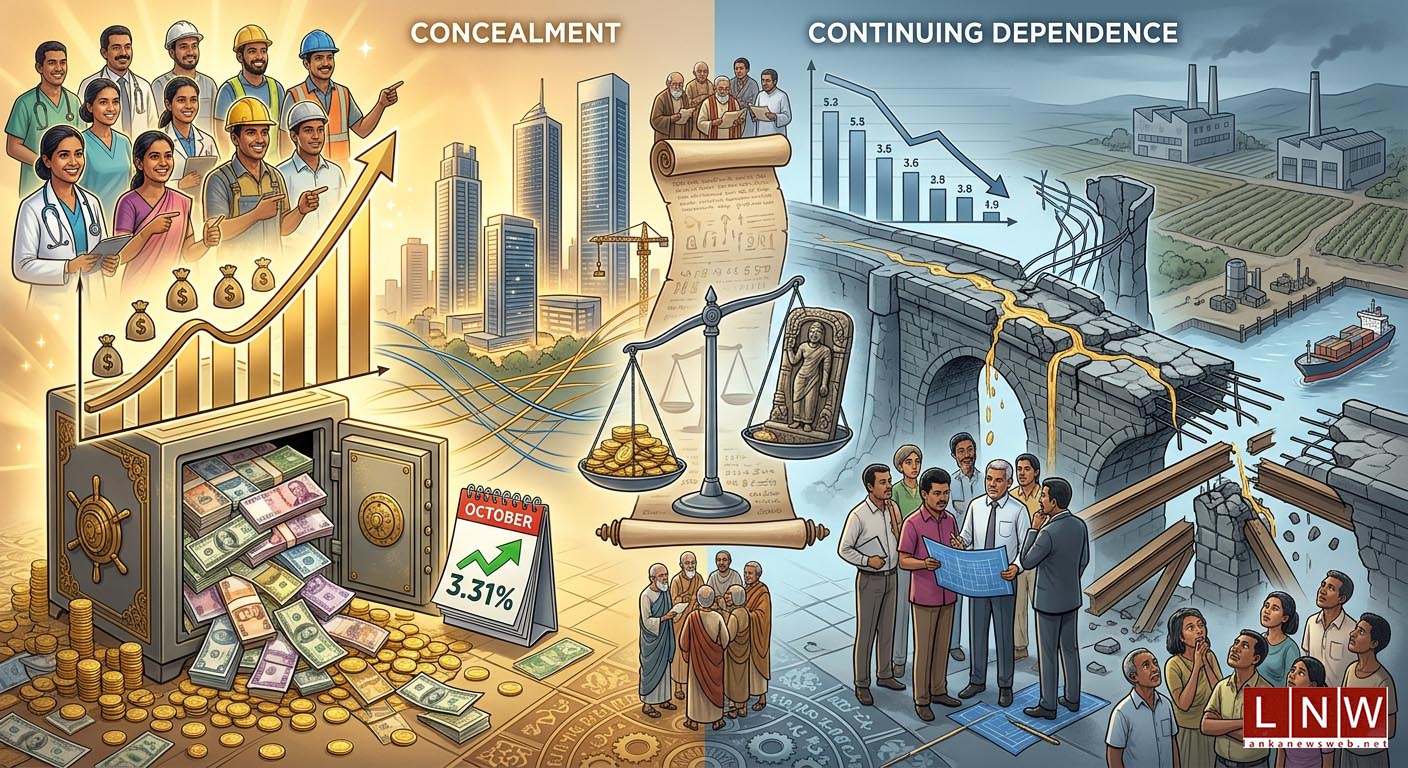
Central Bank figures reveal that workers’ remittances increased to a record US$735.6 million in October 2026, representing a 3.31% year-on-year increase. This marked the ninth consecutive month of exceptionally strong inflows despite uncertainty surrounding the Middle East, which remains a major destination for Sri Lankan migrant workers.
Cumulative remittances during the first ten months exceeded US$7.6 billion, registering 16.5% growth compared with the corresponding period last year. This represents the strongest January-October performance in the country’s history.
The figures reinforce the growing importance of migrant earnings in maintaining Sri Lanka’s external financial stability. Remittances reached US$8.07 billion in 2025, surpassing the previous record of US$7.24 billion in 2016.
The recovery is particularly significant when compared with the 2022 economic collapse, when remittances plunged 31% to US$3.78 billion amid foreign exchange shortages and the expansion of informal money-transfer channels.
The subsequent recovery saw inflows increase by 57% to US$5.96 billion in 2023 and a further 10.1% to US$6.57 billion in 2024.
However, the Government must recognise that remittances, despite their importance, are not a substitute for export competitiveness, foreign direct investment or domestic industrial development.
The concentration of Sri Lankan migrant employment in the Middle East also creates exposure to geopolitical instability. Any prolonged regional conflict, disruption to employment or changes in labour-market conditions could affect household incomes and national foreign exchange availability.
Meanwhile, domestic banking figures reveal a mixed picture regarding the strength of economic activity.
Private-sector credit expanded by Rs.212.4 billion in September, increasing outstanding lending to Rs.11.77 trillion from Rs.11.56 trillion in August. However, annual growth slowed to 23.6% from 24.5%, marking the third consecutive monthly deceleration from July’s 26.4%.
More importantly, September’s monthly credit expansion was 6.4% below the Rs.226.8 billion recorded during the corresponding month of 2025.
Although lending remains substantial, the declining annual growth rate raises questions about the sustainability and composition of private-sector demand. The Government must establish whether credit expansion is increasingly financing productive investment, manufacturing, export-oriented businesses and employment creation or primarily supporting consumption and working-capital requirements.
Credit to public corporations and State-Owned Business Enterprises declined Rs.16.9 billion to Rs.462.9 billion, while annual contraction widened to 24%. This could reflect financial consolidation, but it also highlights the continuing challenges confronting State-owned commercial operations.
Net credit to the Government from the banking system fell Rs.84.8 billion to Rs.7.65 trillion, indicating reduced banking-system exposure to public-sector borrowing during September.
However, reserve money increased Rs.39 billion to Rs.1.95 trillion, with annual growth accelerating to 15.2% from 11.8%. At the same time, broad money aggregate M2b reached Rs.17.19 trillion, although annual growth eased to 11.1%.
These developments require careful assessment in formulating monetary and fiscal policies.
The 2027 Budget must therefore move beyond celebrating record remittances and improved reserves. It should establish measurable targets for export earnings, foreign direct investment, industrial diversification, technology-based services and productive private-sector lending.
The central economic question is whether the Government can convert foreign exchange earned by migrant workers into domestic productive investment and sustainable employment.
Without such a transformation, Sri Lanka risks remaining dependent on the sacrifices of overseas workers to finance an economy that has yet to generate sufficient foreign exchange through its own productive capacity.