
By: Staff Writer
November 16, Colombo (LNW): Sri Lanka’s latest technological partnership with India raises an important economic question: will the India-Sri Lanka Innovation Forum empower domestic entrepreneurs and build national technological capacity, or will it gradually strengthen the competitive position of larger Indian companies in an economy where local startups are already struggling to obtain capital, markets and institutional support?
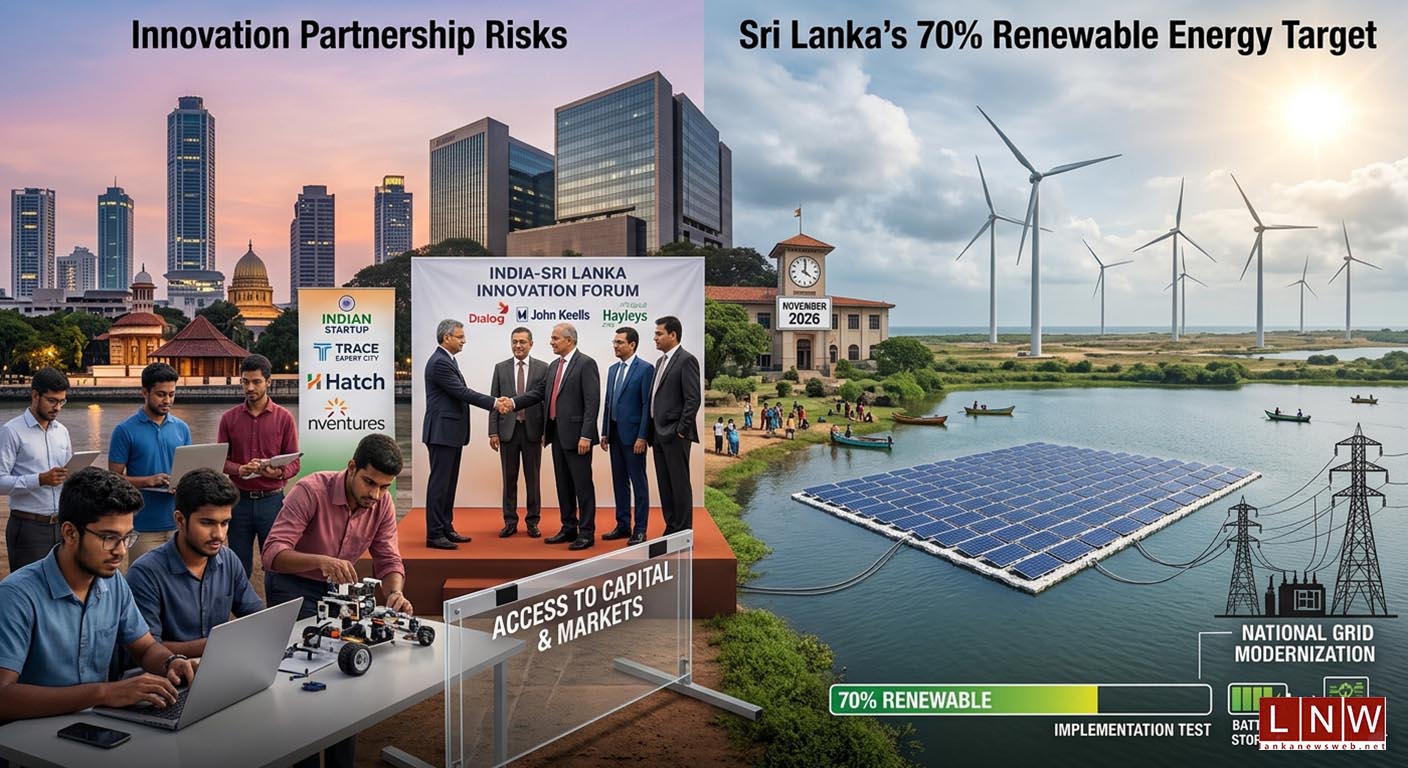
The Forum, launched in Colombo on November 12, 2026, represents an ambitious attempt to establish a business-led platform connecting corporate leaders, startup incubators, investment funds and technology institutions in both countries. Its stated objectives include developing joint projects, strengthening innovation ecosystems and creating stronger links between entrepreneurs on either side of the Palk Strait.
Indian High Commissioner Santosh Jha attended the launch, which attracted leading Sri Lankan corporate organisations, including Dialog Axiata, John Keells Holdings, Hayleys, Hemas Holdings and Sunshine Holdings. Innovation networks such as Trace Expert City, nVentures, Hatch, SLASSCOM, Lanka Angel Network and Yarl IT also participated.
However, the composition of the partnership highlights an important imbalance that policymakers must examine. While major corporate groups and established Indian technology institutions possess considerable financial, technical and institutional resources, many Sri Lankan startups operate with limited access to investment, advanced research facilities and international commercial networks.
The participation of IIT Madras Pravartak, C-CAMP, Atal Innovation Mission and Nasscom could provide valuable opportunities. Yet the success of the Forum will depend on whether these institutions genuinely facilitate technology transfer and domestic enterprise development rather than simply expand access for larger businesses to Sri Lanka’s emerging technology market.
The previous initiatives provide both opportunities and lessons. Nasscom’s Disha programme for technology SMEs was extended to Sri Lanka as the first country outside India. IIT Madras Pravartak conducted a six-week capacity-building and immersion programme for local startups and entered into agreements with SLASSCOM and Dialog.
Similarly, the Atal Innovation Mission’s Tinkering Labs initiative, launched on November 4 through Hemas Holdings and Nalanda College, seeks to encourage innovation among schoolchildren. The Wireless Intelligence and Innovation Institute of Technology, established in June, connects Indian and Finnish institutions with Sri Lankan universities through a clean-network research and development centre.
C-CAMP’s September visit also opened discussions on biotechnology partnerships.
These developments demonstrate that cooperation is already extending into education, telecommunications, biotechnology and advanced research. Nevertheless, several fundamental questions remain unanswered.
Who will finance the joint projects? What proportion of research and development activities will take place in Sri Lanka? Will intellectual property generated through collaborative research remain accessible to Sri Lankan institutions and entrepreneurs? Will local startups receive equal opportunities to commercialise their innovations and enter the Indian market?
These are not minor administrative questions. They concern the country’s future technological sovereignty and its ability to capture economic value from international partnerships.
Sri Lanka must also guard against a situation in which talented graduates and promising startups become increasingly dependent on larger foreign technology companies without developing independent domestic capabilities.
The Government and private-sector partners should therefore establish transparent rules governing intellectual property, research ownership, investment participation, technology transfer and employment opportunities. A dedicated startup financing mechanism, supported by participating businesses and investment funds, could provide practical assistance to promising local ventures.
The Forum should publish annual performance assessments identifying projects completed, investments mobilised, startups supported, technologies commercialised and employment generated in both countries.
India offers Sri Lanka access to a substantially larger technology ecosystem, institutional expertise and investment opportunities. Rejecting such cooperation would be economically short-sighted. But accepting it without safeguards and measurable national benefits would be equally dangerous.
The ultimate measure of this partnership must be whether Sri Lanka develops stronger indigenous businesses, retains its technological talent and creates exportable intellectual property, rather than merely becoming another destination for expanding regional corporate interests.
@@@@@@@@
Article 05
Sri Lanka’s 70% Renewable Energy Target Faces Implementation Test
Sri Lanka’s renewed commitment to generate 70% of its electricity from renewable sources by 2030 has once again placed the country’s energy transition under international scrutiny, raising important questions about whether its ambitious targets can be translated into affordable, reliable and commercially viable electricity for consumers.
The commitment was reiterated by Deputy Minister of Energy Muhammadu Ilyas Muhammadu Arkam at the Ninth Session of the International Solar Alliance (ISA) Assembly, held in New Delhi from November 3 to 5, alongside the Bharat Renewable Energy Summit and Expo 2026. Sri Lanka also reaffirmed its ambition to achieve carbon neutrality in electricity generation by 2050 under its Nationally Determined Contributions to the Paris Agreement.
However, the challenge confronting Sri Lanka is no longer simply announcing renewable energy ambitions at international forums. It is demonstrating the financial capacity, technical readiness, institutional coordination and investment environment required to achieve them.
The Government has identified several areas for expanding renewable energy, including floating solar installations in reservoirs, solar and wind projects in the Northern, Eastern and Southern provinces, green hydrogen, electric mobility, battery energy storage systems and modernisation of the national electricity grid.
The development of wind power in Mannar and assessments of offshore wind potential have also been identified as important opportunities.
Nevertheless these initiatives require substantial capital investment, sophisticated technology, transparent procurement procedures and long-term planning. Without these essential conditions, the 70% target risks becoming another ambitious policy declaration rather than a measurable transformation of the national energy sector.
One of the most significant obstacles is the intermittent nature of solar and wind generation. Increasing their contribution without adequate battery storage, grid flexibility and transmission infrastructure could create serious operational difficulties for the national electricity system.
The Government’s emphasis on battery energy storage and digital grid management therefore deserves particular attention. However, the financial implications of these investments, their procurement costs and their eventual impact on electricity tariffs remain important questions.
Floating solar projects could offer opportunities to utilise existing reservoirs without requiring extensive additional land. Nevertheless, environmental safeguards, water-management requirements, technical feasibility and transparent agreements with investors must be established before large-scale implementation.
Sri Lanka’s participation in the ISA also provides opportunities to mobilise international investment and technical assistance. Its engagement with India, particularly on solar integration, agricultural solarisation and energy storage, could strengthen the country’s technical capabilities.
The proposed Solar Technology Application Resource Centre at the University of Moratuwa is another potentially important development.
But the success of these initiatives will depend on whether cooperation produces operational projects, rather than remaining confined to discussions, memorandums and institutional commitments.
Ultimately, the renewable energy transition must be judged by its economic benefits to electricity consumers, industries and taxpayers. Reducing dependence on imported fossil fuels could strengthen foreign exchange stability and improve long-term energy security.
However, expensive renewable infrastructure, poorly negotiated contracts or inefficient investments could transfer substantial costs to the public.
The Government must therefore publish a credible implementation timetable, investment requirements, financing arrangements and measurable annual targets.
Sri Lanka’s 70% ambition is achievable only if policy declarations are supported by financial discipline, institutional accountability and technically sound execution. The real test begins when international commitments become projects delivering affordable electricity to the public