October 06, Colombo (LNW): Sri Lanka’s banking sector has shown early signs of stabilisation, with non-performing loans (NPLs) easing and profitability strengthening during the second quarter of 2025, according to the latest analysis from the Central Bank of Sri Lanka (CBSL).
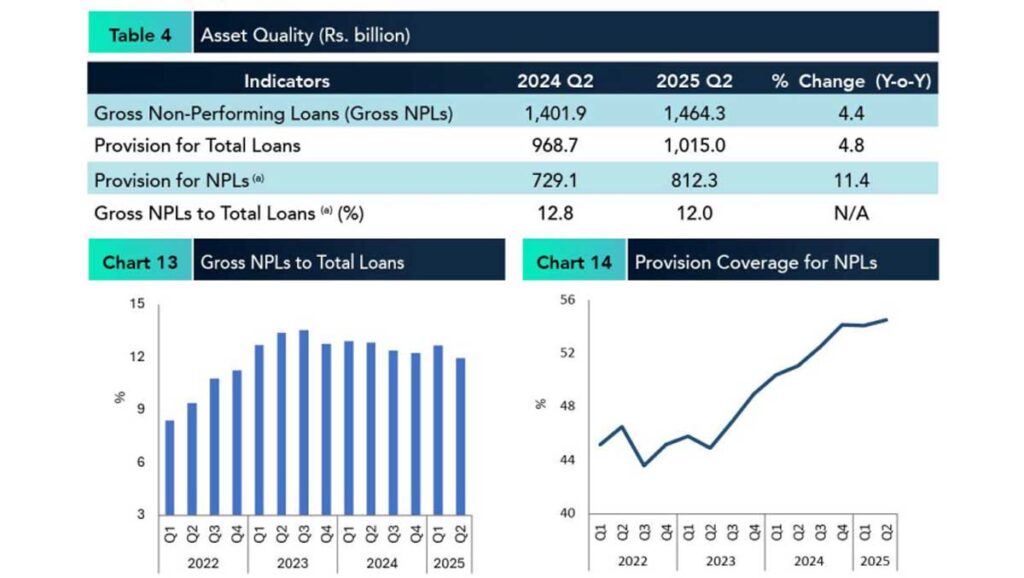
The ratio of gross NPLs to total loans fell to 12.0 per cent by the end of June 2025, down from 12.7 per cent in the first quarter. In absolute terms, gross NPLs declined to Rs. 1,464 billion from Rs. 1,474 billion over the same period, indicating a modest improvement in asset quality following a prolonged period of stress.
Banks also reported a sharp rise in earnings. Net interest income more than doubled to Rs. 501.1 billion in Q2, up from Rs. 251.4 billion in the first quarter. Pre-tax profits rose to Rs. 291.2 billion from Rs. 146.6 billion, while after-tax profits increased to Rs. 187.8 billion, compared to Rs. 93.6 billion in Q1.
The improving financial performance marks a tentative turnaround for the sector, which has been navigating the aftermath of one of the country’s most severe economic and currency crises. The crisis, triggered in part by past rate cuts and excessive liquidity injections, led to Sri Lanka defaulting on its external sovereign debt—the first in its history.
Unlike some nations that opted to restructure domestic debt by defaulting on government securities—an approach that would have inflicted direct losses on commercial banks—Sri Lanka steered clear of such a move. This decision preserved the integrity of domestic government securities and helped maintain stability in the banking sector’s capital base, supporting investor confidence in the local bond market.
During this period, the Central Bank also pursued a deflationary monetary policy stance, which allowed interest rates to gradually ease after a period of sharp tightening. The shift in policy has contributed to a more favourable environment for lending and banking profitability, though risks remain.
Despite the encouraging data, the NPL ratio remains elevated by historical standards, and further progress will depend on broader economic recovery, debt restructuring outcomes, and continued policy discipline.
Nevertheless, the latest figures suggest that the sector is on a cautious path to recovery, with capital buffers, earnings, and asset quality gradually moving in a positive direction.