
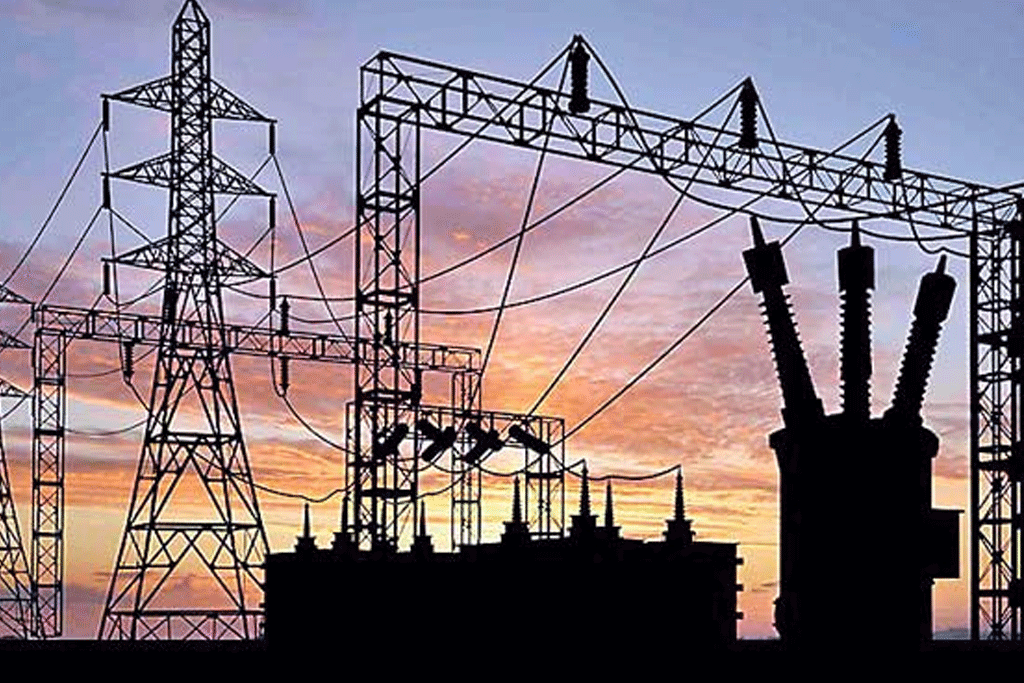
The Sri Lankan government has unveiled a transformative National Electricity Policy, opening it for public feedback until January 9, 2026. The policy outlines sweeping reforms in pricing, regulation, and renewable energy expansion while emphasizing financial sustainability and cost-reflective tariffs in the nation’s electricity sector.
Issued under the amended Sri Lanka Electricity Act by the Ministry of Energy, the policy signals a decisive shift from administratively controlled pricing. Electricity pricing will now consider long-term system costs, supply security, and regulatory oversight, moving away from arbitrary adjustments that have historically burdened taxpayers.
Key features include the formal unbundling of the Ceylon Electricity Board (CEB) into separate entities for generation, transmission, distribution, and system operations. The National System Operator will play a central role in security-constrained dispatch and long-term planning to minimize generation costs while ensuring grid stability.
Cost-reflective tariffs are at the heart of the reform. Future electricity rates are expected to reflect the full cost of generation, transmission, and distribution, with subsidies restricted to vulnerable consumers via transparent, targeted mechanisms. Limited lifeline support will continue, but the era of hidden cross-subsidization is drawing to a close.
The policy prioritizes renewable energy, including solar, wind, hydro, biomass, and waste-to-energy projects. However, integration will follow system limits, grid stability rules, and competitive procurement processes, signaling a departure from ad hoc project approvals. Digitalization is another central pillar, with smart metering, automated meter reading, and centralized data platforms aimed at loss reduction and demand-side management.
The policy also introduces a National Tariff Policy, tightening regulatory oversight of costs and enforcing efficiency benchmarks. Regulatory scrutiny, rather than arbitrary tariff hikes, will address inefficiencies. Phased implementation begins in 2026, encompassing competitive generation procurement, feed-in tariff reviews, and full operationalization of system operator functions.
The reform aligns with Sri Lanka’s International Monetary Fund Extended Fund Facility (EFF) program. IMF Mission Chief Evan Papageorgiou emphasized that cost-recovery pricing and CEB unbundling are critical structural benchmarks. “Cost-reflective pricing supports fiscal stability, ensures utilities operate commercially, and lays the foundation for long-term economic benefits,” he said.
Despite the policy framework, tariffs remain a contentious issue. The Public Utilities Commission of Sri Lanka (PUCSL) rejected a proposed 6.8% hike for late 2025, citing improved hydropower generation. Consumer groups have even called for reductions in early 2026, signaling potential adjustments but not confirming the widely discussed 11% increase.
As Sri Lanka embarks on this energy sector transformation, careful regulatory implementation and public scrutiny will be essential to balance affordability, sustainability, and financial viability in the nation’s electricity supply.