LISTEN TO STORY
WATCH STORY
By: Isuru Parakrama
May 03, World (LNW): The United States Supreme Court’s April 29, 2026 ruling in Louisiana v. Callais marks a profound and deeply polarising turning point in the country’s democratic framework. While framed as a constitutional correction to racial gerrymandering, the decision’s broader implications suggest a systematic weakening of one of America’s most critical civil rights safeguards—the Voting Rights Act (VRA).
At its core, the ruling fundamentally alters how discrimination in electoral maps can be challenged, shifting the legal burden in ways that critics argue could disenfranchise millions, particularly minority communities and women of colour.
What is the Ruling?
In a 6–3 decision authored by Justice Samuel Alito, the Court struck down Louisiana’s congressional map on the grounds of unconstitutional racial gerrymandering. However, the judgment went further, imposing significantly stricter requirements for claims brought under Section 2 of the VRA. Plaintiffs must now demonstrate not only the existence of racial bloc voting, but also prove that such patterns exceed partisan influences, align with all state redistricting priorities—such as protecting incumbents—and, crucially, provide compelling evidence of intentional discrimination in the present day.
This shift from a results-based to an intent-based standard represents a dramatic departure from decades of legal precedent. In a forceful dissent, Justice Elena Kagan, joined by Justices Sonia Sotomayor and Ketanji Brown Jackson, warned that the ruling effectively renders Section 2 “all but a dead letter”.
The dissent underscores a central concern: that proving intent in modern political systems—where discriminatory outcomes can be masked by ostensibly neutral criteria—is exceptionally difficult, if not impossible.
The case itself emerged from post-2020 census redistricting disputes in Louisiana, where Black voters sought the creation of a second majority-Black congressional district. Although a lower court initially supported this remedy, it was later deemed racially gerrymandered, paving the way for the Supreme Court’s intervention.
The Political Context
The ruling’s timing and political context are equally significant. Although not directly tied to the case, the broader policy environment shaped by President Donald Trump’s administration has reinforced concerns about voter access. The proposed SAVE Act, passed by the House in 2025, and a similar executive order issued in March that year, sought to mandate proof of citizenship for voter registration. While courts have partially blocked these measures—ruling that the executive lacks authority to alter registration procedures—their intent signals a broader push towards stricter voting requirements.
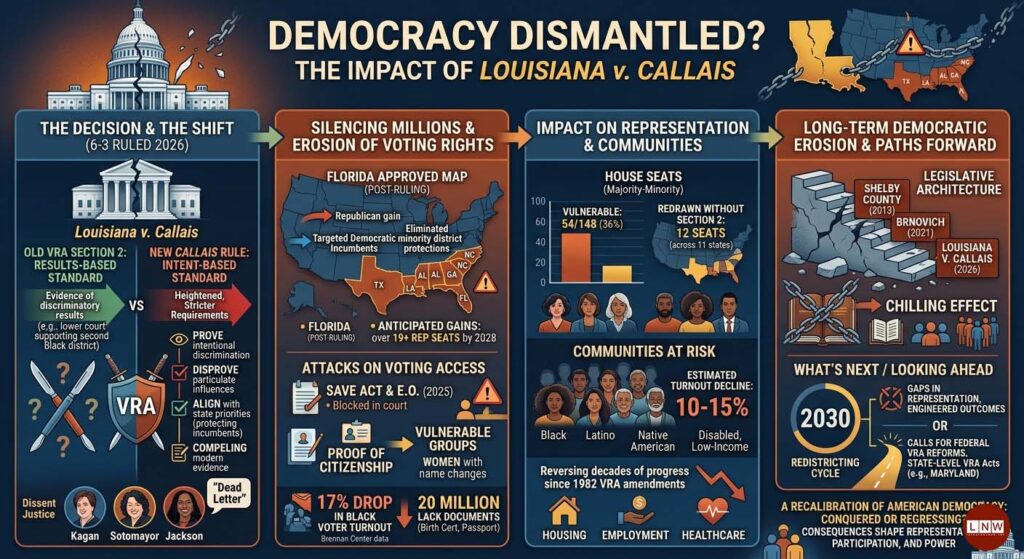
Critics argue that such measures disproportionately burden specific groups, particularly women who have changed their names after marriage and may face difficulties obtaining consistent documentation. Approximately 20 million Americans reportedly lack easy access to documents such as birth certificates or passports, placing them at heightened risk of exclusion from the electoral process.
The immediate political consequences of the Callais ruling were stark. Within hours, Florida approved a new congressional map favouring the Republican Party, eliminating protections for three majority-minority districts and directly targeting Democratic incumbents. Similar actions are anticipated across several states, including Alabama, Georgia, North Carolina, and Texas, where experts predict gains of over 19 Republican seats by 2028 through aggressive redistricting strategies.
The impact on representation is particularly acute for women of colour. Currently, 36 per cent of majority-minority districts—amounting to 54 out of 148 House seats—are considered vulnerable under the new legal framework. Up to 12 such seats across 11 states may be redrawn without the protective shield of Section 2. In practical terms, this could reverse decades of progress achieved since the 1982 amendments to the VRA, which significantly expanded minority representation.
Doomsday Not Far Away?
The broader consequences extend beyond electoral maps. Without robust federal oversight, states may feel emboldened to introduce restrictive voting measures, including stringent identification laws, reduced early voting periods, and the closure of polling stations in minority-heavy areas. Data from the Brennan Center suggests that such measures can reduce Black voter turnout by as much as 17 per cent.
Communities already facing structural disadvantages—Black, Latino, Native American, disabled, and low-income populations—are likely to bear the brunt of these changes. Projections indicate turnout declines of 10 to 15 per cent among some groups, alongside diminished political representation on key issues such as housing, employment, and healthcare.
The ruling also raises concerns about long-term democratic erosion. Combined with earlier Supreme Court decisions such as Shelby County v. Holder and Brnovich v. Democratic National Committee, the Callais judgment continues a pattern of narrowing the scope of federal protections against voter discrimination. The cumulative effect, critics argue, is the gradual dismantling of the legislative architecture established during the civil rights era.
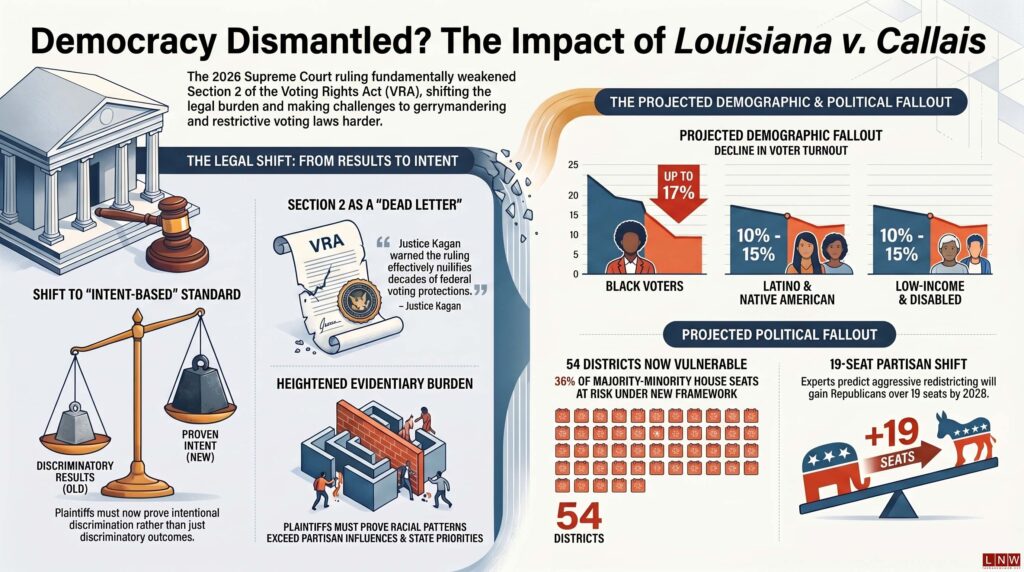
Moreover, the decision may have a chilling effect on future legal challenges. Civil rights organisations warn that the heightened evidentiary standards will deter plaintiffs from pursuing cases, effectively granting states greater freedom to implement partisan and potentially discriminatory electoral maps without fear of judicial intervention.
Looking Ahead
Looking ahead, the 2030 redistricting cycle looms as a critical juncture. Without legislative reforms or the adoption of state-level voting rights acts—such as the one recently enacted in Maryland—the balance of political power may increasingly reflect engineered outcomes rather than genuine voter preferences.
Ultimately, Louisiana v. Callais is more than a legal ruling; it is a recalibration of the American democratic system. Whether it represents a necessary correction or a dangerous regression depends largely on one’s political perspective. What is undeniable, however, is that its consequences will reverberate far beyond Louisiana, shaping the contours of representation, participation, and power in the United States for years to come.