
By: Staff Writer
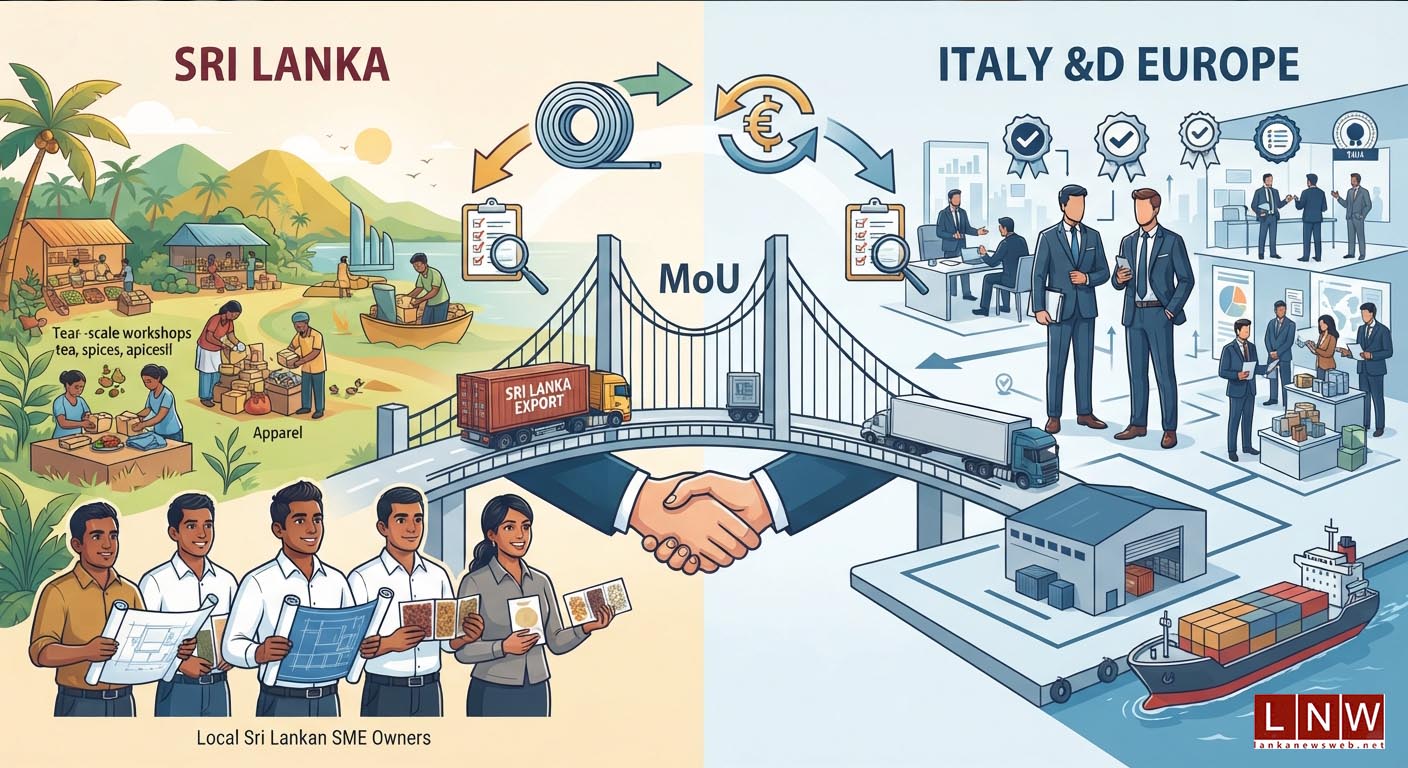
November 26, Colombo (LNW): A new business cooperation agreement between Sri Lanka and Italy has opened another potential route for small and medium-sized enterprises (SMEs) seeking access to European markets. But behind the optimism surrounding the Memorandum of Understanding (MoU) signed between the Ceylon Chamber of Commerce and Unioncamere lies a more fundamental economic question: are Sri Lankan SMEs sufficiently prepared to compete in Italy’s demanding commercial environment?
The agreement establishes a direct institutional relationship between the two countries’ business communities, creating opportunities for commercial partnerships, trade promotion, investment exploration and knowledge exchange. It also provides access to Unioncamere’s extensive network of Italian chambers of commerce, industry, handicraft and agriculture.
For Sri Lankan SMEs, this could address a significant structural weakness in the country’s export economy. While larger companies have the financial capacity to participate in international exhibitions, maintain overseas representatives and establish distribution networks, smaller businesses frequently struggle to identify buyers, negotiate contracts and meet the costs of entering foreign markets.
The planned business-to-business matchmaking programmes and trade delegations could help bridge this gap. However, simply introducing Sri Lankan companies to Italian counterparts will not guarantee commercial success. SMEs must demonstrate consistent production capacity, competitive prices, international quality standards and the ability to fulfil orders within agreed delivery schedules.
European markets impose demanding requirements concerning product safety, environmental sustainability, labour standards, packaging, traceability and certification. These requirements can become particularly difficult for smaller Sri Lankan manufacturers, agricultural producers and food-processing enterprises that lack modern technology and adequate financing.
Consequently, the new agreement should be accompanied by a practical export-readiness programme. The Ceylon Chamber and the Sri Lanka–Italy Business Council should identify promising SMEs, assess their production capabilities and provide targeted assistance in product development, certification, branding and market research.
There is also an important investment dimension. Italian companies could become valuable partners in introducing modern machinery, technical expertise and advanced production technologies to Sri Lanka. Joint ventures in food processing, apparel-related industries, engineering, tourism, renewable energy and other manufacturing activities could strengthen domestic production and create skilled employment.
Such partnerships would be particularly important if they help local enterprises move away from exporting relatively low-value commodities towards finished products with greater value addition and higher foreign-exchange earnings.
Another opportunity lies in connecting Sri Lankan SMEs to Italian supply chains. Rather than depending exclusively on direct exports to individual consumers, local manufacturers could become suppliers to established Italian companies and distributors. This could provide more predictable commercial relationships and encourage improvements in production standards.
The agreement follows more than a year of negotiations initiated by Sri Lanka–Italy Business Council Immediate Past President Daminda Mulgama. The signing ceremony was attended by representatives of Unioncamere and the Italian diplomatic mission, while Sri Lankan business and diplomatic representatives participated virtually.
Nevertheless, the economic impact will depend on the institutions responsible for implementation. Sri Lanka needs measurable targets covering participating SMEs, business contracts, export orders, investment commitments and employment generation.
The Government must also ensure that exporters receive timely assistance in accessing finance, technology and international certification.
Ultimately, the Italian agreement should not become another symbolic international business arrangement. Its real achievement would be enabling smaller Sri Lankan enterprises to enter competitive European supply chains, increase production, generate foreign exchange and create sustainable employment.
For an economy seeking stronger export diversification, empowering SMEs through meaningful international partnerships could deliver benefits far beyond the agreement itself.