July 15, Colombo (LNW): Sena Yaddehige, Chairman of Richard Pieris Group, is set to be arrested upon his return to Sri Lanka due to allegations of sexual assault involving a woman business analyst from the company.
The Kollupitiya Police secured a travel ban from the Fort Magistrate against Yaddehige following a complaint from a 39-year-old woman who claimed he assaulted her on May 7 at a high-end hotel in Kollupitiya.
The woman, who had been working remotely for the company, stated she was informed of Yaddehige’s return and requested to meet him, during which the alleged incident occurred.
Yaddehige reportedly left the country on the same day and has not returned since.
Kollupitiya Police have confirmed they are awaiting his arrival to enforce the travel ban and proceed with the arrest.
July 15, Colombo (LNW): In light of the forthcoming presidential elections, the government has decided to limit its bilateral engagements, except for hosting Indian Prime Minister Narendra Modi.
Plans to host leaders from the UAE and Maldives have been postponed to allow President Ranil Wickremesinghe to focus on the election campaign.
Prime Minister Modi’s visit is expected before the elections, though dates are yet to be confirmed.
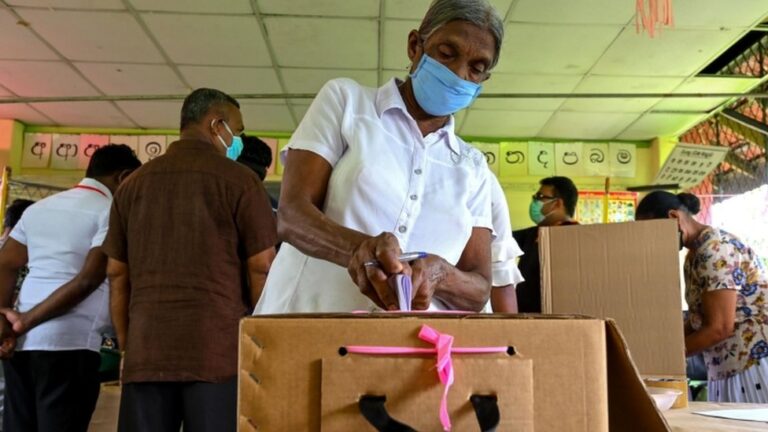
The Election Commission will issue a notice for the elections on July 30 or 31, with polling set between September 17 and October 17.
President Wickremesinghe is anticipated to be supported by a broad alliance, with Prime Minister Dinesh Gunawardena working to unite various parties, including the Sri Lanka Podujana Peramuna (SLPP), in backing the President’s candidacy.
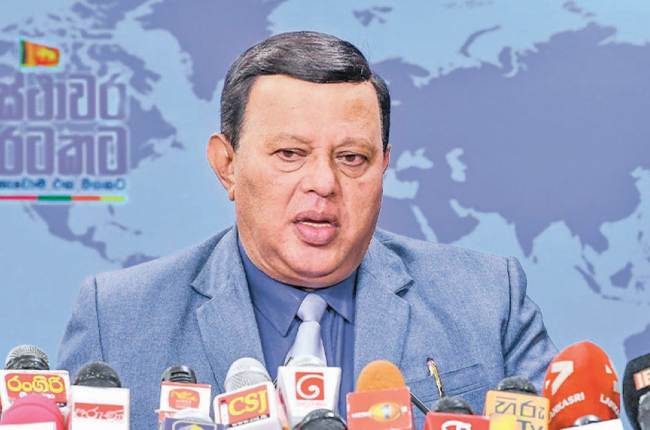
July 15, Colombo (LNW): State Minister Arvind Kumar has announced plans to upgrade 19 National Colleges of Education into universities and increase the number of Zonal Education Offices to 120.
Speaking at a briefing, Kumar highlighted the ongoing reforms aimed at improving the education sector and emphasised the critical role of teachers in shaping the nation’s future.
He noted the recruitment of over 500 language teachers proficient in languages such as Korean, German, French, Hindi, Chinese, and Japanese, aimed at enhancing employment opportunities.
The upgrade of National Colleges of Education into universities will see an increase in enrolment from 5,000 to 7,500 students, producing 7,500 qualified teachers annually.
Additionally, efforts are being made to improve facilities for children with special needs by appointing trained teachers.
Kumar reiterated the Ministry’s stance against illegal money collection in schools and called for parental support in adhering to this guideline.
He acknowledged recent teacher illnesses and urged educators to act conscientiously, given their significant responsibility.
The State Minister also addressed the issue of prolonged strikes and the legal dispute over estate worker wages, expressing confidence that the Court will support the wage increase to Rs. 1,700.
Highlighting economic improvements since President Ranil Wickremesinghe’s tenure, he mentioned salary increases for government employees and stabilisation of the Sri Lankan rupee against the US dollar.
Kumar concluded by urging the public to thoughtfully consider the President’s ongoing programmes in the upcoming Presidential Election.
July 15, Colombo (LNW): Government revenue has surged by 43.3 per cent in the first four months of this year, reaching Rs. 1218.1 billion, up from Rs. 821.3 billion during the same period in 2023.
The Finance Ministry attributes this Rs. 396.7 billion increase to comprehensive tax measures introduced in June 2022, improved revenue administration, positive economic growth since Q3 2023, and the phased removal of import restrictions.
July 15, Colombo (LNW): University executive-grade non-academic staff have decided to return to work today (15), ending their strike after discussions with University Grants Commission Chairman, Prof. Sampath Amaratunge.
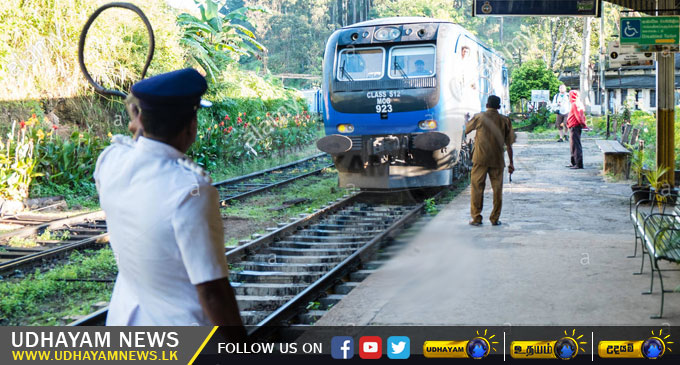
Meanwhile, the Railway Station Masters’ Union has threatened an indefinite strike if the Minister of Transport does not submit their demands for Cabinet approval and provide solutions today (15).
Union President Sumedha Somaratne stated that a final decision will be made tomorrow (16).
July 15, Colombo (LNW): President Ranil Wickremesinghe emphasised that true revolutions involve creating a foundation for people to progress with dignity, rather than resorting to violence.
He highlighted the “Urumaya” programme’s role in achieving this, urging unity beyond political divides to promote genuine socialist ideals.
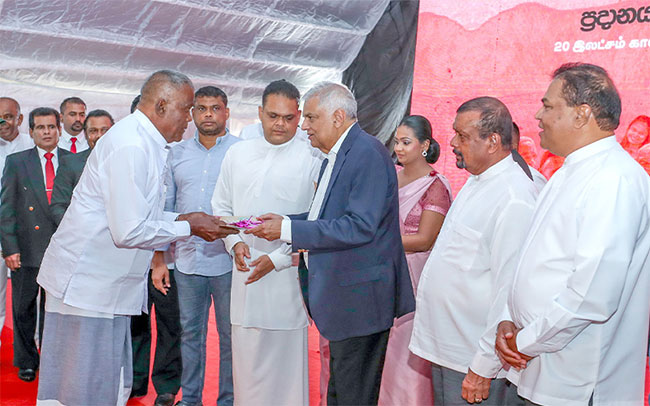
Speaking at the “Urumaya” freehold land deeds award ceremony at Tambuttegama Mahaweli Stadium, President Wickremesinghe awarded 47 freehold land deeds, with a total of 4,012 individuals across nine Mahaweli divisions in Anuradhapura receiving land rights.
The President recalled his visits to Tambuttegama over the years, noting significant development in the region. He mentioned efforts to improve education and infrastructure, including the construction of a new building for Tambuttegama College.
President Wickremesinghe underlined the importance of sustainable national development and collaboration beyond political affiliations.
He praised the success of the education system and acknowledged contributions from various political figures, regardless of their affiliations.
Highlighting the country’s economic recovery, the President emphasised the need for unity during national crises.
He discussed the introduction of the “Aswesuma” programme and other initiatives to support citizens and farmers, aiming for an export-driven economy.
The President urged everyone to support the “Urumaya” programme, which will grant land rights to 2 million people, marking a peaceful and transformative revolution in Sri Lanka.
He called for collective efforts to ensure the nation’s progress and prosperity.
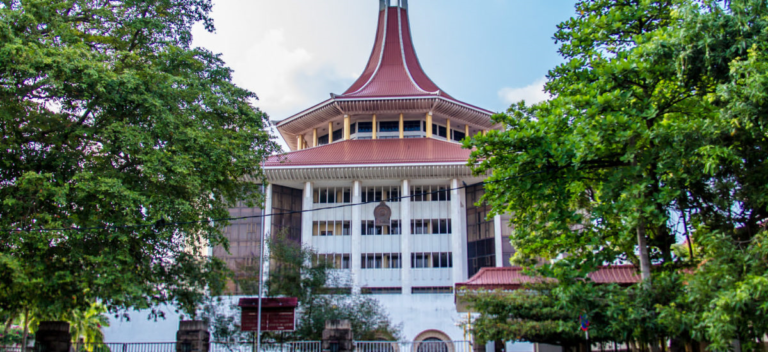
July 15, Colombo (LNW): A petition questioning the legality of the upcoming Presidential Election, citing the improper passage of the 19th Amendment, is set for review today (15).
Filed by lawyer Aruna Laksiri, the case will be heard by Chief Justice Jayantha Jayasuriya and Justices Arjuna Obeysekara and Priyantha Fernando.
The petitioner contends that the 19th Amendment was not correctly enacted in Parliament and argues for a referendum to validate it.
Respondents include the Election Commission, its members, the General Secretary of Parliament, and the Attorney General.
The amendment, which limits the President’s authority to dissolve Parliament after one year, is claimed to be invalid without a referendum, despite a Supreme Court ruling mandating one.
The petitioner asserts that the amendment is not lawfully binding without referendum approval and Presidential assent.
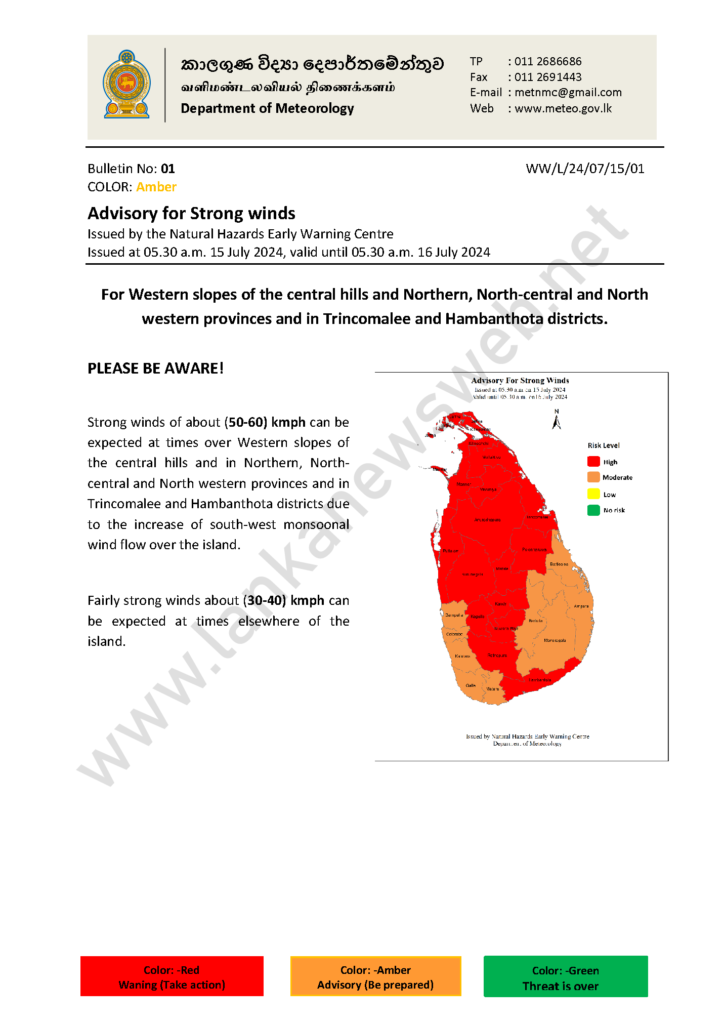
July 15, Colombo (LNW): Showers or thundershowers will occur at times in Western, Sabaragamuwa and North-western provinces and in Kandy, Nuwara-Eliya, Galle and Matara districts, with fairly heavy showers above 50 mm being likely to occur at some places in Western and Sabaragamuwa provinces and in Kandy and Nuwara-Eliya districts, the Department of Meteorology said.
Strong winds of about (50-60) kmph can be expected at times over Western slopes of the central hills and in Northern, North-central and North-western provinces and in Trincomalee and Hambantota districts.
Fairly strong winds about (30-40) kmph can be expected at times elsewhere of the island.
Marine Weather:
Condition of Rain:
Showers or thundershowers will occur at several places in the sea areas off the coast extending from Puttalam to Matara via Colombo and Galle.
Winds:
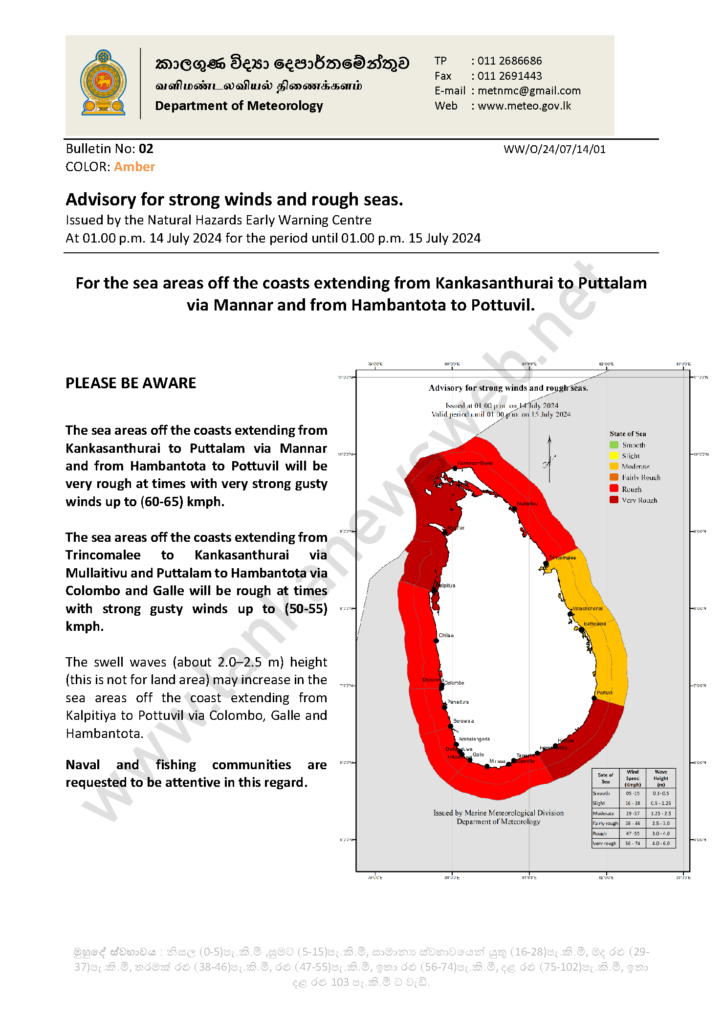
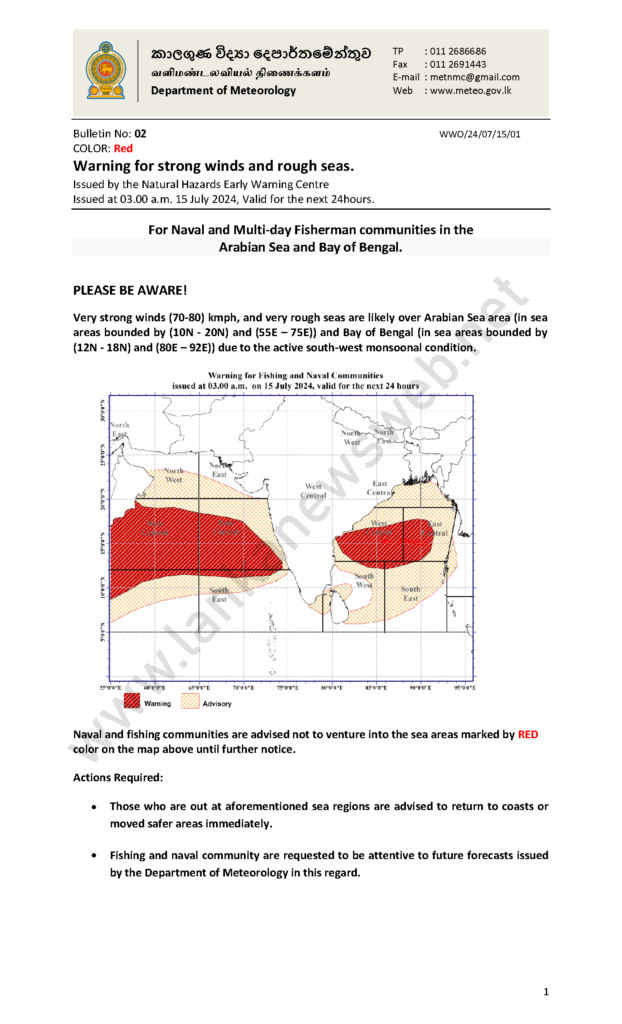
Winds will be westerly to south-westerly and wind speed will be (35-45) kmph. Wind speed can increase up to (60-65) kmph at times in the sea areas off the coasts extending from Kankasanthurai to Puttalam via Mannar and from Hambantota to Pottuvil. Wind speed can increase up to (50-55) kmph at times in the sea areas off the coasts extending from Trincomalee to Kankasanthurai via Mullaitivu and Puttalam to Hambantota via Colombo and Galle.
State of Sea:
The sea areas off the coasts extending from Kankasanthurai to Puttalam via Mannar and from Hambantota to Pottuvil can be very rough at times. The sea areas off the coasts extending from Trincomalee to Kankasanthurai via Mullaitivu and Puttalam to Hambantota via Colombo and Galle can be rough at times. The swell waves (about 2.0–2.5 m) height (this is not for land area) may increase in the sea areas off the coast extending from Kalpitiya to Pottuvil via Colombo, Galle, and Hambantota. Naval and fishing communities are requested to be attentive in this regard. Temporarily strong gusty winds and very rough seas can be expected during thundershowers.
July 14, Colombo (LNW): As the public sector demands for higher pay, for which the government pointed out the need to improve the tax revenues, the International Monetary Fund (IMF) asserted the importance of Sri Lanka having an equitable tax system.
Addressing journalists, IMF Communications Director Julie Kozack said the government needs to have the resources, in order to pay its bills.
“That means ensuring that the taxes are paid by those who can most afford to pay them and that is a key priority in Sri Lanka.
Efforts in this direction include improving tax administration, limiting the size of tax exemptions, that have been granted in the past,” she said.
The IMF acknowledged the “difficult situation” faced by the Sri Lankan people, as the country pushes its reform process.
“The past few years have been very challenging for the people of Sri Lanka and the country does continue to face some very complex policy trade-offs. This is particularly the case when it comes to debt and the fiscal position. Both of those situations do remain in the challenging territory,” Kozack said.
She asserted that restoring fiscal and debt sustainability is essential not only for the Sri Lankan economy to emerge from its current crisis but also to prevent a recurrence of the severe economic conditions faced in 2022.
“They are also essential to lay the foundation for robust and sustainable growth and job creation,” Kozack added.
In this context Sri Lanka plans to tax 14 new previously untaxed sectors including large-scale private tuition classes and private medical services in a bid to increase direct taxation, State Minister of Finance Ranjith Siyambalapitiya said.
He told reporters that private schools and private engineering and surveyor services will also be taxed.
The Inland Revenue Department (IRD) has studied the income of persons engaged in the 14 sectors, said Siyambalapitiya.
“It was by paying attention to such sectors that we were able to increase state revenue from 8.3 percent of GDP to over 11 percent in a short time and bring revenue and expenditure to some balance.
“A primary surplus was possible because all of those sectors were thoroughly looked into and revenues collected. We must continue this,” he said.
It was for this reason that the IRD’s Revenue Administration Management Information System (RAMIS) was being deployed, the state minister said.
“Through that we can get data on not just income but the expenditure of such institutes also. Globally that’s how proper calculation of income and expenditure is calculated. We’re moving forward step by step,” he said.
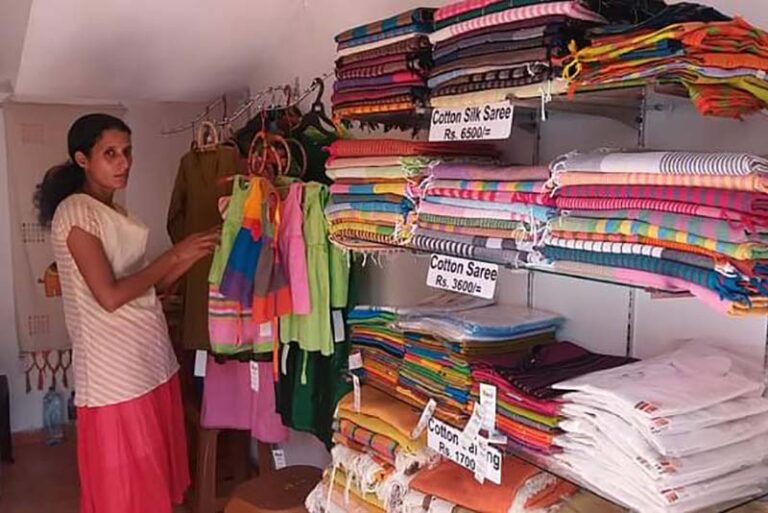
July 14, Colombo (LNW): The Export Development Board (EDB), in collaboration with an international donor agency, has kicked off plans to implement a business matchmaking programme to help women-led businesses enter the UK market.
The board this week called for Expressions of Interest (EOIs) from local businesses that meet specific criteria, including being at least 25 percent women-owned and being registered with the EDB’s women-led export programme.
Additionally, eligible businesses must have their own manufacturing or processing facilities with a minimum HACCP or ISO 22000 food safety certification, as required for the UK market.
Priority food product sectors for the programme include processed fruits and vegetables, coconut kernel-based products, vegan ready meals, spices, essential oils, oleoresins, food supplements and nutraceuticals.
Other eligible sectors include household textiles, ladies’ wear, kids’ wear, recycled/upcycled garments, lifestyle products, giftware, toys and herbal cosmetics.
Moreover, technology-based products and services are also invited to be part of the programme. Priority areas include agri-tech, e-commerce, retail, ed-tech, fintech, banking, health tech, tourism, travel tech, HR services and chem tech.
An EDB panel will shortlist the eligible businesses, which will then be invited to participate in matchmaking sessions held in Sri Lanka.
Applicants are to submit their EOIs via registered post to the EDB Regional Development Director, on or before July 22, 2024
Meanwhile the United States Agency for International Development (USAID) and the Women’s Development Federation (WDF) marked the successful culmination of the “Capacity Building Program on Trade and Market Access for Women Entrepreneurs” by honoring forty resilient women entrepreneurs from Sri Lanka’s southern districts, including Hambantota, Galle, Matara, and Monaragala, at a ceremony in Weerawila.
These women entrepreneurs have completed a year-long journey, during which they received training and mentorship from USAID and WDF, equipping them with essential skills to effectively manage their micro and small businesses.
Moreover, they have gained invaluable insights into expanding their market reach and accessing both domestic and international trade opportunities.
This program, supported by the United States, stands as a significant milestone in empowering women-led and women-owned enterprises and driving socio-economic development in the region
The United States support for the collaboration through USAID’s Partnership for Accelerating Results in Trade, National Expenditure, and Revenue (PARTNER) initiative and WDF underscores a shared commitment to fostering inclusive economic growth and empowering women in Sri Lanka’s growing SME sector.
Dennis Wesner, Deputy Director of USAID’s Office of Economic Growth, reiterated the United States’ commitment to supporting women entrepreneurs, emphasizing the pivotal role they play in advancing Sri Lanka’s economic agenda.