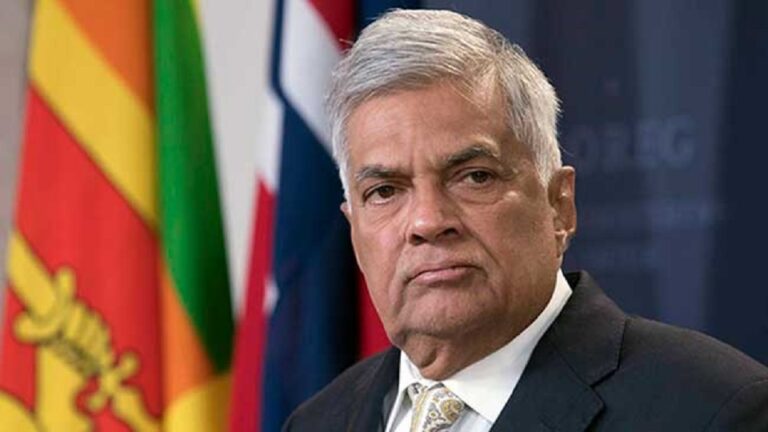
July 14, Colombo (LNW): President Ranil Wickremesinghe faces internal challenges within potential coalition partners due to differing ideologies and past corruption. Despite not officially declaring his candidacy, his allies have begun promoting him.
Opposition and ruling party members have mixed feelings about supporting him due to his market-oriented economic reforms and the SLPP’s poor reputation following Sri Lanka’s economic crisis.
Public opinion remains divided, and Wickremesinghe’s popularity is gradually increasing. He has enacted several economic reforms to address the country’s financial crisis, which have been unpopular among some groups but necessary for economic recovery.
The Election Commission (EC) has been explaining new campaign finance laws ahead of Sri Lanka’s scheduled Presidential elections and the expected Parliamentary elections.
Historically, election campaign financing in Sri Lanka has been chaotic, with funds flowing freely from various sources, including corporate entities, village businessmen, and even foreign governments.
These contributions often come with expectations of future returns, such as favorable treatment in business deals.
Sri Lanka faces challenges in enforcing its election laws, particularly regarding campaign financing. Although there are legal provisions to disqualify candidates who exceed spending limits, enforcement is weak, relying heavily on public complaints and police investigations, which rarely lead to action against winners.
A Commission of Inquiry is currently examining how to align election laws with contemporary needs, potentially restoring public trust in politics. However, there is skepticism about whether the EC is serious about addressing financing irregularities or if a French-style independent commission might be more effective.
Sri Lanka has been considering a hybrid system combining FPP and PR to better reflect the national vote in Parliament. The Dinesh Gunawardene Parliamentary Select Committee of 2022 recommended this system, but there has been a delay in implementing these reforms.
Election laws become farcical when it comes to monitoring campaign financing, and it is a reason for the honest individual candidate who is squeamish about collecting such under-the-table donations to come forward in elections nowadays.
Given the amounts needed for spending at elections, especially when there is PR and a whole big district to be covered unlike a smaller constituency in the past, the reluctance is understandable. A Code of Conduct for candidates is nothing but a joke without any punitive action to follow.
Though a candidate can be disqualified if they exceed the spending limit, the onus is on the public to complain. If the EC is to initiate action they have to rely on the Police to start an investigation and the Attorney General to see if it is actionable in a court. Any action against the winners will be when ‘hell freezes over’.
Overall, the article underscores the urgent need for effective regulation and transparency in campaign financing and the importance of electoral reform to ensure fair representation in government.
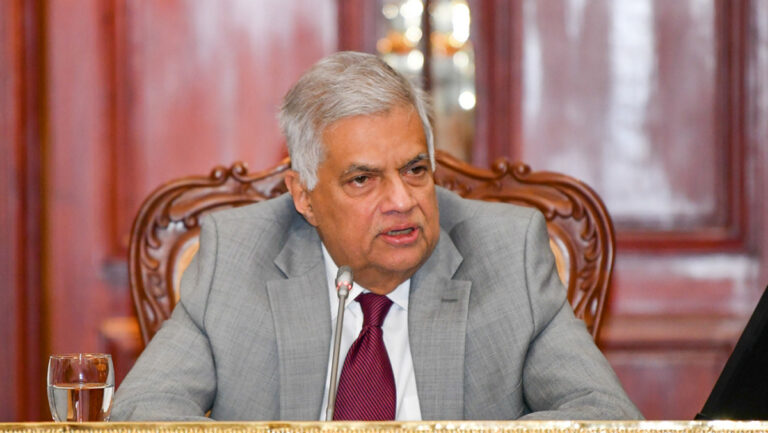
July 14, Colombo (LNW): President Ranil Wickremesinghe reiterated his commitment to establishing a robust economic framework that guarantees long-term stability for future generations. Moving away from short-term fixes, which could lead to economic collapse, the President stressed the importance of strategic, long-term governance over immediate power gains.
He reflected on past economic and political crises, advocating for a political structure that extends beyond five-year electoral cycles to focus on sustainable national development. During the event, he formally handed over the swimming pool to the college, celebrated students’ achievements in the 2023 GCE Advanced Level Examination, and received a donation to the President’s Fund from the students.
The President acknowledged the contributions of the Government and the Alumni Association in constructing the swimming pool and promised to notify the Ministry of Education to build a three-storied building requested by the principal. He also announced plans for a fully-equipped fitness center for the college as part of ongoing efforts to enhance the school’s facilities.
In a speech, President Wickremesinghe emphasized the necessity of strategic planning for a prosperous future. He warned that without a sustainable economic trajectory, the nation could face severe economic crises within the next 15 years.
The President outlined a vision to transition the economy from one dependent on imports to one driven by exports, necessitating a comprehensive overhaul of existing economic structures. Central to this transformation is an agricultural modernization program, supported by the Economic Transformation Act.
The President highlighted successful harvests in recent years due to farmer dedication and fertilizer support and introduced an inheritance tax exemption program for farmers in the North Central Province.
He projected a global population increase of 2 billion by 2050, underscoring the need for modern technology to maximize agricultural output and ensure food security. He also identified potential for solar energy projects and tourism development in the provinces.
President Wickremesinghe announced collaborative initiatives such as the Trincomalee port development project with India and plans to establish three new technological universities with foreign expertise. Embracing advancements in artificial intelligence, he emphasized the importance of reassessing and innovating for sustained growth.
Criticizing politicians focused solely on short-term power gains, Wickremesinghe advocated for a national-level thinking group that prioritizes the nation’s well-being. He credited his administration’s collaborative efforts for revitalizing the national economy and urged representatives to prioritize national interests over partisan agendas.
State Minister of Finance Shehan Semasinghe acknowledged the challenges faced in completing the swimming pool amidst recent economic turbulence. He praised President Wickremesinghe’s strategic initiatives, which secured funding for the project and led to successful economic stabilization.
Semasinghe highlighted ongoing reforms and transformative initiatives aimed at safeguarding the economy and enhancing infrastructure across education, healthcare, and the broader economy, fostering a brighter outlook for the nation’s future.
President Ranil Wickremesinghe emphasises the need for long-term economic stability over short-term solutions at the inauguration of a swimming pool at Anuradhapura Central College: highlights past crises, the importance of sustainable development, and the necessity of export-driven economic transformation: The event also included recognising student achievements and announcing future plans for educational infrastructure and agricultural modernisation.
The assassination attempt on former US President Donald Trump is widely being condemned by world leaders, including Sri Lanka’s President Ranil Wickremesinghe: Wickremesinghe highlights Sri Lanka’s own history with political violence, calling for adherence to democratic laws.
SJB MP Eran Wickramaratne urges the government to ensure the safety of Opposition Leader Sajith Premadasa, drawing parallels to the recent assassination attempt on former US President Donald Trump: condemns political violence and stresses the importance of democratic processes: emphasises the need for timely elections and accuses some parties of creating unrest to delay the polls.
The European Union is supporting Sri Lanka’s new Department of Cinnamon Development through the Export Agriculture in Sri Lanka project: The EU, with the International Finance Corporation’s help, aims to boost Ceylon cinnamon exports by improving quality, enhancing field officer and farmer capacities, and providing advanced technology: President Ranil Wickremesinghe inaugurated the department, awarding Geographical Indications certificates to top cinnamon entrepreneurs.
A three-member judicial panel will review a petition seeking to halt the Presidential Election due to alleged improper passage of the 19th Amendment: Filed by lawyer Aruna Laksiri, the petition claims the amendment, which limits the President’s power to dissolve Parliament, was not enacted properly: The Supreme Court’s Chief Justice Jayantha Jayasuriya and Justices Arjuna Obeysekara and Priyantha Fernando will consider the case on Monday.
From July 15, Thailand will allow visa-free entry for travellers from 93 countries, including Sri Lanka, extending stays from 30 to 60 days: Travellers must show proof of funds, accommodation, and return tickets: Additionally, the new Destination Thailand Visa (DTV) for digital nomads permits 180-day stays and is valid for five years.
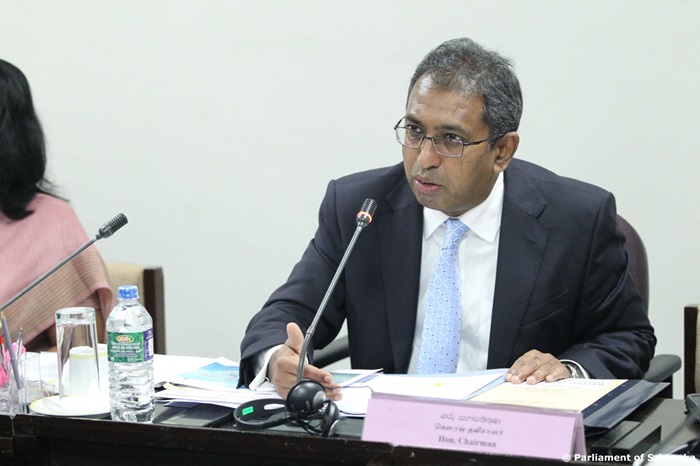
SLPP MP Mahindananda Aluthgamage says twelve members of the Parliament Committee on Public Finance (COPF) rejected a report on online visa issuance presented by Chairman Dr. Harsha de Silva, citing conflicting statistics and a rushed submission: COPF Chief noted the report exposed that VFS Global was chosen without a bidding process, causing the Department of Immigration and Emigration to miss competitive rates.
The Vehicular Emission Test Trust Fund (VET) announces excessively smoky vehicles will be blacklisted: Complaints can be reported via WhatsApp at 070 3500 525: VET Director Dasun Gamage urges drivers to avoid fraudulent means for obtaining smoke certificates: Rigorous inspections are ongoing, and vehicles emitting excessive smoke will receive maintenance orders or prohibition orders if issues persist.
The upcoming wedding of Anant Ambani and Radhika Merchant has garnered much attention, featuring a guest list of global celebrities, including former Sri Lankan cricket captain Mahela Jayawardene and MP Namal Rajapaksa: The celebrations began on Saturday with a blessing ceremony at a 16,000-capacity convention centre in Mumbai, followed by a star-studded party.
Sports Minister Harin Fernando presents comprehensive insurance covers to Rugby players from Isipathana College and Trinity College: This first-of-its-kind insurance scheme will extend to all Rugby-playing schools in Sri Lanka for under-19 and under-16 age groups: Additionally, Rs. 3 million was allocated to the Sri Lanka Rugby Football Referees Union, and Henry Pediris Park was handed over to Isipathana College.
Now that Pride Month has passed, why not address the controversy?
July 14, Colombo (LNW): Pride Month is simply a celebration and commemoration dedicated for LGBTQIA+ pride. At least, to many it is. To the average heterosexual man, however, June means so much more. The month marks a significant time for the LGBTQIA+ community worldwide, serving not only as a mere celebration, but as a powerful statement of visibility and acceptance.
Originally stemming from the Stonewall Riots of 1969, Pride Month has evolved into a crucial annual event that carries immense importance for LGBTQIA+ individuals and their allies. One of the fundamental reasons for the profound significance of the undivided acceptance that Pride provides is the Celebration of Identity. It is fundamentally about celebrating diverse sexual orientations and gender identities. It provides LGBTQ+ individuals with a platform to express themselves authentically and to celebrate their true selves without fear of judgment or discrimination. It fosters a sense of belonging and community, which is essential for mental health and well-being.
As one of the most argued debates in contemporary time, what many a man loved to make as a counterattack is why speak out if they wanted to be treated as any other heterosexual individual who, by every means, can do whatever they want and is easily forgiven for their choice of partners. If the races or religions or any other beliefs aren’t compatible between the two, the majority views it as an outcome of racism or colonialism or generally as a social fault rather than the individuals. But in the concerns of LGBTQIA+ issues, the fault is almost always on the individual.
One argument that many loved to make is the case of reproduction, which also must be addressed, only relates to homosexuality, which is only a part of the LGBTQIA+ spectrum. The argument, although many viewed to be justifiable or reasonable, is, for a lack of a better word, unbelievably dull-witted. Primarily because the case of reproduction was always at risk with fertility concerns, and presently with the vigor in which the employment or services sector works, giving birth to more career-oriented individuals than that of family-oriented.
Secondly, and the most trivial of reasoning perhaps, is when the ability to procreate is fundamentally prohibited for the said individuals in more states than it should be. There are many nations out there (Sri Lanka, unfortunately, included) which don’t allow a homosexual unit to sire a child, deeming them ‘incapable’. The same individuals had they been heterosexual would’ve been more than apt. The individuality of the man is so brutally disassociated in speaking for the concerns of LGBTQIA+ community in ways the average socially accepted version of man could comprehend. The fact that a single parent burdening all the tasks of the family instead of a collective unit working together for the betterment of the family is accepted is rather hilarious in retrospection. And truly pathetic in return.
And their respectable lifestyles are often questioned, and their capabilities often doubted when they iteratively had proven time and time again that their capacities should not be judged any different simply due to how they identify. To perceive this, one needs not look beyond the main sporting event of the world: Olympics, where 40 athletes are registered officially and openly as LGBTQIA+ and have shown to be fully capable in handling their lives better than most with loving families and thriving careers. The fact that being an Olympian is a feat itself to the average man should dispel all doubts regarding the many unjustifiable inquiries on the notion.
Visibility is also crucial in the fight for LGBTQ+ rights and equality. Pride Month helps to increase visibility by showcasing the diversity and vibrancy of the LGBTQ+ community through parades, events, and campaigns. This visibility challenges stereotypes, breaks down stigma, and educates the general public about LGBTQ+ issues, ultimately promoting greater acceptance and understanding.
Although considering the way the celebration was ‘welcomed’, the public, especially in Sri Lanka, seems to be moving backward in ages, confusing many forms of conflicts with sexual orientation. The comments that are posted under the celebratory clips are astounding and quite saddening. Their unawareness and ignorance to contemporary concerns of the globe is quite evident in the utterly hideous and obscene stands they have taken against it, which in hindsight declares a nation’s standing.
If one considers the geographical acceptance of the LGBTQIA+ community, what is easily noticeable is the nations considered to be first world with thriving economies majorly have embraced this diversity. USA, reigning high on the list. Meanwhile, the countries which in hindsight are at the bottom of the food chain are the problematic ones, giving the impression that development is comparatively easily and swiftly achieved when one is given the station they deserve, disregarding the factors irrelevant to the capability to perform the task at hand.
If the countries could utilize criminals and traitors to their objective and both subjective gains, pardoning them and welcoming them to civil society, why can’t they accept completely law-abiding citizens who would be nothing less than miracles and sparkling gems in the nation’s development?
Pride Month has its roots in the struggle for LGBTQ+ rights, particularly commemorating the Stonewall Riots, where LGBTQ+ individuals fought back against police brutality and oppression and is historically significant as an ode to freedom of expression. This historical context reminds us of the ongoing fight for equality and justice and honors those who paved the way for progress. And how everyone would be benefited in embracing it sooner rather than later.
Considering the establishments in support for the cause, the cause to freedom is revealed to be certainly great. For example, the Goethe Institut was highly involved with the Pride Parade in Colombo this year, promoting their agenda of equality and liberty of expressions and identity specifically. Such establishments joining hands with such a worthy cause, in reality, should be eye-opening enough, but once dense, it is quite hard to let go of the collected unintelligence.
At the very least, what the haters, or rather the individuals too set in their false notions, should consider is the cost-effectiveness and social standing of the cause. If the world powerful players are participating, why shouldn’t we aim for the same diversity, same equality, same harmony?
In the slightest, at least regarding the individuals which it inhabits for their betterment and well-being, if not for the country as a whole, since, after all, the primary duty of the state refers to maintaining a safe, trustworthy environment to its occupants. They would really take the closeted group which dwells with identity crises, unable to engage in what they prefer, in contrast to what is socially acceptable.
Thus, considering the reasoning, advocacy, and advancement proves to be a healthy method of initiating progression. Pride Month serves as a rallying point for advocacy and activism. It provides a platform for LGBTQ+ organizations and activists to raise awareness about ongoing challenges, such as discrimination, violence, and legal inequalities. Pride events often include protests, marches, and educational programs aimed at promoting social change and advancing LGBTQ+ rights globally.
This is probably why for many LGBTQ+ individuals, Pride Month is a time to find support, solidarity, and connection within the community. It reinforces a sense of unity and mutual support among LGBTQ+ people and their allies, offering a safe space where individuals can share experiences, stories, and struggles without fear of rejection.
With the passage of time, Pride was also involved in political and law matters. Pride Month highlights the achievements and progress made in the realm of LGBTQ+ rights. It celebrates milestones such as legalizing same-sex marriage, anti-discrimination protections, and advances in healthcare access. However, it also serves as a reminder of the work that still needs to be done to achieve full equality for LGBTQ+ individuals worldwide.
Yet perhaps its most profound significance lies with personal empowerment. Participating in Pride Month can be personally empowering for LGBTQ+ individuals. It encourages self-acceptance, self-expression, and self-love, which are essential components of mental and emotional well-being. It allows individuals to embrace their identities proudly and to affirm their worth and dignity in a world that often marginalizes or erases LGBTQ+ voices.
In conclusion, Pride Month is not just a celebration but a profound statement of resilience, courage, and progress within the LGBTQ+ community. It fosters visibility, promotes acceptance, honors history, and advocates for a future where all individuals, regardless of sexual orientation or gender identity, can live openly, authentically, and without fear. By recognizing and celebrating Pride Month, we reaffirm our commitment to equality, justice, and human rights for all.
July 14, Colombo (LNW): Public Security Minister Tiran Alles has issued a stern warning to senior police officers, including Western Province (South) Deputy Inspector General of Police Gayantha Marapana, over the interrogation of a tattoo studio owner in front of the media.
The footage in question shows DIG Marapana and other senior officers questioning the owner of the tattoo studio in Athurugiriya, where a recent shooting incident occurred.
The event resulted in the death of Surendra Wasantha Perera alias ‘Club Wasantha,’ and six others, including singer K. Sujeewa being injured.
Alles reported that DIG Marapana has apologised to him and assured that such incidents will not be repeated.
In response, Inspector General of Police (IGP) Deshabandu Tennakoon has released a new directive instructing all police officers to refrain from broadcasting suspects’ statements to the media.
July 14, Colombo (LNW): In the wake of the recent assassination attempt on former US President Donald Trump, political ideologists who are against his reemergence face a critical juncture.
The event has sparked intense reactions across the political spectrum, but it is imperative for those who champion progressive ideals to resist the impulse to praise or condone such violence.
This moment calls for a reaffirmation of core principles that uphold democracy, human rights, and the rule of law.
Praising acts of violence, regardless of the target, undermines the ethical foundation of any political movement. For leftist ideologists who advocate for social justice, equality, and the protection of human rights, endorsing an assassination attempt stands in stark contradiction to these values.
Such actions not only tarnish the moral high ground but also risk alienating potential allies and supporters who are crucial for meaningful progress.
At the heart of leftist ideology is a commitment to democratic principles. This includes respecting the rule of law and the peaceful transition of power, even when the political landscape appears adversarial.
Engaging in or supporting violent acts as a means of political expression erodes the very fabric of democracy and sets a dangerous precedent.
It is vital to remember that genuine change is achieved through dialogue, activism, and the democratic process, not through violence and coercion.
Violence begets violence. Praising an assassination attempt can incite further acts of aggression, leading to a cycle of retaliation that can engulf society in chaos and fear. This destabilises communities and detracts from the real issues that need addressing, such as economic inequality, climate change, and social justice.
Leftist movements must focus on constructive and peaceful methods to advance their causes, ensuring that the narrative remains one of hope and progress rather than fear and division.
Leadership within leftist movements bears the responsibility of setting a tone that reflects their principles. Condemning violence unequivocally sends a clear message that such actions are unacceptable and that the movement’s goals will be pursued through ethical means.
This stance not only reinforces the moral integrity of the movement but also attracts individuals who are committed to justice and peace.
History is replete with examples of successful nonviolent resistance. Figures such as Mahatma Gandhi, Martin Luther King Jr., and Nelson Mandela have demonstrated that profound and lasting change can be achieved without resorting to violence. Their legacies remind us that the strength of a movement lies in its ability to mobilise people through the power of ideas, solidarity, and peaceful protest.
The recent assassination attempt on Trump also brings about a stark reminder of the ongoing gun violence in the United States. Gun violence remains a pervasive and devastating issue in the States. Trump’s assassination attempt rewinds the US government’s ongoing failure to address this crisis effectively all over again.
This incident highlights the urgent need for comprehensive gun control measures to protect all citizens, regardless of their political affiliations or public status.
Trump’s political ideology may not be in everyone’s interest given his last tenure as the Commander-in-Chief being the stemming point for the US to open gates for racist, xenophobic, sexist, misogynist and queerphobic malignancies across the nation.
But killing him is not the solution at all. By rejecting violence and embracing democratic principles, people can continue to fight for justice and equality in a manner by which dignity and humanity for all individuals are upheld.
July 14, Colombo (LNW): From tomorrow (15), Thailand will permit visa-free entry for travellers from 93 countries and territories, including Sri Lanka.
This marks the first time Sri Lankans can visit Thailand without needing a paper visa, though Thai citizens can already visit Sri Lanka visa-free with a US$ 10 processing fee.
The new policy, announced by Thailand’s Ministry of Interior, extends the visa-free stay from 30 to 60 days.
Travellers must provide proof of funds, accommodation, and return or onward tickets, with entry subject to the discretion of immigration officers at airports.
Ministry spokesperson Traisuree Taisaranakul stated that this change will benefit tourists and short-term business travellers.
Additionally, the number of countries eligible for visas on arrival will increase to 31. Thailand has experienced a 35 per cent increase in foreign arrivals this year, totalling 18.2 million visitors and generating 858 billion baht (US$ 24 billion) in revenue.
China, Malaysia, and India have been the largest sources of tourists in 2024, with approximately 350,000 Sri Lankans travelling to Thailand annually.
Starting July 15, Thailand will also introduce the Destination Thailand Visa (DTV), aimed at digital nomads, freelancers, and those wishing to learn skills such as cooking and martial arts.
This visa permits stays of up to 180 days and is valid for five years. Applicants must apply for the DTV at the Thai Embassy in their home country.
Furthermore, visiting students earning a bachelor’s degree or higher in Thailand will be allowed to stay for one year post-graduation to seek employment, travel, or conduct research.
July 14, Colombo (LNW): President Ranil Wickremesinghe has expressed his shock and relief following the assassination attempt on former U.S. President Donald Trump, confirming that Trump is safe.
Highlighting Sri Lanka’s own history with political violence, President Wickremesinghe called for adherence to democratic laws, as reported by the President’s Media Division.
The incident occurred during a rally in Butler, Pennsylvania, where gunshots were fired. Both Republican and Democratic leaders, including President Joe Biden, condemned the attack.
Biden expressed relief at Trump’s safety, emphasising that “there’s no place for this kind of violence in America” and extended his gratitude to the Secret Service for their swift response.
Trump reported on social media that the bullet “pierced the upper part of my right ear,” causing significant bleeding. He was quickly escorted off stage by Secret Service agents and taken to a medical facility. The gunman was reported dead, along with another rally attendee.
Vice President Kamala Harris denounced the attack as “abhorrent” and called for collective efforts to prevent further violence. She praised the swift actions of the Secret Service, first responders, and local authorities.
Indian Prime Minister Narendra Modi also condemned the incident, stating, “Violence has no place in politics and democracies. Wishing Trump a speedy recovery. Our thoughts and prayers are with the family of the deceased, those injured, and the American people.”
Former U.S. Presidents George W. Bush and Barack Obama also expressed their support for Trump and condemned the attack. Obama called for a recommitment to civility in politics, while Bush praised the Secret Service for their prompt actions.
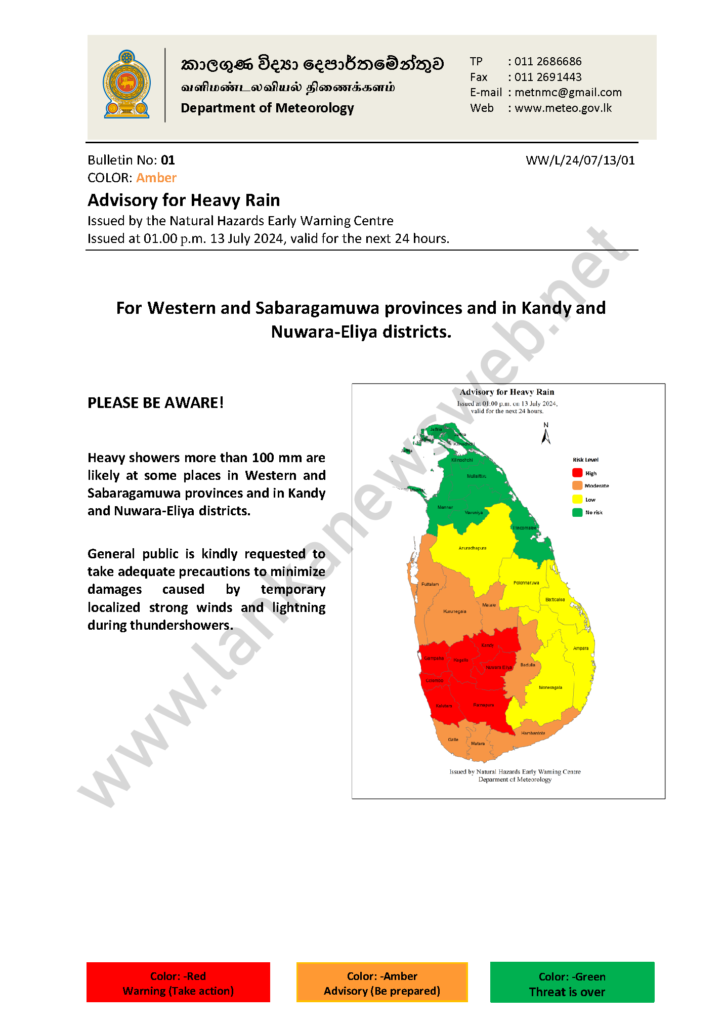
July 14, Colombo (LNW): Showers or thundershowers will occur at times in Western, Sabaragamuwa and North-western provinces and in Kandy, Nuwara-Eliya, Galle and Matara districts, with fairly heavy showers above 50 mm being expected to occur at some places in Sabaragamuwa province and in Kandy and Nuwara-Eliya districts, the Department of Meteorology said in its daily weather forecast today (14).
Showers or thundershowers may occur at a few places in Uva province and in Ampara and Batticaloa districts in the evening or night.
Strong winds of about (40-50) kmph can be expected at times over the Western slopes of the central hills, Western, Southern, Northern, North-central and North-western provincesand in Trincomalee district.
General public is kindly requested to take adequate precautions to minimise damages caused by temporary localised strong winds and lightning during thundershowers.
Marine Weather:
Condition of Rain:
Showers or thundershowers will occur at several places in the sea areas off the coast extending from Puttalam to Matara via Colombo and Galle.
Winds:
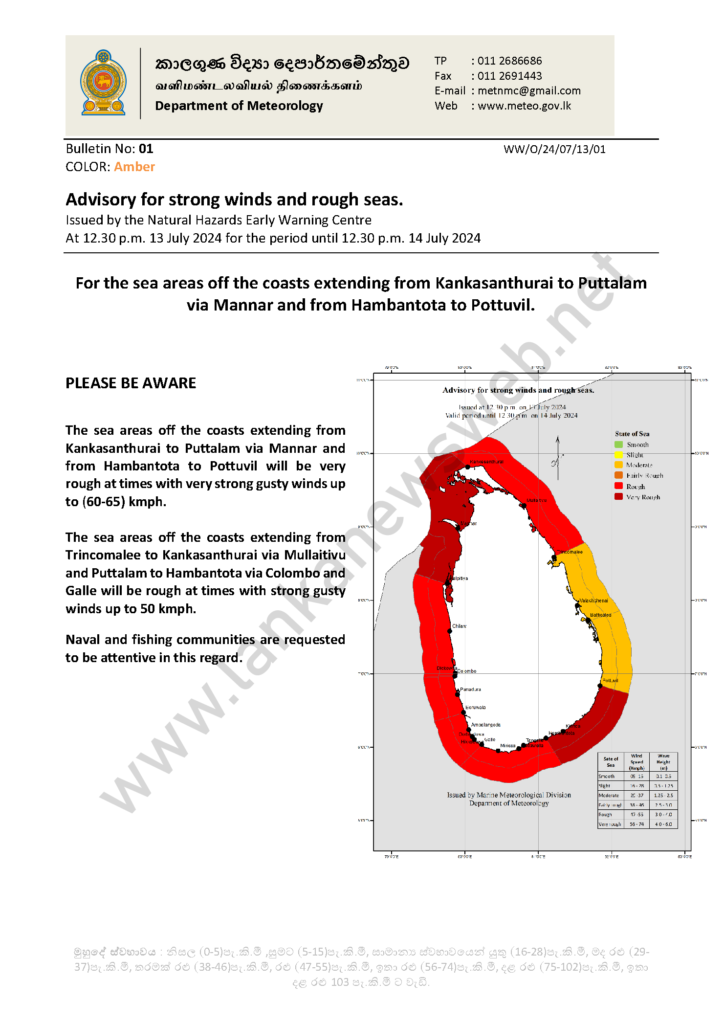
Winds will be westerly to south-westerly and wind speed will be (30-40) kmph. Wind speed can increase up to (60-65) kmph at times in the sea areas off the coasts extending from Kankasanthurai to Puttalam via Mannar and from Hambantota to Pottuvil. Wind speed can increase up to 50 kmph at times in the sea areas off the coasts extending from Trincomalee to Kankasanthurai via Mullaitivu and Puttalam to Hambantota via Colombo and Galle.
State of Sea:
The sea areas off the coasts extending from Kankasanthurai to Puttalam via Mannar and from Hambantota to Pottuvil can be very rough at times. The sea areas off the coasts extending from Trincomalee to Kankasanthurai via Mullaitivu and Puttalam to Hambantota via Colombo and Galle can be rough at times. Naval and fishing communities are requested to be attentive in this regard. The swell waves (about 2.0–2.5 m) height (this is not for land area) may increase in the sea areas off the coast extending from Kalpitiya to Pottuvil via Colombo, Galle, and Hambantota. Temporarily strong gusty winds and very rough seas can be expected during thundershowers.
July 14, Colombo (LNW): MP Mahindananda Aluthgamage announced that twelve members of the Parliament Committee on Public Finance (COPF) have rejected the report presented to Parliament by Committee’s Chairman Dr. Harsha de Silva, concerning the online visa issuance for tourists.
Among those disagreeing with the report are MPs Shehan Semasinghe, Mahindananda Aluthgamage, Vajira Abeywardena, Suren Raghavan, Duminda Dissanayake, Nimal Siripala de Silva, Sita Arambepola, Anupa Pasqual, Johnston Fernando, and Madhura Withanage, as mentioned by Aluthgamage.
He further explained that due to conflicting statistics received by the committee about tourist arrivals, the group had requested the Chairman to postpone the presentation of the report to Parliament.
However, Dr. Harsha de Silva disregarded this objection and submitted the report, Aluthgamage stated.
Speaking in Parliament on Friday (12), Harsha de Silva highlighted that the COPF report revealed that VFS Global was selected without an official bidding process, resulting in the Department of Immigration and Emigration missing out on competitive rates for visa issuance.