Home Blog Page 1119

Mobile Phone Prices Witness Significant Drop Amid Rupee Appreciation

0

April 06, Colombo (LNW): The Sri Lanka Mobile Phone Importers’ and Sellers’ Association has announced a notable decline in mobile phone prices, ranging between 18% to 20%. Association President, Samith Senarath, attributed this price reduction to the consistent appreciation of the Sri Lankan Rupee against the US Dollar.

Speaking at a press briefing on the matter, Senarath highlighted that the recent strengthening of the Sri Lankan Rupee has positively impacted the pricing of mobile phones in the country. This development marks a significant relief for consumers who have been facing high costs for mobile devices in recent times.

The association’s statement underscores the correlation between currency exchange rates and consumer prices, emphasizing the tangible benefits of a favorable exchange rate environment. With the Sri Lankan Rupee showing signs of stability and appreciation against major currencies, including the US Dollar, consumers can expect more affordable options when purchasing mobile phones.

Senarath’s remarks signal a positive trend in the mobile phone market, indicating improved accessibility and affordability for Sri Lankan consumers.

Sri Lanka Repays USD 1.9 Billion in Foreign Debt Amid Ongoing Financial Reforms

0

April 06, Colombo (LNW): In a significant update on Sri Lanka’s debt repayment efforts, Mr. Rajith Keerthy Tennakoon, President Director General of Community Affairs, announced that the government has settled a total of USD 1909.7 million in foreign debt and interest payments between President Ranil Wickremesinghe’s assumption of office and February 2024.

According to Mr. Tennakoon, from July 21, 2022, to February 2024, the government disbursed USD 1338.8 million in multilateral loans and interest, with no outstanding arrears in loan instalments or interest payments up to February 2024.

Highlighting the breakdown of payments, Mr. Tennakoon stated that significant amounts were paid to institutions such as the Asian Development Bank (USD 760.1 million), the International Monetary Fund (USD 9.8 million), and the World Bank (USD 489.9 million), among others.

The positive track record in debt repayment has enabled Sri Lanka to negotiate further financial support from institutions like the ADB, IMF, and World Bank. Bilateral loan agreements with various countries and financial institutions have also contributed to strengthening the country’s financial position.

Despite these achievements, discussions are ongoing with relevant states and institutions to finalize agreements on the repayment of bilateral loans and interest amounting to USD 571.0 million. Preliminary agreements have been reached with members of the Paris Club, with outstanding interest to be settled by the end of February 2024, totaling USD 450.7 million.

Additionally, efforts are underway to restructure business loans and interest totaling USD 4,439.2 million to alleviate the burden of high-interest rates. However, the reinstatement of the special interest rate for fixed deposits of senior citizens, initially introduced in 2015, faces challenges due to the country’s economic crisis.

Mr. Tennakoon emphasized the need for sustainable financial management practices to prevent future crises and ensure economic stability. He highlighted the importance of addressing the necessary funding for reinstating the special interest rate for senior citizens and upholding prudent financial policies to foster economic growth.

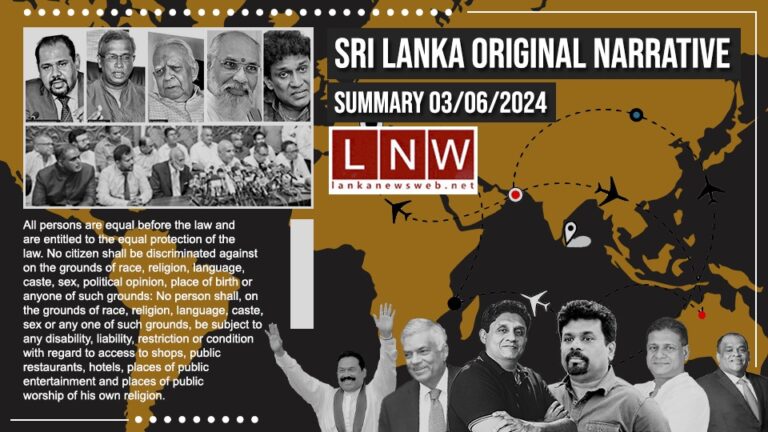
Sri Lanka Original Narrative Summary: 06/04

0
  1. President Ranil Wickremesinghe emphasized that the renewal of knowledge stands as a pivotal task within the realm of education, underscoring the trajectory towards a knowledge-based society for the nation’s advancement over the next 75 years. Acknowledging the burgeoning role of modern technology and knowledge as the new pillars of education, he warned that irrespective of economic prowess, failure to synchronize with global transformations would impede progress.
  2. Opposition Leader Sajith Premadasa said that he will convene an international aid conference to develop the North and East when the Samagi Jana Balawegaya (SJB) comes into power. He said addressing an event at Mullaitivu where he distributed equipment needed for a digital classroom to Thanneeroottu Muslim School.
  3. Actress Damitha Abeyratne and her husband, who was arrested by the Criminal Investigation Department (CID) over an alleged financial fraud, has been remanded on the orders of the Colombo Fort Magistrate’s Court. Accordingly, the couple will be behind bars on remand until April 17.
  4. Vegetable prices in Dambulla Economic Centre have dropped to its lowest after about 10 years. Traders of the Dambulla Economic Centre said that the price has come down due to the increase in the amount of vegetables received at the centre daily.
  5. Rajith Keerthy Tennakoon, President Director General of Community Affairs says that after between President Ranil Wickremesinghe’s assumption of office and February 2024, the Sri Lankan government has settled a total of USD 1909.7 million in foreign debt and interest payments. According to the Department of External Resources, payments totalling USD 760.1 million have been made to the Asian Development Bank and USD 7.0 million to the Asian Infrastructure Investment Bank.
  6. Speaking to the media, Siyambalapitiya expressed that the Cabinet of Ministers approved the import of 250 buses and 750 vans intended for the tourism industry. The approval was given after taking into account the unsatisfactory and insufficient conditions of the vehicles currently used in the tourism industry, despite the fact that vehicles engaged in the industry for tourist transportation should not be used for more than 6 years.
  7. The Sri Lanka Freedom Party (SLFP) has lodged a complaint with the Maradana Police, alleging that several ‘important’ files have gone missing from the party headquarters. The complaint was filed by the party’s Acting General Secretary Dushmantha Mithrapala.
  8. The prices of mobile phones in Sri Lanka have dropped by 18% – 20%, says the Sri Lanka Mobile Phone Importers’ and Sellers’ Association.
  9. The first prohibition order under Sri Lanka’s “Online Safety Act”, which was recently passed to regulate social media, has been issued by the Colombo Magistrate’s Court. According to media reports, Colombo Magistrate Prasanna Alwis issued the order after taking up for consideration a complaint that had been filed by the former Chairman of the Public Utilities Commission of Sri Lanka (PUCSL), Janaka Ratnayake.
  10. Minister of Water Supply and Estate Infrastructure Development, Jeevan Thondaman has been recognised as a Young Global Leader by the World Economic Forum. The World Economic Forum announced Minister Thondaman’s selection, highlighting his role in improving access to clean water and advocating for social justice. 

Agriculture Ministry Targets Reduction in Fresh Produce Losses During Transportation

0

April 06, Colombo (LNW): The Sri Lankan Ministry of Agriculture is intensifying efforts to address the significant loss of nearly 40% of fresh vegetables and fruits during transportation from distant cultivation areas to major markets. Minister Mahinda Amaraweera emphasized the importance of implementing proper transportation guidelines to minimize such losses, particularly in key vegetable markets like Dambulla and Peliyagoda.

According to the Industrial Technology Institute of Sri Lanka (ITISL), vegetables and fruits are primarily transported from cultivation districts such as Dambulla, Peliyagoda, Polonnaruwa, Nuwara Eliya, and Ampara to economic centers nationwide, and then further to urban centers like Colombo.

Minister Amaraweera highlighted the potential to reduce the current 40% loss rate to around 10% by adopting measures such as using plastic crates for transporting certain varieties like tomatoes, cabbage, and citrus fruits. Additionally, proper timing of harvest for certain vegetables and fruits, including ladies’ fingers, beans, papaya, and mangoes, can further minimize losses.

The minister emphasized the need for farmers to adhere to proper agricultural practices to maximize the longevity of their produce. Harvesting at the right time, before maturity, is crucial to preserving freshness and quality during transportation.

Concerns were also raised about the detrimental effects of improper transportation practices, such as workers sitting on gunny bags filled with fresh produce, which accelerates spoilage.

Somasiri Peiris, a member of the Peliyagoda Manning Market Vegetable Traders Association, highlighted the potential role of strengthened railway transportation in reducing losses. He noted that significant quantities of vegetables and fruits, amounting to around 3,000 kg daily, are currently being discarded due to transportation challenges.

The Ministry’s proactive measures, coupled with cooperation from farmers, traders, and transportation authorities, are essential in minimizing post-harvest losses and ensuring the efficient distribution of fresh produce across the country.

Korean Prime Minister Discusses Economic Opportunities and Bilateral Relations with Sri Lankan Counterpart

0

April 06, Colombo (LNW):A significant meeting between Korean Prime Minister Han Duck Soo and Sri Lankan Prime Minister Dinesh Gunawardena took place on April 4 at the Prime Minister’s Office in Seoul, paving the way for discussions on economic cooperation and bilateral relations between the two nations.

During the meeting, Prime Minister Han Duck Soo emphasized the potential for creating numerous job opportunities in Sri Lanka, spanning various sectors including agriculture, construction, health services, and professional services. As a member of the Paris Club, he reiterated Korea’s commitment to supporting Sri Lanka’s recovery from recent financial challenges and facilitating its future endeavors.

Prime Minister Han Duck Soo urged measures to streamline preliminary work for upcoming projects while reaffirming the implementation of existing agreements in renewable energy, fisheries, and joint investment areas. He emphasized the importance of expanding floating solar power installations, highlighting Korea’s interest in supporting sustainable energy initiatives in Sri Lanka.

Furthermore, Prime Minister Han Duck Soo expressed Korea’s keen interest in promoting tourism between the two countries, acknowledging Sri Lanka as one of the world’s most attractive tourist destinations. He pledged support for facilitating more opportunities for Korean visitors to explore Sri Lanka’s rich cultural and natural heritage.

Reflecting on past collaborations, Prime Minister Han Duck Soo commended Sri Lanka’s initiative to include Korean language education in its curriculum during Prime Minister Dinesh Gunawardena’s tenure as Minister of Education. He also appreciated Sri Lanka’s support during the COVID-19 pandemic, underscoring the enduring friendship between the two nations.

The meeting was attended by high-ranking officials from both governments, including State Ministers Piyal Nishantha and Anupa Pasqual, MP Yadamini Gunawardena, Secretary to the Prime Minister Anura Dissanayake, Sri Lankan Ambassador to South Korea Savithri Panabokke, and Media Secretary to the Prime Minister Lalith Rohan Liyanage, signifying the mutual commitment to strengthening diplomatic ties and fostering economic cooperation between Sri Lanka and Korea.

President Ranil Wickremesinghe Advocates Knowledge Renewal for National Advancement

0

April 06, Colombo (LNW): During the 2022 annual prize-giving ceremony at Sirimavo Bandaranaike Vidyalaya in Colombo, President Ranil Wickremesinghe underscored the critical role of knowledge renewal in shaping Sri Lanka’s trajectory towards a knowledge-based society over the next 75 years.

Emphasizing the significance of modern technology and knowledge as new pillars of education, President Wickremesinghe cautioned against complacency, stressing that failure to align with global transformations could impede progress.

At the ceremony, President Wickremesinghe honored female students who excelled in the 2022 A-Level Examination and commended teachers for their contributions. Notably, Imasha Wimalaratne received the prestigious Dr. Sumedha Jayaweera Challenge Trophy for exceptional academic performance.

Reflecting on his commitment to advancing Sirimavo Bandaranaike Vidyalaya during his tenure as Education Minister, President Wickremesinghe highlighted ongoing efforts to propel the country forward and emphasized the importance of sustaining momentum for another 5 to 10 years.

Addressing the future of Sri Lanka’s youth, President Wickremesinghe stressed the government’s duty to equip them for an evolving society, leveraging modern tools such as mobile phones and laptops for educational purposes.

Looking ahead, President Wickremesinghe outlined plans to modernize various sectors, emphasizing the significance of knowledge and technology in fostering economic growth and development. He underscored the importance of continuous learning and announced initiatives to revamp the education system, including integrating AI technology into the curriculum and enhancing English language proficiency and IT skills.

Additionally, President Wickremesinghe detailed plans for educational institutions, including the establishment of the Green University and the expansion of technical universities and engineering faculties. Recognizing the shortage of medical professionals, efforts are underway to expand medical faculties and address this critical need.

President Wickremesinghe’s remarks reaffirm the government’s commitment to advancing education, fostering innovation, and preparing Sri Lanka’s youth for the challenges and opportunities of the future.

IMF Expects Sri Lanka to Reach Deal with Commercial Creditors, Notes Positive Macroeconomic Reforms

0

April 06, Colombo (LNW):The International Monetary Fund (IMF) has expressed optimism regarding Sri Lanka’s ongoing negotiations with its commercial creditors, stating a “strong expectation” for a deal to be reached by the completion of the IMF’s second review.

IMF Communications Director Julie Kozack highlighted that domestic debt operations in Sri Lanka have been largely completed, indicating progress in negotiations. She emphasized the importance of reaching agreements with commercial creditors consistent with program parameters by the conclusion of the second review.

Speaking at a press conference held at the IMF headquarters in Washington, Kozack conveyed confidence in the negotiation process, noting that the next steps in debt restructuring involve concluding negotiations with external commercial creditors and implementing agreements with official creditors.

Kozack also commended Sri Lanka’s macroeconomic policy reforms, citing rapid disinflation, robust reserve accumulation, and initial signs of economic growth while maintaining financial system stability. She underscored the strengthening of public finances following substantial fiscal reforms, urging continued momentum in reform efforts.

Furthermore, Kozack mentioned that the IMF’s Executive Board approved the first review of Sri Lanka’s program, enabling a disbursement of US$337 million on December 12, 2023. This approval signifies the IMF’s support for Sri Lanka’s economic reform agenda and underscores the importance of continued collaboration to achieve fiscal sustainability and economic stability.

Showers expected in multiple areas after 2pm today

0

April 06, Colombo (LNW): Showers or thundershowers will occur at a few places in Western, Sabaragamuwa and North-western provinces and in Galle and Matara districts after 2.00 p.m.

Misty conditions can be expected at some places in Western, Central and Sabaragamuwa provinces and in Galle and Matara districts during the morning.

General public is kindly requested to take adequate precautions to minimize damages caused by temporary localized strong winds and lightning during thundershowers.

On the apparent northward relative motion of the sun, it is going to be directly over the latitudes of Sri Lanka during 05th to 15th of April in this year. The nearest areas of Sri Lanka over which the sun is overhead today (06th) are Lellopitiya, Balangoda, Bulathsinhala, Kalthota and Wadduwaat about 12:12 noon.

SOE losses incur a cost of  Rs. 141,809 per Sri Lankan household

0

The soft pedalling by the Government to carry out crucial reforms of State Owned Enterprises is forcing taxpayer’s wallets to take the brunt of the hit, Advocata Institute said yesterday.

Its CEO Dhananath Fernando said this taking into account the upcoming election cycle, the Advocata Institute, urged the need to reform State Owned (SOE) Enterprises. Here it was said that irrespective of the Government that comes into power, SOE reforms must continue. 

The cumulative losses of key 52 SOE’s in 2022 amounted to LKR 744.6Bn, costing LKR 1.7Mn per registered taxpayer, LKR 33,949 per citizen and LKR 141,809 per household. Despite the sharp increase in tax collection, estimates of tax collection for 2024 cannot cover the losses incurred by these 52 SOE’s for the year 2022. 

 “The delay in restructuring is impacting ordinary Sri Lankans the most and the longer it takes and it’s going to make it worse for Sri Lankan citizens and taxpayers irrespective of who comes to power in the upcoming polls,” Fernando said. “There’s a 1 in 3 who don’t make 30,000 rupees per month in Sri Lanka hence putting more burden on taxpayers makes no sense.” 

It was brought to attention that despite the reforms that are underway, they have been running at a snail’s pace. The current rate would be “just enough” for Sri Lanka to avoid another crisis but not enough to put Sri Lanka into a trajectory to be competitive in international markets. 

Among the 16 recommendations highlighted by the International Monetary Fund, SOE reforms are reiterated to be of importance. Specifically the holding company as well as the need to include skilled and competent members for the advisory board.

The cyclical nature of the debt of SOE’s and the domino effect it has on the fiscal deficit on the Government was described through the example of Sri Lankan Airlines. The possibility of a second round of debt restructuring owing to an inability to deal with SOE’s and their losses was explained. 

The need to divest  Sri Lankan Airlines through transparent bidding process was implored as allowing this process to be politicized would lead to a zero sum game at the cost of the taxpayer.

Fernando reiterated the nature of SOE’s being utilized as vehicles for corruption in light of the lack of transparency with regard to financial reports.

 Here he identified that only a mere 52 SOE’s have released their financial reports to the public. He noted that revenue from income tax barely covers the losses established by the SOE’s. 

The losses sustained by Sri Lanka Airlines and the Government expenditure on Samurdhi benefits was compared to conceptualize the enormous opportunity cost the people of Sri Lanka are subjected to. 

Hingurakgoda domestic Airport upgrades to international level as strategic asset 

0

The government has decided to modernise the Hingurakgoda Domestic Airport, an antiquated airport in Sri Lanka, to facilitate international flight operations. 

This airport, originally constructed for the Royal Air Force of England during World War II, was known as RAF Minneriya at the time.

Plans have been unveiled to revamp the Hingurakgoda Domestic Airport, a historic airfield with roots dating back to World War II.

Now, the government aims to elevate this antiquated facility into a bustling international airport, poised to drive economic growth and connectivity.

The Ministry of Ports, Shipping, and Aviation said that the 2024 budget allocates a substantial sum of 2 billion rupees for the initial construction and development activities at Hingurakgoda Airport.

The first phase of development will focus on extending the existing runway. Currently measuring 2287 meters in length and 46 meters in width, the runway will be expanded to a total length of 2500 meters.

This enhancement will enable the airport to accommodate larger aircraft, including the popular Airbus A320 and Boeing B737 models.The comprehensive modernization project is estimated to cost a total of 17 billion rupees.

Sri Lankan aviation stands at a pivotal moment as it considers the transformation of Hingurakgoda Airport, also known as Minneriya Airport, from a primarily Air Force facility to a fully-fledged international civilian airport. 

This initiative, underlined by a substantial budget of Rs.2 billion (about US $ 6.5 million), has enthused a national debate. 

It’s not merely a matter of financial allocation but also financial economics with extensive consequences that could reshape Sri Lanka’s aviation landscape and its position in regional connectivity.

The government’s plan for Hingurakgoda Airport is marked by ambitious upgrades, including runway extensions, advanced air navigation systems, a new passenger terminal and a state-of-the-art air traffic control (ATC) tower, which will require a massive budget beyond the proposed allocation. 

These developments aim to elevate the airport from its current military utilisation towards serving a growing international civil aviation demand. However, this move raises crucial questions about its necessity and practicality, especially in a nation with five international airports.

Critics point out that such a significant investment might be overreaching, given Sri Lanka’s existing aviation infrastructure and the country’s pressing economic challenges.

 The suggestion is that these resources could be more beneficially deployed in other critical sectors needing attention or it’s about assessing the airport’s financial viability and potential role in boosting tourism and local development. 

The experience with underused facilities like Mattala Rajapaksa International Airport (MRIA) appears over this project, indicating that the demand for another international airport might be overestimated.