May 07, Colombo (LNW): Following discussions at yesterday’s (06) Cabinet meeting, it has been decided to retain the current fee of US $50 for a 30-day visa for foreign visitors to Sri Lanka, reported the President’s Media Division.
Additionally, it has been reaffirmed that the free visa service extended to citizens of seven countries—India, China, Russia, Japan, Malaysia, Thailand, and Indonesia—will remain in place.
The Government underscores that the Department of Immigration and Emigration holds full responsibility for issuing relevant visas to foreigners upon their arrival in the country.
Against the backdrop of significant strides in the nation’s tourism sector, various stakeholders in the industry have recently appealed to President Ranil Wickremesinghe to uphold the maximum visa fee for foreigners at US $50.
This decision is seen as pivotal support for the sector’s future growth.
Consequently, President Ranil Wickremesinghe arrived at this determination after presenting the matter at today’s Cabinet meeting, confirmed the PMD statement.
May 07, Colombo (LNW): Amidst the anticipation surrounding the establishment of a new regulatory body for Sri Lanka’s petroleum industry, concerns have emerged regarding the possibility of unauthorised entrants, particularly in the lubricant sector.
The former regulatory authority, the Public Utilities Commission of Sri Lanka (PUCSL), has ceased its functions in market monitoring, consumer and trade education, import inspection, and action against unauthorised operators and product adulterators.
Following a directive from the Energy Ministry, the lubricant licence fees previously paid to the PUCSL are now to be remitted directly to the ministry, raising apprehensions among industry players.
Chevron Lubricants Lanka PLC has voiced its apprehension over this development, expressing concerns about the potential proliferation of unauthorised players and product adulteration in the absence of robust regulatory oversight.
Bertram Paul, MD/CEO of Chevron Lubricants Lanka, highlighted these concerns in the company’s annual report, emphasising the risks posed to licensed players, consumers, and government revenue.
In August 2023, the Energy Ministry notified lubricant players that the PUCSL would shift its focus solely to regulating the electricity industry, paving the way for a new regulator for the broader petroleum industry, covering fuels, liquid petroleum gas, and lubricants, expected to be established in 2024.
The industry has welcomed the initiative to establish a comprehensive regulatory framework.
In a recent development, the Cabinet approved the formation of a panel to draft legislation for the creation of the petroleum regulator, tasked with overseeing liquified petroleum gas, petrol, diesel, kerosene, aviation fuel, and lubricants.
Meanwhile, the lubricant industry has witnessed a notable increase in the number of players over the past five years, nearly tripling from 13 to 35.
Despite a downturn in the market over the last two years, the government has continued to issue new lubricant licences.
Looking ahead, Paul expressed cautious optimism about the industry’s prospects, citing signs of demand recovery in certain segments.
However, he noted that the upcoming year, 2024, being an election year, introduces additional uncertainties into the environment.
May 07, Colombo (LNW): The 5th edition of the Lanka Premier League 2024, which is Sri Lanka’s top-most domestic T20 tournament with an international flavor, will be held from July 1st to 21st.
The 2024 Lanka Premier League player auction will be held on 21 May 2024.
The auction will be held at the Hotel Shangi-La, Colombo starting at noon.
This is the second consecutive year that the Lanka Premier League, which is growing in strength and popularity, is conducting a ‘player auction.’
During the initial three editions, the players were picked by a ‘player draft.’
Every team has the option of having a maximum of 24 and a minimum of 20 players in a squad, while each squad should consist of six overseas players.
It will be mandatory to play an U23 player (Sri Lanka) in the playing XI.
The auction will be shown live across TV and digital platforms.
The LPL will be conducted from July 1st to 21st, starting in Kandy, then in Dambulla, before heading to Colombo for the business end of the tournament.
The 5th edition of the Lanka Premier League 2024 has seen interest from over 500 players from overseas, ready to take the field in the upcoming edition.
Players from 24 cricket-playing nations, including the ones from all the ICC full member nations, have registered for the upcoming player auction and are vying to get picked into one of the five teams in the Lanka Premier League 2024.
Among the key players registered are Tamim Iqbal, Tim Southee, Rassie Van Der Dussen, Jimmy Neesham, Mushfiqur Rahim, Reeza Hendricks, Rilee Rossouw, Shai Hope, Taskin Ahmed, Lungi Ngidi. Naseem Shah, Rahmanullah Gurbaz, Najmul Hossain Shanto, Colin Munro, Ish Sodhi, Mark Chapman, Jason Behrendorff, Andre Fletcher, Oshane Thomas, Keemo Paul and Fabian Allen.
Apart from them, Usman Khawaja, Tabraiz Shamsi, Evin Lewis, Mujeeb Ur Rahman, Noor Ahmad, Reece Topley, Iftikhar Ahmad, Mohammad Nawaz, Gulbadin Naib, and Ibrahim Zadran are also among the top players.
May 07, Colombo (LNW):An enhancement of showery condition over most parts of the island is expected during next few days (after 08th May), the Department of Meteorology said in its daily weather forecast today (07).
Showers or thundershowers will occur at several places in Western, Sabaragamuwa, Central, North-western, Uva and Eastern provinces and in Galle and Matara districts after 2.00 p.m., with showers or thundershowers being expected at a few places elsewhere during the afternoon or night.
Showers may occur over the coastal areas of Puttalam to Hambantota via Colombo and Galle during the morning too.
Fairly heavy showers about 50 mm are likely at some places in Western, Sabaragamuwa and Uva provinces and in Galle and Matara districts.
Misty conditions can be expected at some places in Central and Sabaragamuwa provinces during the morning.
General public is kindly requested to take adequate precautions to minimise damages caused by temporary localised strong winds and lightning during thundershowers.
Marine Weather:
Condition of Rain:
Showers or thundershowers will occur at several places in the sea areas off the coast extending from Puttalam to Pottuvil via Colombo, Galle and Hambantota.
Winds:
Winds will be southwesterly or variable and wind speed will be (20-30)kmph. Wind speed may increase up to (40-45) kmph at times in the sea areas off the coasts extending from Puttalam to Kankasanthurai via Mannar and from Batticaloa to Hambanthota via Pottuvil.
State of Sea:
The sea areas off the coasts extending from Puttalam to Kankasanthurai via Mannar and from Batticaloa to Hambanthota via Pottuvil can be fairly rough at times. Temporarily strong gusty winds and very rough seas can be expected during thundershowers.
Meanwhile, heat index, the temperature felt on human body is expected to increase up to ‘Extreme Caution level’ at some places in Northern, North-central and Eastern provinces and in Kurunegala and Monaragala districts and that values, expected to increase up to ‘Caution level’ at some places in Western, Sabaragamuwa and Southern provinces and in Puttalam and Matale districts, the Natural Hazards Early Warning Centre of the Department said.
The public, therefore, is urged to stay hydrated and take breaks in the shade as often as possible, check up on the elderly and the sick, never leave children unattended, limit strenuous outdoor activities, find shade and stay hydrated, and wear lightweight and white or light-coloured clothing.
According to CB’s annual financial statements released on 25 April 2024, the loss of the CB for its independent monetary and financial operations was Rs. 114.4 bn. In addition, the profit remittable to the government for the year was negative Rs. 313.7 bn.
A man on the road may wonder why the CB run by an esteemed class of international economists and experts by printing of money as they wish (central bank independence) makes such colossal losses and who are accountable to and who pay for such losses.
Although CB financial statements are difficult to understand, they show many arbitrary operations hiding behind the independent monetary policy responsible for these colossal losses. In last article, (Read article here) I presented one factor as the CB’s payment of interest on daily bank excess reserves balances held at the CB. This unnecessarily incurred cost was Rs. 15.9 bn for 2023.
This short article highlights how the CB lost income by supplying reserves to banks through daily overnight reserve repo auctions at interest rates lower than the rates charged on the CB’s daily standing lending facility (SLFR) to banks. The loss is around Rs. 10.7 bn for 2023 and Rs. 17.6 from January 2023 up to the end of April 2024.
Why overnight reverse repo auctions at lower interest rates are connected with monetary irregularity?
First, the present monetary policy model is to set a limit or corridor for the variability of overnight inter-bank interest rates. This corridor is the policy rates, i.e., SLFR and SDFR (standing deposit facility rate which is the rate pays interest on bank excess reserve balances). Therefore, overnight inter-bank interest rates will always fluctuate in the corridor depending on the bank liquidity gaps.
Second, the CB conducts daily auctions of reverse repo lending to banks at interest rates lower than SLFR through which banks make daily profit.
Third, both standing lending and overnight revere repos are equal in credit quality as both are secured by government securities and mature overnight. Therefore, lower interest rates on overnight revere repos have no economic basis.
Therefore, offering reserves at lower rates through overnight reverse repo auctions than SLFR is a monetary policy irregularity that may have connections to insider dealings with bank dealers.
Reverse repo monetary irregularity in graph
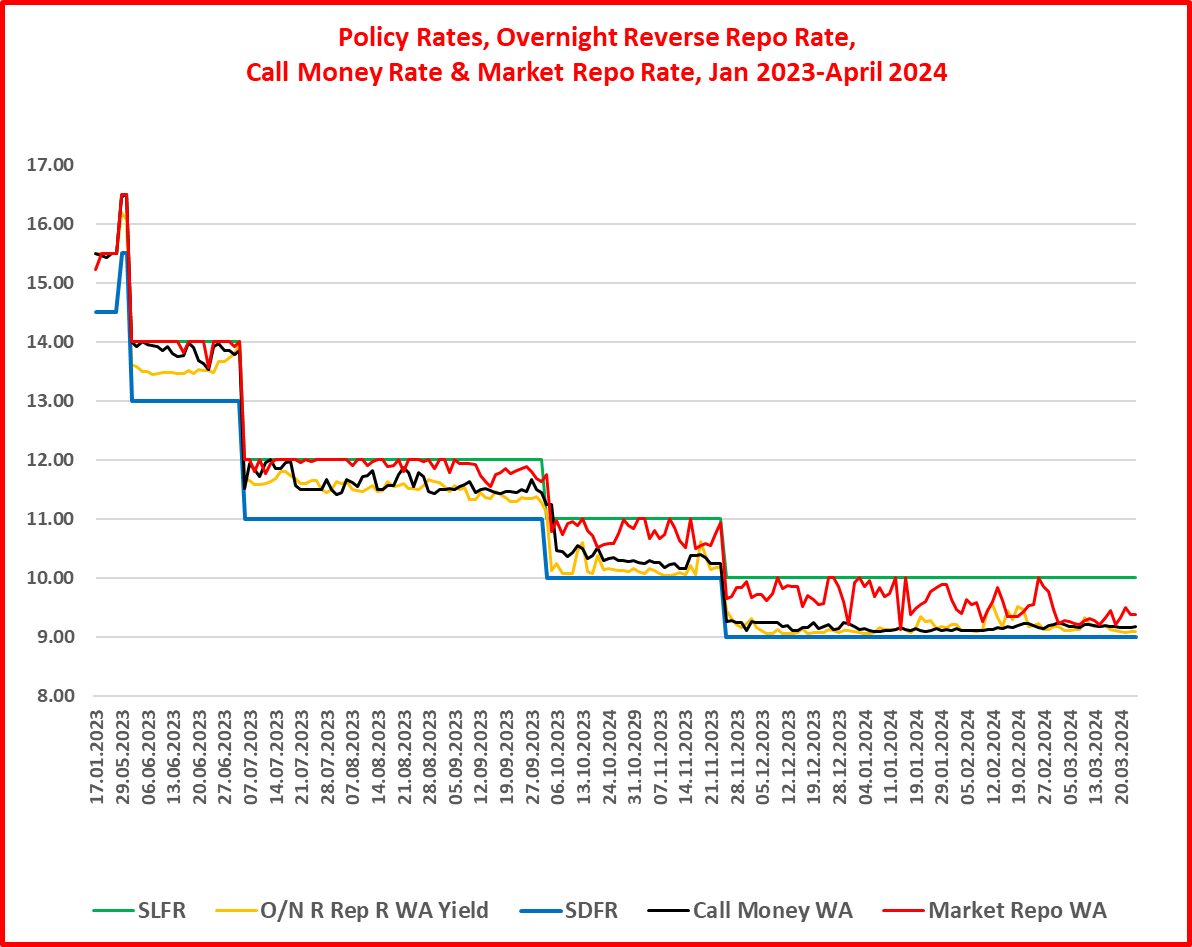
The graph below presents the extent of the irregularity.
From October 2023, overnight inter-bank rate (Call Money Rate) has been moved closer to SDFR from being close to SLFR before.
For this motive, overnight reverse repos auctions have been conducted unnecessarily by the CB at rates closer to SDFR but mostly below overnight inter-bank rate. The loss to the CB based on inter-bank rate is Rs. 2.3 bn. The specific reason why the CB wanted such lower overnight inter-bank rates is not known, given the policy rates corridor and market-based monetary policy model for inter-bank interest rates.
The inter-bank loan product comparable with CB’s overnight reverse repos is the market repos. However, overnight repo rates have been significantly lower than market repo rates which have been within the policy rates corridor. The loss to the CB based on market repo rates is Rs. 11.7 bn.
The CB has granted a total of Rs. 10.4 trillion against the offer of Rs. 13.6 trillion through 226 auctions during the period from January 2023 to the end of April 2024 (see the graph below).
Irregularity of term reverse repo auctions
In addition, the CB has been frequently conducting reverse repo auctions on term basis mainly ranging from 6 days to 90 days (longer auctions exceeding 800 days also are reported.) to provide additional reserves on long-term basis. However, it is difficult to find benchmark interest rates to compare these auctions rates and estimate losses incurred by the CB in such auctions.
Further, the specific reason why the CB want such long-term term-reverse repos when it implements a policy rates corridor based monetary policy is not known.
The CB has granted a total of Rs. 3.9 trillion against the offer of Rs. 5.1 trillion through 147 auctions during the period from January 2023 to the end of April 2024 (see two graphs below).
Special liquidity facility
The CB also has operated an additional facility to supply reserves to commercial banks and National Savings Bank on a case by case basis (private placements). Applicable terms and conditions and turnover are not known. The only information available is the interest income earned on the facility is Rs. 16.7 bn for 2023 as compared with interest income of Rs. 51.5 bn on supply of reserves through reverse repo auctions.
Why the CB provides such liquidity facilities privately despite the policy rates corridor-based monetary policy is a serious concern over the CB’s policy governance and independence.
Misleading graph presented by the CB
Policy rates and inter-bank interest rate are presented by the CB as below in its brand new Annual Economic Review 2023 (page 25) along with selected liquidity information. This graphical tries to misleads the public by providing only inappropriate information.
Two basic problems arise here.
First, how interest rates fell in 2023 while overnight liquidity falling to zero where the opposite happened in 2022. It is a simple monetary fact that lower interest rates are maintained by the supply of more reserves to banks and vise versa.
Second, the outstanding/term liquidity supplied through term revere repo auctions and special liquidity facility by the CB is not shown here. Outstanding liquidity supplied by the CB has been mostly between Rs. 100 bn to Rs. 300 bn on daily basis in 2023. Therefore, the reason for the fall of inter-bank interest rates is the supply of longer term reserves and the manipulated overnight reverse repo auctions and other term auctions by the CB as highlighted above.
Concerned remarks
It appears that the CB lavishly prints money to supply reserves as stated above to fill the cash flow mismatch on credit creation-based business of banks without any regard to the bankruptcy of the economy. In fact, it appears that the CB supplies such reserves as the lender of first resort to bank in a manner of spoon-feeding that encourages banks be negligent on liquidity management behind the credit creation business. It is in this context the CB states that the banking system is sound and resilient.
National leaders approaching for national elections propose various economic development models to upgrade living standards of the general public from the present bankruptcy and poverty. However, nobody seems to propose underlying models of financing such development models. They need funds because they do not bring inherited wealth to fund these models.
In modern sovereign currency-based monetary economies, it is the monetary policy that is the nuclear in distribution of finance across economic and business activities, irrespective of the development model. It happens through the types of reserves supplied by central banks to the financial system. Therefore, national leader must consider whether the present model of bank dealer supporting monetary policy model will provide required financing for their country development models.
I saw one political party stating that it would use the exiting bank branch network to finance the proposed development without any specific development banking services. This raises two issues.
First, who will issue regulations to banks to engage in such development lending as part of their profit-based money creation business. Will the Parliament issue specific regulations directly overriding the present sect of regulations issued by the CB?
Second, will the CB provide reserves to fill cash mismatches arising from such development credit creation of banks similar to the present spoon-feeding practice.
Therefore, national leaders have to propose how they fund their economic governance system as against the present bankrupt system.
However, if they plan to sell government bonds to foreign investors and use proceeds to finance the economy to keep the public happy with cash and abundant imports, the country and general public will slip from the poverty to the poverty in generations to come while most of us would have dead and gone with those election promises leaving a new round of foreign debt to new generations to default.
This article is released in the interest of participating in the professional dialogue to find out solutions to present economic crisis confronted by the general public consequent to the global Corona pandemic, subsequent economic disruptions and shocks both local and global and policy failures. All are personal views of the author based on his research in the subject of Economics which have no intension to personally or maliciously discredit characters of any individuals.)
P Samarasiri
Former Deputy Governor, Central Bank of Sri Lanka
(Former Director of Bank Supervision, Assistant Governor, Secretary to the Monetary Board and Compliance Officer of the Central Bank, Former Chairman of the Sri Lanka Accounting and Auditing Standards Board and Credit Information Bureau, Former Chairman and Vice Chairman of the Institute of Bankers of Sri Lanka, Former Member of the Securities and Exchange Commission and Insurance Regulatory Commission and the Author of 12 Economics and Banking Books and a large number of articles published.
May 06, Colombo (LNW): Online financial scams have been increasing in Sri Lanka with fraudsters using increasingly sophisticated tactics to exploit unsuspecting individuals and businesses.
It can be defined as a fraudulent activity conducted through Internet connected devices or digital platforms with the intent to deceive and financially exploit individuals or organisations.
Therefore Sri Lankans have been warned of this new menace from phishing electronic mails and text messages to fraudulent websites that mimic legitimate platforms including those of government institutions aiming to steal sensitive financial information or money.
As technology advances, scammers find new ways to deceive people, making it vital for everyone to be aware of common warning signs and learn how to protect themselves
The Sri Lanka Banks’ Association, LankaPay and FinCSIRT issued a joint statement on Sunday (5) warning the general public over the rise in online scams.
“We have been alerted regarding several incidents of financial fraud, both globally and in Sri Lanka, disguised as attractive online offers, leading to mobile device users inadvertently clicking on unknown links and downloading malicious apps and files,” said the statement.
This action grants scammers complete access to the mobile device, enabling them to control it remotely.
Once the fraudsters take control of the mobile device, they have easy access to bank/payment apps that are installed on that device, leading to theft from bank accounts and payment cards accessed via the mobile device.
“We wish to advise the general public to be more vigilant in order to avoid falling prey to such scams. These fraudsters use social media platforms, websites and online messaging platforms to carry out such fraudulent activities.
It is important to note that these reported fraud cases are due to fraudsters gaining control of your mobile device and not due to any security vulnerability of banking/payment apps, which are adhering to international security standards,” they added.
To prevent falling victim to such scams, Sri Lanka Banks’ Association, LankaPay and FinCSIRT, advise the public to exercise caution and follow guidelines to protect themselves from these fraudsters.
People have been asked to beware of online advertisements offering unrealistic deals and avoid clicking on links and downloading apps or files from unknown sources.
They should exit from unknown and unfamiliar groups on social media platforms or online messaging platforms to which your are added without consent and avoid clicking on links shared via such groups.
The most importantly people should refrain from saving passwords on your device or download apps only from official app stores like the Apple App Store, Google Play Store etc and use biometric authentication (e.g., fingerprint, facial recognition) to access bank/payment apps where available as well as regularly review app permissions and remove any excessive permissions granted to installed apps.
It is essential to Install a reputable antivirus app from official app stores and keep it updated to detect and remove viruses and malware and be cautious of messages prompting you to disclose personal or financial information by clicking on links.
May 06, Colombo (LNW): The Consular Division of the Sri Lanka High Commission (HC) in the United Kingdom led by High Commissioner Rohitha Bogollagama has reached a significant milestone by surpassing £100,000 in income last month.
This achievement marks the division’s dedication to providing essential services to Sri Lankan nationals in the UK.
A key factor in this success has been the Consular Division’s commitment to extending its services beyond London.
By organising mobile consular services in cities like Leeds and Liverpool, the division has been able to reach a wider audience and meet the needs of Sri Lankan communities across the UK.
High Commissioner Rohitha Bogollagama commended the diligent efforts of Deputy High Commissioner Manorie Mallikaratchy, Minister (Consular) Aruna Fernando, and the Consular staff for their instrumental role in achieving this milestone.
Their dedication and commitment to serving the Sri Lankan diaspora have been crucial in ensuring the smooth operation of consular services and the attainment of this significant accomplishment.
The Consular Division plays a vital role in providing various services to Sri Lankan nationals living abroad, including issuing passports, assisting with visa applications, and providing consular assistance in times of need.
By surpassing £100,000 in income, the division has demonstrated its effectiveness in delivering these essential services and meeting the diverse needs of the Sri Lankan community in the UK.
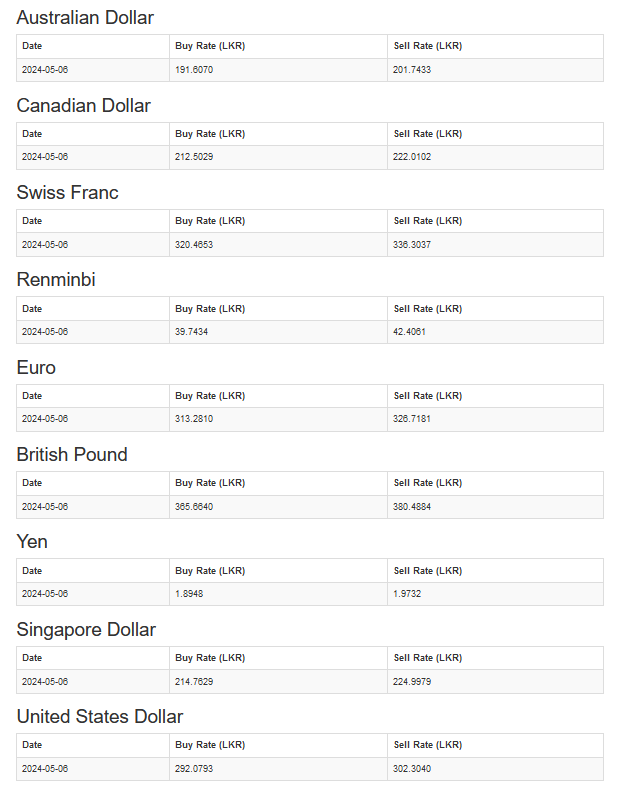
May 06, Colombo (LNW): The Sri Lankan Rupee (LKR) indicates steadiness against the US Dollar today (06) in comparison to last week, as per the official exchange rates released by the Central Bank of Sri Lanka (CBSL).
Accordingly, the buying price of the US Dollar has dropped to Rs. 292.07 from Rs. 292.12, but the selling price has increased to Rs. 302.30 from Rs. 301.90.
The Rupee, meanwhile, indicates depreciation against several foreign currencies, including Gulf currencies.
May 05, Colombo (LNW): The sign is the elephant. Although it is said to be an elephant, it has the tusks of an elephant. Those who climb onto the back of this tusker and carry the elephant hook later put the tusked elephant to sleep for a camel to caress. As the camel walked calmly, the people who had put the elephant to sleep waved. Today is no different.
However, the elephant king, who made it clear to the camel and those wishing to caress him that a tusker cannot be put to sleep forever, demonstrated his strength, resulting in an impressive final score of 45-7 against the giants of Kazakhstan.
The Sri Lankan players are elevating the country to one of the top divisions in Asia, despite facing barriers erected by the Asia Association that hinder not only the ascent of the national team but also the visibility of the Sri Lankan flag at the Asian level. There were also individuals who, based on that bitter history, destroyed the country for their own comfort and happiness, raising questions among players, referees, and other Sri Lankans who contributed to the rugby game in various capacities.
But as well as the desire to win in the burning cages of Kazakhstan, and the enjoyment of the wickedness of the previously mentioned group, the young players of Sri Lanka lifted them up and smashed them on the ground.
Despite having an elephant in the symbol, if you compare the height and weight of the Kazakhstan team with the condition of the Sri Lankan players, Sri Lanka had no small competition when it came to body. Despite being smaller in stature compared to the Kazakhstan players, they understand that the richness of their technique, along with maintaining a continuous rhythm and rapport as a team, is their greatest strength that leads to victory.
The Sri Lankan players controlled the Kazakhstani players who came to their limits with impetuousness and passion like taming an elephant with a small tusk. It was a beautiful sight. The likes of Tharindu Chaturanga and Sachith Peiris often took the lead by dropping those heavy bodies.
The head coach of the Sri Lankan team, Sanath Martinez, as well as Nilufer Ibrahim and Dushan Lewke, should be appreciated for building the correlation with the continuous rhythm and focus in the process of this victory. Indeed, appreciation should also be extended to the original coaches of the players who, over time, molded them both physically and mentally to a standard suitable for the national level, thereby facilitating their performance in this endeavor.
In terms of team responsibility, Tharinda Ratwatte’s commendable effort to implement it in the field with a sharp yet calm demeanor stands out. Noteworthy contributions from Heshan Jansen, Tenuka Nanayakkara, Adisha Wiratunga, and Zubair Dore further accentuate the team’s dedication. The score of 45 – 7 was brought down to 45 from what was anticipated to exceed 50. In the final minutes, Heshan Nethmina facilitated two potential tries by delivering precise passes to Dinal Ekanayake. Regrettably, despite Dinal’s standout performance throughout the game, he failed to capitalize on those opportunities.
During the initial half of the match, Sri Lanka secured a commanding 31-0 lead through a combination of speed and strategic play. Zubair Dabare clinched the first victory for Sri Lanka, followed by Adisha Weeratunga. Tenuka Nanayakkara claimed the third, while Tarinda Ratwatte and Dinal Ekanayake secured the fourth and fifth respectively. At the halftime break, Tarinda Ratwatte successfully scored those three tries.
After the break, Kazakhstan tried to be more aggressive than in the first half and showed a strong desire to defend. The Sri Lankan team intelligently tried to increase the number of points by not allowing the opponents to overcome the advantage of their points difference. s a result, the two tries scored by Heshan Janson and Sachith Silva in the second half were expertly converted by Nethmina. Kazakhstan breached Sri Lanka’s territory only once during the half, securing a try, with the conversion executed accurately.
Throughout the tournament, greater prominence was afforded to ONE TRY ONE TREE, fulfilling the wish of the acting president. Despite facing international restrictions imposed by the Asia President, which had confined Sri Lanka Rugby for many years, Sri Lanka Rugby persevered. Under such challenging circumstances, the organization continued to participate in and garner support for rugby within Sri Lanka, exemplified by its involvement in the Commonwealth tournament.
Simultaneously, amidst disruptions caused by the Stabilization Committee during the Asian Games, the Sri Lankan team faced challenges accessing adequate training opportunities for the tournament. Nonetheless, domestic matches within Sri Lanka proceeded uninterrupted.
Efforts were made to establish systems and tournaments aimed at identifying and nurturing new talent. Additionally, initiatives were undertaken to bolster international relations between countries.
These were launched in connection with the Acting President. Therefore, it was not possible to ban rugby in Sri Lanka and hide its existence. They worked.
Nalin de Silva hid the history related to himself and avoided the tree that could only bring out his own identity and delayed telling the world that he could not bring down Sri Lanka rugby, and he did not want to damage the embrace of the currently recovering Asia President.
We also know that thinking about the environment is an important thing globally. But to talk about rugby, to talk about its pride, it is absurd to plant trees in a rugby sports tournament. Ultimately, the Acting President of rugby redirected the conversation away from the value of rugby itself, to the extent that several rugby matches were overshadowed by a tree-planting initiative.
However, the 15 Sri Lankan players who were on the field, constantly raised the pride of Sri Lankan rugby with their minds and bodies and made it visible above the plants that were raised to show it.
How the concept of allotting individual plants named after the player who scores each try would fit into a team sport may not have crossed the mind of the acting president as he was crushed under the plants.
Had the Sri Lankan players prioritized winning individual accolades such as having plants named after them over striving for team victory with unwavering professionalism, the situation might have deteriorated, resulting in defeat.
This recalls how the Sri Lankan football team faced consequences for similar individualistic goals during a South Asian tournament.
Even though the monks who are involved in the work played games, their focus here is to spread the growing of plants. But the lucky one who played as a player and got to sit on the first chair of the association due to the resignation of the president, these owners had to show the injustice that happens to a player who gives his hand to the team to win, even if he did not score a try in a team game in his life.
Therefore, those plants were named 1, 2, 3 etc. for the name of the country. The name Tuskers of the Sri Lankan team was also used and the names Tuskers 1,2,3 were also to be continued.
However, we pay our respects to the skills of the Sri Lanka Rugby players who made it possible for the world to see and hear a proud story about Sri Lanka, as well as to write and speak to the media.
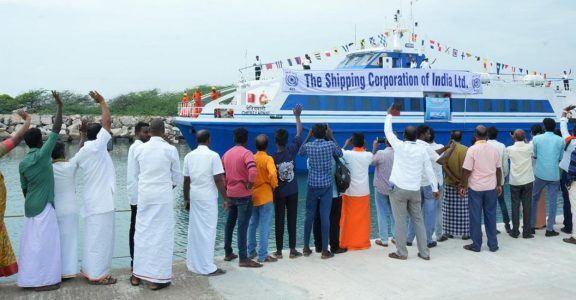
May 06, Colombo (LNW): An age-old sea route between India and Sri Lanka has been rejuvenated with the resumption of a passenger ferry service from Nagapattinam in Tamil Nadu to Kankesanthurai in Jaffna, Northern Sri Lanka next Monday.
The initiative is aimed at bolstering bilateral ties, boosting tourism, and increasing people-to-people relations. It is expected to benefit local traders on both shores.
The Indian High Commission in Colombo yesterday announced that the passenger ferry service between Nagapattinam in India and Kankesanthurai (KKS) in Jaffna, which was launched in October 2023 by the Shipping Corporation of India (SCI), will resume on 13 May tentatively.
Accordingly, the ferry service will be operated by a private operator, IndSri Ferry Services, selected by SCI in consultation with the Government of Sri Lanka (GoSL).
“In order to make the service affordable and attractive for passengers, the Government of India has decided to bear the cost towards applicable taxes and other relevant charges and operating cost at Nagapattinam port to the tune of over Rs. 25 million per month for a period of one year.
Similarly,Sri Lanka government has reduced the deviation tax currently charged to passengers leaving Sri Lanka by passenger vessels and ships,” the statement issued by the High Commission read.
The Government of India has also extended grant assistance of $ 63.65 million to GoSL for the rehabilitation of the KKS Harbour, previously planned under a Line of Credit.
This is in keeping with India’s strong commitment to Sri Lanka’s economic recovery and its march towards progress and prosperity, along with and in close collaboration with India.
Strengthening maritime connectivity between India and Sri Lanka was a vital component of the vision document for economic partnership jointly adopted during the visit of the President of Sri Lanka to India in July 2023.
The resumption of the ferry service is an affirmation of the people-centric policies of the Government of India. In his remarks during the launch of the service in October 2023, Prime Minister Narendra Modi had highlighted that connectivity is not only about bringing two cities closer but bringing countries and its people closer.
He mentioned that the people of Sri Lanka will benefit from the India-Middle East-Europe Economic Corridor launched during the G20 summit in India in September 2023, as multimodal connectivity between our two countries is strengthened. “In the future, connectivity with Sri Lanka will be further enhanced through electricity grid interconnection, two-way multipurpose pipeline and setting up a land connectivity economic corridor,” the statement added.