Dr. Lionel Bopage (Melbourne, Australia)
Introduction
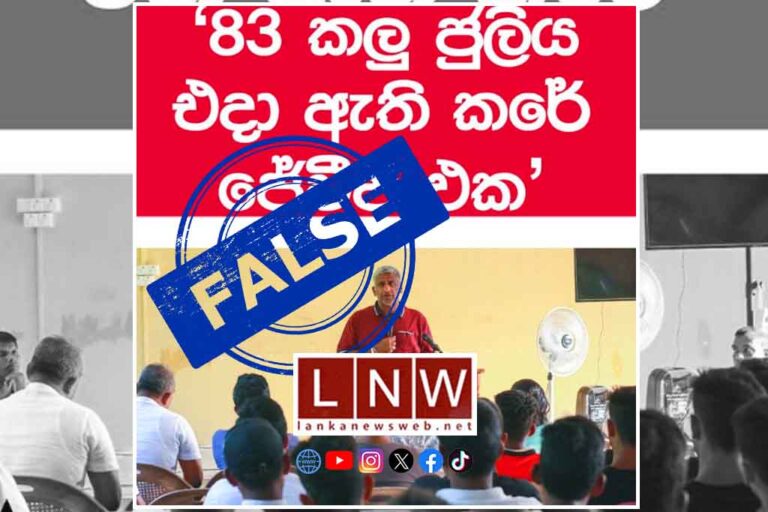
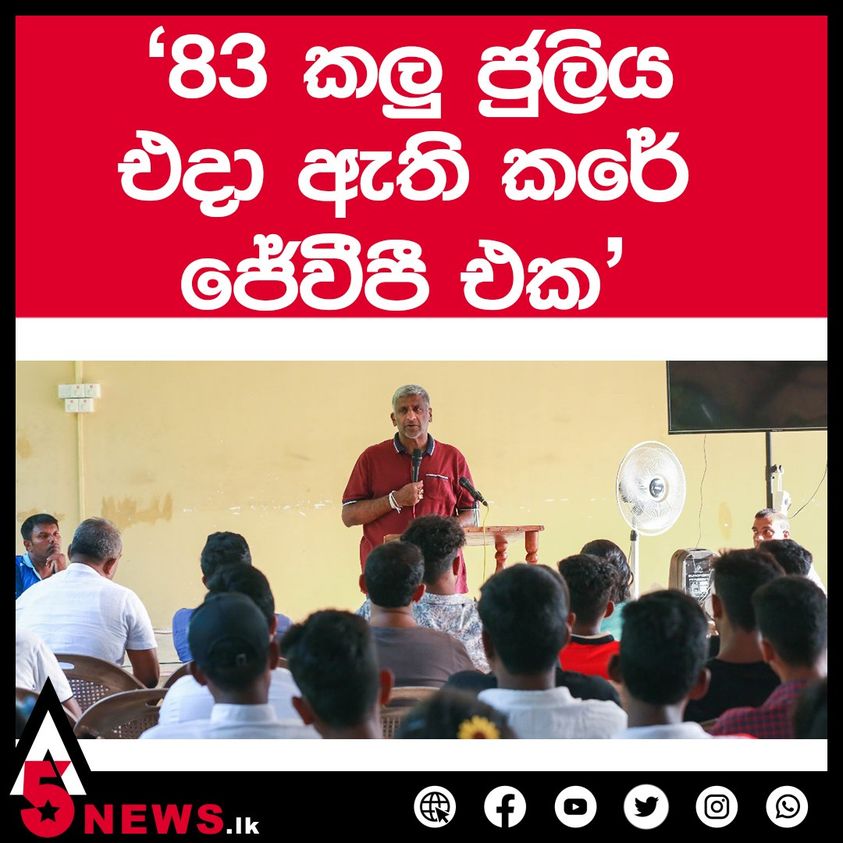
1 March 2024: A recent statement attributed to Prasanna Ranatunga, the Urban Development and Housing Minister of Sri Lanka, and publicised by the A5 News Facebook page prompted the drafting of this article. Whether Ranatunga’s statement was a misguided attempt to mislead the younger generation born post-1980 remains unclear. Many of them might be unaware of the role played by President J.R. Jayawardene’s regime during that period, which led to two insurrections, one by the JVP under the Desha Vimukthi Vyaparaya in the South, and a decades-long armed conflict in the North and East.
Politicians in Sri Lanka have a history of falsehoods during election campaigns, as evidenced by the vast disparities between their promises and actual outcomes. Year 2024 is said to be an election year and such false statements like in the past are commonly made to manipulate and deceive voters, a tactic not unique to Sri Lanka but prevalent worldwide, especially during election times.
Since gaining independence in 1948, Sri Lanka has been controlled by three family clans: the Rajapaksas, Bandaranaikes, and Senanayakes, driven primarily by a thirst for power and economic interests. Their disregard for the rule of law, democratic practices, corruption, and incompetence have often been obscured by scapegoating. However, in 2022, this façade crumbled when the government had to seek assistance from the International Monetary Fund to mitigate a severe economic crisis, exposing the true causes of the country’s woes.
Black July Riots of 1983
Black July marked a week-long pogrom against native Tamil civilians in Sri Lanka, characterised by unprecedented efficiency in brutality. The catalyst was an ambush of Sinhalese troops by the LTTE (Tamil Tigers), resulting in 13 deaths. In retaliation, the army killed around sixty civilians, a fact often omitted in the South. Subsequently, mobs systematically targeted Tamil households and shops in Colombo, looting, burning properties, and inflicting violence on inhabitants. The death toll remains uncertain, ranging from government claims of around 300 to more credible estimates of up to 3,000.
Government’s Response
The government’s response to the riots was inadequate and callous. President Jayewardene showed indifference towards Tamil lives, and his government enacted measures that further marginalised Tamils, including the passage of the sixth amendment of the Constitution, which deprived them of elected representation. He infamously said at the time that Tamils should be taught a lesson.
The government scapegoated the opposition for the riots and banned political parties like the Janatha Vimukthi Peramuna (JVP), the Communist Party of Sri Lanka, and the Nava Sama Samaja Party. However, credible evidence suggests the involvement of UNP luminaries like Cyril Mathew. They also orchestrated the violence, particularly the burning of the Jaffna library in June 1981.
Personal Testimony
As General Secretary of the JVP at the time, I witnessed the organised assault on Tamils during Black July. The streets of Colombo were engulfed in violence and chaos, with armed mobs targeting Tamil-owned properties. Security forces stood by, allowing the atrocities to unfold.
While on my way home from the party office, I witnessed many incidents of savagery and brutality. I was stopped just in front of Ceylon Tyre Corporation, Kelaniya by some people armed with swords and iron bars. I was asked to say ‘Baldiya’ aloud and when I obliged, they knew I was Sinhalese and did not attack me. Yet, they decided to remove petrol from the car. Fortunately, someone recognised me and told others to let me go. The petrol tank was half-empty when I was asked to leave. There I witnessed the carnage and atrocities that characterised Black July. Rioters stopped lorries, looted all goods in them, moved all goods to other vehicles and set the lorries on fire, burning the passengers and drivers.
While I was on my way along Kiribathgoda Mawaramandiya road, a CTB service truck full of a gang brandishing swords and crowbars stopped me. They got down from the truck and came running towards me in droves scolding me in the filthiest language imaginable. They had assumed that I was a Tamil fleeing Colombo. I yelled back at them in Sinhala. They desisted and went back to their truck and proceeded towards Colombo. The next day, I saw the colossal damage these hordes of rioters had wrought on the city.
I went inquiring about our comrades of Tamil background who were living in Narahenpita, Maradana and Kotahena. Most of those houses had been attacked or burnt down. According to what I heard, people wearing security uniforms went from place-to-place encouraging people to take part in the violence. There had been credible reports of Buddhist monks carrying electoral lists for identifying properties that belonged to Tamils. They accompanied the rioters.
I was summarily arrested later while at home, put into solitary confinement, psychologically tortured but not charged with any offence; and then released after about six months of detention, when the habaes corpus application Chitra had filed was to be heard.
Some of the guilty
Dr Rajan Hoole presents his meticulous account in The Arrogance of Power: Myths, Decadence and Murder. There are other thorough investigations of this horrific episode in the country’s history. The evidence shows that several UNP luminaries played a major role in the ensuing pogrom. Foremost amongst them was Cyril Mathew. The trucks used to ferry the goons and the petrol used to ignite Tamil businesses came from the public corporations under the jurisdiction of his Ministry. Some others who either participated or turned a blind eye to the use of government property and employees under their control were:
• Mr R. Premadasa, who was Prime Minister at the time; he probably was not physically involved, but his power base was the lumpen elements in Pettah and its environs. They played a key role in the ensuing mayhem.
• Mr Siresena Cooray, Mayor of Colombo and a protégé of Premadasa who filled the Ceylon Transport Board with his thugs; and
• Mr Ranil Wickremesinghe, (the Current President) at the time, Minister of Education and Youth Affairs. While there is no direct evidence of his involvement, his trusted assistant Gonawela Sunil and members of Sunil’s gang did participate.
However, no genuine reforms have ever been forthcoming and no perpetrators were brought before the court and prosecuted.
One of the most horrific and reprehensible incident was the killing of Tamil militants who were arrested and detained under the PTA. As Colombo was engulfed by violence and the law of the mob, around 400 Sinhalese prisoners in A3 ward of Welikada Prison armed with iron poles, wooden sticks, manna knives, axes, pointed iron sticks, broken chair legs and coils of wire attacked and opened the doors of wards B3 and D3 where Tamil political prisoners were detained. They hacked to death 35 unarmed Tamil prisoners The dead bodies including those of Kuttimani and Thangathurai were scattered all over the hall corridor, where they had been held. The blood lust of the attackers was not abated and they methodically went about to find those who were barely alive and beat them till they died.
The next day, on July 26th, prisoners Manikkathasan, Panagoda Maheswaran, Paranthan Rajan, Douglas Devananda (current Cabinet Minister) and Antoni Pillai Alagiri stressed to all others that if there were going to be another attack against them, they should prepare as much as possible thinking that it would be better to face it and die.
While the Tamil prisoners were trying to defend themselves with implements they could find, the security forces fired tear gas at them. When dust settled on July 26, 1983, the dead bodies of another 17 Tamil prisoners were found. Among those killed in the attack in Welikada Prison on the second day was Secretary of the Gandhiam Movement, Dr Somasundaram Rajasundaram. Not only those injured were not rushed to hospitals for treatment, but even those admitted to hospitals were reported to have not received proper treatment due to the ethnic bias of sone hospital staff.
It was obvious that this murderous attack inside the prison was well planned. It was reported that Sunil Perera alias Gonawala Sunil, a thug previously mentioned, who had been in prison for some time and released after receiving an amnesty offered by President Jayawardene, was also involved in this horrific attack. When questioned about the massacre of 53 Tamil political prisoners in Welikada Prison within two consecutive days, the then Prime Minister R. Premadasa evaded to respond by saying that ‘one Sinhalese prisoner has also died’ in the incident.
Conclusion
Why does a responsible minister make unvirtuous statements with no factual basis? The consequences of the Black July pogrom were catastrophic. It exacerbated ethnic tensions and paved the way for a protracted civil war. The JVP, unfairly blamed for the violence, intensified its activities, leading to further bloodshed. That is why, one should expose such statements and strongly condemn those.
Moving forward, Sri Lanka must learn from its past mistakes and strive for a more equitable society. This entails holding accountable those responsible for past atrocities, promoting transparency and the rule of law, and fostering unity and reconciliation among its diverse populace.
Sri Lanka’s future hinges on its ability to confront its past and embrace a path towards peace, justice, and prosperity for all its citizens. We must not let the sins of the past dictate our future. Instead, let us forge ahead with wisdom and unity, ensuring a brighter tomorrow for generations to come.